Also known as: Copper tripeptide-1 · Copper peptide GHK-Cu · GHK copper · Prezatide copper acetate · Glycyl-L-histidyl-L-lysine copper
Human observationalMixed
On this page
- What people actually use GHK-Cu for — and what they report
- What is GHK-Cu?
- How does GHK-Cu work?
- Does GHK-Cu actually work? What the science says
- Is GHK-Cu safe? Side effects
- FDA & legal status (2026)
- How people use GHK-Cu: topical routine, doses & mixing
- GHK-Cu vs other skin and healing peptides
- Frequently asked questions
- Who GHK-Cu is for — and who should be cautious
- Evidence by outcome
- FDA & legal status
- Registered clinical trials
- Reported side effects
- Chemical identifiers
- References
- Related compounds
- More on GHK-Cu
If you landed here, you probably saw “copper peptides” on a serum bottle or in a peptide thread and want to know whether GHK-Cu actually firms skin, fades a scar, or does anything for hair, and whether the injected version is worth the trouble over the cream.
GHK-Cu is a copper-carrying peptide people use three ways: as a topical anti-aging serum, as an injected research chemical, and, with the most hope and the least proof, for hair. Topical skin has real but mixed human evidence; injections and hair have essentially none. GHK-Cu isn’t FDA-approved, and after all the marketing, the strongest case is still the thing you rub on.
What people actually use GHK-Cu for — and what they report
GHK-Cu has two very different fan bases, and telling them apart clears up most of the confusion online. The big one is the skincare crowd: people who buy a copper-peptide serum (usually 1% GHK-Cu, sometimes 2%) and work it into a nightly routine for fine lines, tone, and firmness. The smaller one is the peptide-forum crowd: people who buy research-grade GHK-Cu powder, reconstitute it, and inject a milligram or two under the skin, chasing those same skin goals plus scars and stretch marks. Hair is the third thing people reach for, topically or with microneedling, and it’s the use with the least behind it.
What the serum users report is slow-but-real: softer, more hydrated texture in the first week or two, then a gradual smoothing of fine lines and a little more firmness over a couple of months. Nobody honest calls it dramatic. It’s a “my skin looks healthier” ingredient, not a retinoid-grade overhaul, and most people run it as one layer among several.
The one rule the community repeats: don’t stack copper peptides with straight vitamin C or strong exfoliating acids in the same step. Copper and L-ascorbic acid destabilize each other, so the standing advice (sound chemistry, not superstition) is to split them, vitamin C in the morning and copper peptides at night, or leave a real gap between layers. Retinoids get the alternate-nights treatment for the same tolerability reason.
The strengths and doses people actually run (anecdotal, not a validated protocol): topically, 1% GHK-Cu serums are the default, applied once or twice a day. Injectors most often describe one to two milligrams under the skin a day, some pushing to three, into abdominal fat with rotated sites, run in short cycles: a few weeks on with breaks, or a “five days on, two off” pattern. Reported timelines mirror the serums, texture first, firmness by roughly six to eight weeks, the clearest before-and-after near the three-month mark. None of these numbers come from a human trial; they’re passed peer to peer, and they carry exactly that much authority.
The letdowns, because they’re the useful half. Plenty of people see nothing, especially on deep wrinkles or old, set stretch marks, where copper peptides tend to shift a scar’s color more than its texture. A subset gets the opposite of a glow: the “copper uglies,” a stretch of breakouts, roughness, or redness that shows up when someone ramps on too fast. The grounded read is that most copper uglies are ordinary irritation, not a mystical purge the skin has to suffer through first; the fix people land on is starting two or three nights a week, building slowly, and pulling back if it doesn’t settle. And some people just don’t get along with copper, full stop.
One honest filter on all of this: skincare is a before-and-after culture, so the wins get photographed and posted while the duds get quietly dropped from the routine and never written up. Read “everyone loves it” as “everyone who kept using it and posted about it loves it,” which is a much smaller claim than it looks at first.
What is GHK-Cu?
GHK-Cu is a tiny three-amino-acid peptide (the sequence is literally glycine-histidine-lysine, or GHK) clamped onto a single copper atom, molecular weight about 403. Unlike most research peptides, it isn’t a lab invention: the GHK part occurs naturally in your blood, saliva, and urine, and it grabs copper on its own inside the body.
The backstory that powers its reputation is that your blood level of GHK is high in your twenties and drops to roughly a third of that by your seventies, which is the hook behind the “reset skin toward its younger settings” pitch. For products, GHK-Cu is chemically synthesized and sold two ways: as the cosmetic ingredient “copper tripeptide-1” in over-the-counter serums, and as a research-chemical powder that a smaller group reconstitutes and injects.
How does GHK-Cu work?
GHK-Cu works, in the lab picture, as two jobs at once: a copper courier and a genetic dimmer switch. Copper is a cofactor that several repair and antioxidant enzymes can’t run without, and GHK-Cu is unusually good at binding it and delivering it where cells can use it. On top of that delivery job, cell studies show GHK-Cu turning many genes up and down together, nudging skin cells to make more collagen and elastin and to behave more like they did when they were younger and healing faster (Pickart et al., 2015).
The everyday version: GHK-Cu is less a single key that fits one lock and more a foreman who walks into a slow worksite, hands out the part that was missing (copper), and tells several crews to pick up the pace. The catch worth stating plainly is that most of this map was drawn in cultured cells. Exactly how GHK-Cu produces a visible result in living human skin still isn’t fully pinned down.
Does GHK-Cu actually work? What the science says
GHK-Cu’s evidence is strong at the bench, mixed on human skin, and basically empty for the needle, and the route you’re asking about decides which pile you’re standing in. Here is the honest split the sales pages tend to blur.
Topical skin: a real but mixed human signal. Small cosmetic studies of copper-peptide creams reported firmer, smoother-looking skin and fewer fine lines, though many were small, uncontrolled, or run by people with a commercial stake. The best-looking positive is one randomized, double-blind trial: 40 women aged 40–65, 39 of them finishing eight weeks of a twice-daily GHK-Cu serum, which beat both its vehicle and a Matrixyl 3000 comparator on wrinkle volume and depth (Badenhorst et al., 2016). The asterisk that keeps it honest: it was funded by the serum’s maker, tested that maker’s own product, and appeared in a low-tier journal, so it’s a promising human signal, not independent proof.
Set against that, the most rigorous test is a cold shower. In a 13-person split-face study after CO2 laser resurfacing, blinded evaluators found no objective advantage for GHK-Cu on redness, wrinkles, or overall skin quality; only the participants’ own rating favored the GHK-Cu side (Leyden et al., 2006). That gap, where people feel a difference the instruments don’t confirm, is exactly why this page grades topical skin “mixed” instead of “proven.”
Wound healing, hair, and the rest: mostly still to come. The mechanism is well mapped in cultured cells, where GHK-Cu raises collagen and tissue-repair signaling (Pickart et al., 2015; Greco et al., 2025). Wound healing, the use people most want confirmed, is only now getting a proper human test: a Phase 2 trial of a topical GHK-Cu gel for acute skin wounds is recruiting, with no results yet (NCT07437586). Beyond skin, the animal and cell work keeps widening: GHK-Cu cut silica-driven lung inflammation and scarring in mice (Bian et al., 2024) and protected neurons from copper- and zinc-triggered damage in cells (Min et al., 2024). Those are leads in mice and dishes, not human results. Hair is thinner still: there’s real enthusiasm and plausible follicle biology, but no solid human trial showing GHK-Cu regrows or thickens hair, so it sits a tier below even the topical-skin data.
One quiet honesty check under all the topical hype: researchers are still measuring how much intact GHK-Cu even crosses the skin barrier from a cream (Ogórek et al., 2025). The encouraging way to read the whole board is that the human testing GHK-Cu skipped for years is finally getting scheduled.
| Route and goal | Best evidence so far | What a before-and-after can honestly claim |
|---|---|---|
| Topical skin appearance | Small cosmetic studies + one maker-funded RCT; one 13-person controlled split-face study | Possible subjective improvement; objective benefit unsettled |
| Topical acute-wound healing | Phase 2 trial recruiting, no results yet | Human testing underway; efficacy unknown |
| Injected GHK-Cu (skin, scars) | No controlled human outcome trial | No validated skin, scar, or recovery timeline |
| Hair growth or thickness | Anecdote only; no human trial | Unproven, the weakest of the popular uses |
| Lung inflammation or fibrosis | Mouse studies | Helped in mice; not a human result |
| Cell repair and matrix remodeling | In-vitro studies | Mechanism support only |
For how to read those before-and-after photos fairly, and where the human evidence actually stops, the GHK-Cu before-and-after evidence guide walks through what a photo can and can’t prove.
Is GHK-Cu safe? Side effects
GHK-Cu’s safety picture splits by route: reassuring on skin, thinly studied by needle. As a topical cosmetic ingredient it has decades of use with few reported problems beyond occasional irritation, redness, or itching, usually at higher concentrations. Injected or systemic GHK-Cu is a different question, and there is no long-term human safety dataset for it. FDA specifically says compounded injectable GHK-Cu may carry an immunogenicity risk from aggregation and peptide-related impurities, and that human safety information is limited (FDA safety-risk list).
The “copper uglies” belong here, stated straight: it’s a community label for irritation and breakouts, not a diagnosed purge reaction or an effect confirmed in a trial. Reports cluster in acne-prone skin and with higher-strength products, and the cause can simply be ordinary product irritation rather than proof that skin must worsen before it improves. One proposed explanation is temporary MMP/TIMP-driven matrix remodeling, since GHK-Cu changes those signals in cultured fibroblasts, but that experiment did not study a purge and does not establish the mechanism in serum users (Badenhorst et al., 2016). If it happens, reducing frequency or stopping is the cautious response.
Copper itself is essential but reactive; in the wrong setting it can drive oxidation rather than calm it. People with Wilson’s disease, another copper-overload disorder, or a known copper sensitivity have a specific reason to avoid copper-loaded products. Research vials add their own risks, because identity, purity, dose accuracy, endotoxin burden, and sterility all depend on the actual batch, and a copper-carrying peptide raises the aggregation question FDA flagged. A chemical-purity number does not establish sterility or a low endotoxin burden, and a clean label does not confirm the vial holds the right molecule in the stated amount. For injected GHK-Cu, product quality is therefore part of the safety gap, not a workaround for the long-term human data that don’t yet exist.
FDA & legal status (2026)
GHK-Cu is not FDA-approved as a drug for any use as of July 2026, and the route now changes the compounding analysis. FDA’s May 14, 2026 503A categories update places GHK-Cu except injectable routes in Category 1, meaning under evaluation, which is not an approval. FDA separately keeps injectable GHK-Cu on its list of bulk substances that may present significant safety risks. A compounded product is not an FDA-approved product.
The cosmetic lane is different. “Copper tripeptide-1” can be sold in over-the-counter skincare because cosmetics don’t need drug pre-approval, but a cosmetic cannot legally claim to treat disease or heal a wound, and a research-use-only vial is neither a dietary supplement nor permission to inject. That route-specific split is the detail most “where to buy GHK-Cu injection” pages skip.
For tested sport, GHK-Cu is not named individually on the 2026 WADA Prohibited List, but injected research GHK-Cu fits the S0 catch-all for pharmacological substances with no current approval for human therapeutic use, which is prohibited at all times. Ordinary topical cosmetic use is not that scenario; even so, an athlete should verify the exact product with their anti-doping authority rather than read a missing name as clearance.
How people use GHK-Cu: topical routine, doses & mixing
GHK-Cu shows up two ways, and “how to use it” depends entirely on which. Topically, it’s already dissolved in a serum or cream, so there’s nothing to prepare: you apply it, usually once daily to start and following the product label, and you keep it away from straight vitamin C and strong acids in the same step (alternate times, or alternate nights with a retinoid). The research-grade powder is the opposite. It arrives freeze-dried and has to be reconstituted with bacteriostatic water before any injectable use, and getting the concentration right is pure arithmetic: the reconstitution & dosing calculator turns a vial size, a water volume, and a target dose into exact syringe units.
There is no FDA-approved GHK-Cu dose, injection site, cycle length, or frequency. No controlled human trial defines one, and a topical concentration cannot be converted into an injection dose. Community and clinic schedules describe practice, not a validated standard; the GHK-Cu dosage chart evidence guide separates the published quantities from the anecdotal protocols. “How to inject GHK-Cu” and “where to inject it” have the same status: accounts usually describe subcutaneous use in abdominal fat, but no trial validates a site, technique, or rotation, and the GHK-Cu injections guide collects the route-specific evidence and the product-quality checks in one place.
On mixing, GHK-Cu is a popular ingredient in skin-and-healing combinations like the GLOW stack and KLOW stack, but the copper it carries is a redox-active metal that can catalyze oxidation of other peptides, so the cautious default is to keep GHK-Cu in its own syringe. The mixing compatibility reference covers which pairs people commonly combine and where the honest answer is “not enough data.” Reconstitution math also can’t establish sterility, compatibility, or a medically appropriate dose, so none of this is a step-by-step injection protocol.
GHK-Cu vs other skin and healing peptides
GHK-Cu gets mentioned alongside the injury-repair peptides, but it plays a different position: it’s the skin specialist, collagen and tone and fine lines and scars, while BPC-157 and TB-500 (a fragment of thymosin beta-4) are studied more for tendons, ligaments, muscle, and gut. The overlap is wound healing, which is why the three get combined in the GLOW stack, and why Pentadeca Arginate (a newer BPC-157 relative) keeps coming up in the same threads. None of them has human RCT proof for its headline use yet; GHK-Cu is the one with the longest cosmetic track record and the most in-cell mechanism work. You can see the whole group from the cosmetic peptides hub.
For a straight skincare-ingredient comparison, GHK-Cu vs Matrixyl puts two collagen-focused peptides side by side without inventing a head-to-head trial, and GHK-Cu vs KPV separates GHK-Cu’s matrix-remodeling role from KPV’s preclinical anti-inflammatory one. The right pick depends on the goal; these peptides don’t share one evidence tier or one interchangeable job.
Frequently asked questions
GHK-Cu questions circle the same gaps: whether the visible change is real, whether the needle beats the cream, whether it does anything for hair, and where the 2026 rules leave buyers and athletes. Short answers below, with published evidence kept separate from community practice.
Does GHK-Cu actually work for skin?
For appearance, the human signal is mixed rather than empty. Small cosmetic studies and one maker-funded RCT reported firmer, smoother skin and fewer fine lines; the most rigorous test, a 13-person controlled split-face study after laser resurfacing, found no objective advantage, even though participants rated the GHK-Cu side better. The mechanism is worth following; the clinical effect still needs a larger independent trial. Expect “healthier-looking,” not “resurfaced.”
Does GHK-Cu work for hair?
Hair is the most speculative of GHK-Cu’s popular uses. People apply it topically or with microneedling hoping for thicker, healthier hair, and copper peptides have plausible wound-and-follicle biology behind the idea, but there’s no solid human trial showing GHK-Cu regrows or thickens hair. Right now it’s hope plus anecdote, a step below even its topical-skin evidence.
Is topical or injectable GHK-Cu better?
They’re studied for different things, and only one has real human data. Topical GHK-Cu has the actual cosmetic track record and the lowest risk, but faces an open question about how much of it crosses the skin. Injectable GHK-Cu puts more peptide into circulation, which is what the founder experience above describes, but it’s far less studied in humans and carries the usual research-chemical unknowns. No head-to-head trial crowns a winner.
Is GHK-Cu legal?
As copper tripeptide-1, GHK-Cu can be sold in US cosmetics, but it isn’t an FDA-approved drug. FDA’s May 2026 update keeps non-injectable GHK-Cu under evaluation for 503A compounding and separately flags injectable GHK-Cu as a potential significant safety risk. A “research use only” label does not authorize human use.
Is GHK-Cu banned in sport?
GHK-Cu is not named individually, but injected research GHK-Cu fits WADA’s S0 catch-all for pharmacological substances without approval for human therapeutic use, which is prohibited at all times under the 2026 list. Tested athletes should verify the exact product and route with their anti-doping authority.
What are the “copper uglies”?
It’s a community nickname for a stretch of breakouts, roughness, or redness some people hit after starting copper peptides, usually after ramping up too fast. It isn’t a proven purge reaction. Most of the time it’s ordinary irritation, and the common fix is starting two to three nights a week, building slowly, and easing off if it doesn’t settle.
Who GHK-Cu is for — and who should be cautious
GHK-Cu tends to pull in skin-focused people: someone watching new fine lines show up, trying to soften a scar or a stretch mark, who read that copper peptides help and wants the version that admits what’s proven and what isn’t. On that count it’s a fair fit, a genuine in-cell repair mechanism, mixed-but-real human topical evidence, and a first registered wound-healing trial now underway, as long as expectations sit at “slow and subtle” and the injection and hair claims are held as anecdote rather than fact.
It’s a poor fit for anyone with Wilson’s disease or another copper-overload disorder, a known copper sensitivity, or, for the injected form, pregnancy, breastfeeding, an active infection at a proposed injection site, or no appetite for unquantified long-term risk. Tested athletes carry the S0 problem. And if what you actually want is an FDA-approved dose, a validated injection site, or a guaranteed before-and-after, GHK-Cu can’t give you that yet: those are exactly the answers the human trials are only now starting to produce.
Evidence by outcome
Each outcome GHK-Cu has been studied for, with the honest evidence grade and what the studies actually found. A tier never stands alone — the verdict rides with it.
| Outcome | Evidence | What was found |
|---|---|---|
| Skin aging, wrinkles & firmness | Human observationalMixed | Small human cosmetic studies of copper-peptide creams reported firmer, smoother-looking skin and fewer fine lines, but the clearest controlled split-face study found no objective advantage after laser resurfacing; only the participants' rating of overall skin quality favored GHK-Cu. Most studies were small, uncontrolled, or commercially connected. The human signal is therefore mixed, while the collagen and repair mechanism is well mapped in cells. |
| Skin wound healing | In-vitroUnclear⚠ none in humans | GHK-Cu's wound-healing case rests on cell and analytical work so far; a registered Phase 2 trial of a topical GHK-Cu gel for acute skin wounds is recruiting as of 2026 (NCT07437586) but has reported no results yet. In humans this use is untested — the first proper trial is only now underway. |
| Lung inflammation & fibrosis | Animal-onlyHelped⚠ none in humans | In mice, GHK-Cu reduced silica-induced lung inflammation and scarring by acting on the antioxidant enzyme peroxiredoxin 6. That is a promising lead in rodents, not a human result — no human trial has tested GHK-Cu for lung disease. |
FDA & legal status
- United States: research use only (as of Jul 2026)
GHK-Cu is not an FDA-approved drug for any use. FDA's May 14, 2026 503A update placed GHK-Cu except injectable routes in Category 1, meaning it remains under evaluation rather than approved; FDA separately lists injectable GHK-Cu among bulk substances that may present significant safety risks. Copper tripeptide-1 may still be sold as a cosmetic ingredient, but injectable research GHK-Cu is not approved for human use.
openFDA Drugs@FDA lists no approved product for GHK-Cu as of 2026-07-15.
Registered clinical trials
2 registered studies mention GHK-Cu on ClinicalTrials.gov (latest update 2026-10-19). A registered trial means a study is planned or underway — not that GHK-Cu is approved or proven.
| Study | Status | Phase | Sponsor |
|---|---|---|---|
| Topical GHK-Cu Gel for Acute Skin Wound HealingNCT07437586 | recruiting | Phase 2 | Hudson Biotech |
| AI-Personalized Skincare Regimen for Facial Photoaging in WomenNCT07879833 | completed | NA | MDalgorithms Inc. |
Reported side effects
| Effect | Frequency | Severity |
|---|---|---|
| Skin irritation, redness or itching (topical use) | — | usually mild |
| Injection-site reactions (research / injectable use) | — | reported anecdotally; not systematically studied |
Chemical identifiers
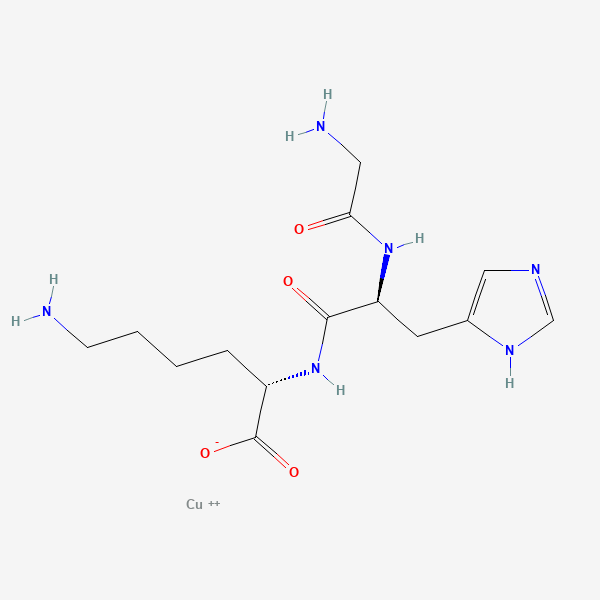
- Molecular formula
- C14H23CuN6O4+
- Molecular weight
- 402.92 g/mol
- IUPAC name
- copper (2S)-6-amino-2-[[(2S)-2-[(2-aminoacetyl)amino]-3-(1H-imidazol-5-yl)propanoyl]amino]hexanoate
Verified external records:
References
- 1.Pickart et al., 2015 — GHK peptide as a natural modulator of skin-regeneration pathways (review)
- 2.Greco et al., 2025 — GHK-Cu conjugates show antioxidant, osteogenic and angiogenic effects (in-vitro)
- 3.Bian et al., 2024 — GHK-Cu attenuates lung inflammation and fibrosis in a silicosis mouse model
- 4.Ogórek et al., 2025 — measuring skin permeation of GHK-Cu encapsulated in liposomes
- 5.Min et al., 2024 — GHK prevents copper- and zinc-induced protein aggregation and cell death in vitro
- 6.Topical GHK-Cu gel for acute skin wound healing — registered Phase 2 trial (ClinicalTrials.gov)
- 7.Badenhorst et al., 2016 — GHK-Cu physicochemical characterization and dermal preformulation
- 8.Leyden et al., 2006 — controlled split-face study after CO2 laser resurfacing
- 9.Badenhorst et al., 2016 — randomized topical GHK-Cu trial and MMP/TIMP study
- 10.FDA — bulk drug substances that may present significant safety risks
- 11.FDA — 503A bulk drug substances categories, updated May 14, 2026
- 12.USADA — 2026 WADA Prohibited List
More on GHK-Cu
Everything else we've written about GHK-Cu — what the community reports, the explainers that cover it, and the terms it keeps running into.
- GHK-Cu on Reddit: what copper-peptide users reportOn Reddit
- Can You Use Peptides With Retinol? Mostly, YesExplainer
- Does copper peptide serum work? The GHK-Cu evidenceExplainer
- GHK-Cu Peptide Injection Before and After: EvidenceExplainer
- GHK-Cu peptide dosage chart: Where Numbers Come FromExplainer
- GHK-Cu peptide injection: what the evidence showsExplainer
- K18 Peptide: What It Is and Whether It Repairs HairExplainer
- SystemicGlossary
- Systemic vs local effectGlossary
- TopicalGlossary