Also known as: gonadotropin-releasing hormone · GnRH · GnRH-I · luteinizing hormone-releasing hormone · LHRH
Human (controlled)Helped
On this page
- What is gonadorelin?
- How does gonadorelin work?
- What does the human evidence show?
- Does gonadorelin TRT work?
- What gonadorelin dosage has research tested?
- Gonadorelin vs hCG: what is the difference?
- What are gonadorelin side effects?
- Is gonadorelin FDA-approved or legal in 2026?
- Who is gonadorelin actually supported for?
- Evidence by outcome
- FDA & legal status
- Reported side effects
- Chemical identifiers
- References
- Related compounds
- More on Gonadorelin
The gonadorelin peptide is synthetic gonadotropin-releasing hormone (GnRH), a ten-amino-acid signal that can restart LH and FSH release in frequent pulses. Human evidence supports pump-driven therapy for hypothalamic fertility disorders. It does not establish that two-or-three-times-weekly TRT-clinic injections reproduce those results.
Key facts
- Evidence: Human-controlled for pulsatile treatment; no direct human evidence found for intermittent gonadorelin TRT protocols.
- U.S. status, July 2026: Historically approved, with no marketed FDA-approved human product; compounding questions remain.
- Studied use: Pump-delivered pulses roughly every 90 minutes, not a few weekly shots.
- Half-life: About 2.4 minutes after intravenous injection in six volunteers.
- Main risks: Injection-site reactions, gynecomastia, allergy, and uncertain product quality.
- Sport: Prohibited at all times in male athletes under WADA S2.2.1.
What is gonadorelin?
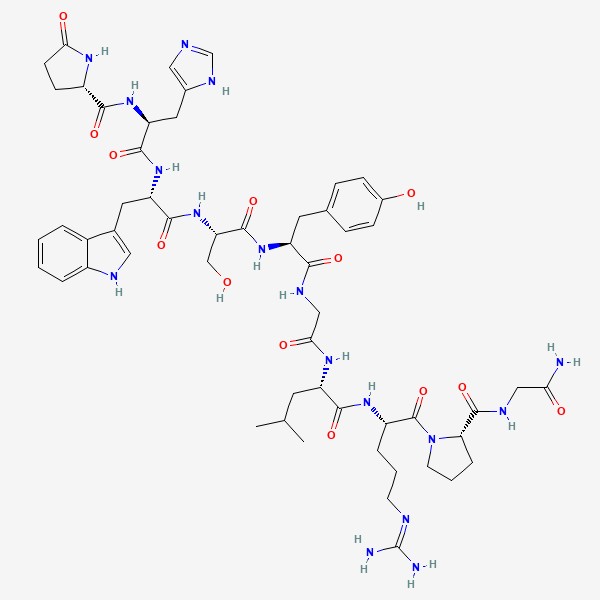
Gonadorelin is a lab-made copy of the body’s GnRH peptide, the signal that starts the reproductive-hormone chain. PubChem identifies formula C55H75N17O13, molecular weight 1,182.3 g/mol, CAS 33515-09-2, and CID 638793. DrugBank identifies the same compound as DB00644.
Gonadorelin belongs with reproductive hormones, despite sitting in our broader growth-hormone peptide hub. Both families signal through the pituitary, but request different hormones.
How does gonadorelin work?
Gonadorelin works only when its timing makes biological sense. A brief pulse activates pituitary receptors; LH and FSH are released; the gonads then make sex hormones and support eggs or sperm. Think doorbell, not light switch: short rings carry information.
That timing matters because gonadorelin disappears quickly. In six volunteers, intravenous synthetic LH-RH had a plasma half-life of 2.4 ± 0.4 minutes. A long gap between injections is not a quieter version of pump therapy. It is a different regimen.
What does the human evidence show?
Gonadorelin has human evidence for congenital hypogonadotropic hypogonadism (CHH), where the hypothalamus provides too little GnRH. Pulsatile treatment can restore LH and FSH and induce sperm production. This earns a human-controlled tier for the studied use, not every clinic protocol.
A comparative cohort found earlier sperm appearance with pulsatile GnRH than with combined hCG/human menopausal gonadotropin therapy, while calling for randomized confirmation (PMID 28051040). A meta-analysis found both approaches effective in men with CHH (PMID 32777865). Evidence also extends to women with hypothalamic amenorrhea.
Does gonadorelin TRT work?
Gonadorelin TRT claims run ahead of the regimen tested. Human literature supports pump-delivered pulses every 60 to 120 minutes in people with deficient GnRH signaling. The searches for this page found no controlled human trial showing that two or three injections weekly preserve fertility or sperm production during testosterone therapy.
The mechanism is plausible, but testosterone suppresses the reproductive axis, and a minutes-long signal given days apart may not overcome that environment. The guides to peptides and TRT and peptides that increase testosterone separate a hormone spike from a fertility outcome.
What gonadorelin dosage has research tested?
Gonadorelin dosage in human research is pulsatile and pump-driven. A 2024 series treated 45 men with CHH using 7 to 15 micrograms per pulse every 90 minutes; LH, FSH, and testosterone rose, and sperm appeared in 33 men (PMID 39210488). That is reported research, not a personal protocol.
Historical Lutrepulse dosing likewise used tiny repeated pulses. Neither evidence base validates a compounded shot every few days. Quoting micrograms without the interval is like quoting a song’s notes but deleting the rhythm.
Gonadorelin vs hCG: what is the difference?
Gonadorelin vs hCG is pituitary signaling versus direct testicular signaling. Gonadorelin prompts release of both LH and FSH. Human chorionic gonadotropin (hCG) bypasses the pituitary and acts directly at the LH receptor, supporting intratesticular testosterone when upstream signaling is suppressed.
For CHH, both approaches have human fertility evidence. During testosterone use, hCG has direct gonadal action, while occasional gonadorelin still depends on a responsive, suppressed pituitary. The hCG peptide guide covers the evidence and regulatory differences.
What are gonadorelin side effects?
Gonadorelin side effects are described for pulsatile treatment, but not well mapped for intermittent TRT use. In the 45-man CHH series, researchers reported gynecomastia, firm areas under the skin, and allergic reactions. Female fertility treatment also requires monitoring for ovarian over-response and multiple pregnancy.
Supply adds another risk layer. A compounded preparation is not FDA-approved, and an online vial is not equivalent to either historical medicine. FDA’s June 2026 warning letter naming gonadorelin called the marketed injectable an unapproved new drug and highlighted contamination risks.
Is gonadorelin FDA-approved or legal in 2026?
Gonadorelin has an FDA-approval history, but no FDA-approved human product is marketed in the United States as of July 2026. Factrel was the diagnostic injection; Lutrepulse was the pump product. An FDA review says pump problems, cost, and limited demand led to Lutrepulse’s commercial discontinuation.
Factrel is also discontinued, but the primary records opened here did not state why. Calling both withdrawals “commercial” would overread the record. Current veterinary Factrel is labeled not for human use.
Compounded supply exists, but FDA’s 503A guidance makes eligibility depend on the monograph, approved-product, or bulks-list pathway. The Category 1 list does not name gonadorelin, and FDA has not posted a compound-specific answer covering every salt and formulation. A 503A pharmacy does not make the drug FDA-approved.
For sport, the 2026 WADA Prohibited List places gonadorelin under testosterone-stimulating peptides prohibited at all times in male athletes.
Who is gonadorelin actually supported for?
Gonadorelin is supported for patients who lack normal hypothalamic GnRH pulses but retain responsive pituitary and gonadal function. In that setting, pump therapy replaces a missing rhythm. Gonadorelin is not similarly established as an occasional TRT add-on.
The dividing line is delivery. Gonadorelin can restore a missing rhythm; evidence does not show that hundreds of weekly pulses compress into two or three injections with the same fertility result. That gap is the part a vial menu leaves out.
Evidence by outcome
Each outcome Gonadorelin has been studied for, with the honest evidence grade and what the studies actually found. A tier never stands alone — the verdict rides with it.
| Outcome | Evidence | What was found |
|---|---|---|
| LH and FSH restoration in congenital hypogonadotropic hypogonadism | Human (controlled)Helped | Human cohorts and comparative studies show that frequent pulsatile GnRH can restore pituitary LH and FSH secretion in people whose hypothalamus does not supply the signal normally. The studied delivery method is a pump, not a few injections per week. |
| Spermatogenesis and male fertility in congenital hypogonadotropic hypogonadism | Human (controlled)Helped | Comparative human evidence and a meta-analysis support pulsatile GnRH for inducing sperm production in men with congenital hypogonadotropic hypogonadism. These findings do not establish fertility preservation during testosterone replacement therapy. |
| Fertility preservation during testosterone replacement therapy | MechanisticUnclear⚠ none in humans | Gonadorelin can trigger pituitary LH and FSH, but controlled human evidence was not found for intermittent gonadorelin injections as an adjunct to TRT. Evidence from pump-treated hormone-deficient patients cannot be transferred wholesale to men receiving exogenous testosterone. |
FDA & legal status
- United States: withdrawn (as of Jul 2026)
Factrel and Lutrepulse were historically FDA-approved human products, but no FDA-approved human gonadorelin product is currently marketed. Compounded preparations are supplied by some 503A pharmacies; FDA's current materials do not provide a gonadorelin-specific final answer covering every salt, formulation, and circumstance.
Reported side effects
| Effect | Frequency | Severity |
|---|---|---|
| Gynecomastia | — | — |
| Subcutaneous injection-site induration | — | — |
| Allergic reaction | — | — |
Chemical identifiers
References
- 1.PubChem — Gonadorelin (CID 638793)
- 2.Fauconnier et al., 1978 — plasma disappearance of synthetic LH-RH (PMID 378777)
- 3.Liu et al., 2021 — pulsatile GnRH versus gonadotropin therapy in male CHH (PMID 32777865)
- 4.Niu et al., 2024 — pulsatile gonadorelin in 45 men with CHH (PMID 39210488)
- 5.FDA orphan-drug record — Lutrepulse (gonadorelin acetate)
- 6.FDA Luveris medical review — history and discontinuation of Lutrepulse
- 7.FDA — Interim Policy on Compounding Using Bulk Drug Substances Under Section 503A
- 8.FDA warning letter — gonadorelin sold as an unapproved new drug
- 9.WADA — 2026 Prohibited List
More on Gonadorelin
Everything else we've written about Gonadorelin — what the community reports, the explainers that cover it, and the terms it keeps running into.