Also known as: KP-10 · Kp-10 · metastin 45-54
Human (controlled)Helped
On this page
- What is kisspeptin-10?
- How does KP-10 work?
- What does the human evidence show?
- Does kisspeptin-10 improve libido?
- What kisspeptin-10 dosage has research used?
- Is kisspeptin-10 safe? Side effects and unknowns
- Is kisspeptin-10 FDA-approved or legal in 2026?
- Kisspeptin vs PT-141: what is the difference?
- Evidence by outcome
- FDA & legal status
- Chemical identifiers
- References
- Related compounds
- More on Kisspeptin-10
Kisspeptin-10 is a 10-amino-acid reproductive signaling peptide that reliably raises LH and FSH in small controlled human studies. The evidence supports a short-lived hormone response, not an established treatment for low testosterone or low libido. Kisspeptin-10 is not FDA-approved, is outside 503A compounding, and is banned in male athletes under WADA rules.
Key facts: Human-controlled evidence for LH/FSH release · no FDA-approved use (July 2026) · research-use-only supply · intravenous study doses, not a consumer protocol · long-term and injected-product safety remain uncertain · WADA-prohibited at all times in male athletes.
What is kisspeptin-10?
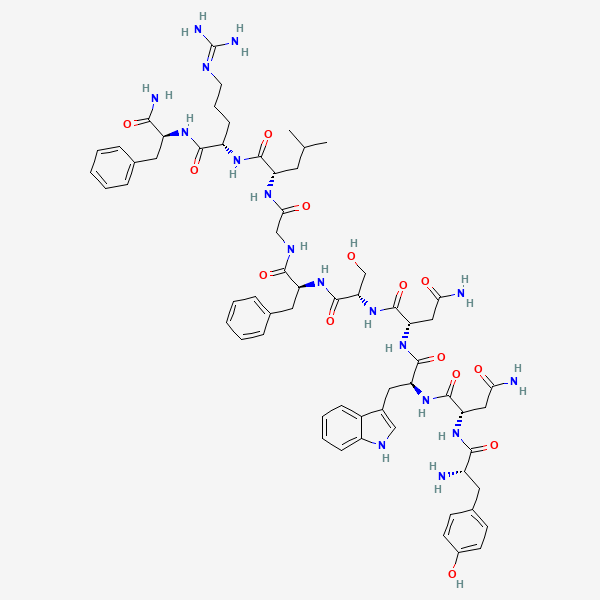
Kisspeptin-10 is the shortest natural fragment of kisspeptin that retains full activity at the kisspeptin receptor, KISS1R. The kisspeptin peptide is also called KP-10 or metastin 45-54 because these 10 amino acids form the tail of the longer 54-amino-acid metastin molecule. The verified sequence is YNWNSFGLRF-NH2, with a molecular weight of about 1,302 g/mol and PubChem CID 25240297 (PubChem).
Kisspeptin-10 is not a growth-hormone secretagogue. It sits in this site’s broader growth-hormone and endocrine-signaling hub because its main research story is hormone release, but the hormones are gonadotropins: LH and FSH, not growth hormone.
How does KP-10 work?
KP-10 activates KISS1R upstream of gonadotropin-releasing hormone (GnRH). Picture a three-stage relay: kisspeptin signals GnRH neurons, GnRH signals the pituitary, and the pituitary releases luteinizing hormone (LH) and follicle-stimulating hormone (FSH). Those hormones then tell the testes or ovaries to make sex steroids and support reproductive function.
That upstream position matters. Gonadorelin is GnRH itself, so it enters the relay one step later. In a direct study of healthy men, GnRH produced more gonadotropin release than matched intravenous infusions of kisspeptin-10 or kisspeptin-54 (direct comparison). Biology has an order of operations, even when peptide marketing prefers a shortcut.
What does the human evidence show?
Kisspeptin-10 has human-controlled evidence for stimulating reproductive hormones, but the studies were small physiology experiments rather than treatment trials. In healthy men, intravenous bolus doses raised LH at 0.3 nmol/kg and FSH at 1.0 nmol/kg. Women studied in the follicular phase responded far less, showing that a single result cannot be copied across sexes or menstrual phases (Jayasena et al., PMID 21976724).
Another study found a dose-dependent LH rise in healthy men, with the largest tested response at 1 microgram/kg; a 22.5-hour infusion also increased LH pulse frequency and testosterone in four men (George et al., PMID 21632807). That supports the kisspeptin testosterone mechanism. It does not show durable symptom relief, fertility improvement, muscle gain, or successful treatment of diagnosed hypogonadism. FDA reached the same narrower reading when it found insufficient evidence for male secondary hypogonadism.
Does kisspeptin-10 improve libido?
Kisspeptin-10 has not been shown to treat low libido in a randomized trial. The often-quoted Imperial College trials enrolled 32 women and 32 men who completed placebo-controlled crossover studies, and both found changes in sexual brain processing. The men’s trial also found more penile tumescence during sexual video stimuli. But both trials infused kisspeptin-54, not KP-10 (women; men).
That distinction is the piece most summaries drop. The findings make kisspeptin libido research worth following, but receptor-family evidence is not product-level proof. Anyone comparing options can start with the broader guide to peptides for erectile and sexual health.
What kisspeptin-10 dosage has research used?
Kisspeptin-10 dosage in published human work has usually been weight-based and intravenous, under intensive blood sampling. The controlled study above used bolus doses from 0.3 to 10 nmol/kg, while other male work tested 0.01 to 3 micrograms/kg and a continuous infusion. These are reported research exposures, not a dosing schedule for self-use.
KP-10 also disappears quickly: plasma half-life was about 3.8 minutes in men and 4.1 minutes in women after intravenous administration. An online subcutaneous vial is therefore not interchangeable with the IV experiments, and no validated consumer protocol fills that gap.
Is kisspeptin-10 safe? Side effects and unknowns
Kisspeptin-10 looked tolerable during small, acute intravenous experiments, but long-term human safety is unknown. FDA found no major acute safety signal in the IV literature, yet found too little information about repeated therapeutic use, subcutaneous or intramuscular treatment in men with hypogonadism, appropriate dose, or duration (FDA review).
The product adds a separate risk. Peptides can aggregate or degrade when formulation, pH, temperature, or manufacturing changes; injected aggregates and impurities may trigger immune reactions. FDA specifically cited those unresolved issues for compounded KP-10. Short trials with clean research material cannot certify a vial from the research market.
Is kisspeptin-10 FDA-approved or legal in 2026?
Kisspeptin-10 is not FDA-approved and is not a component of any FDA-approved drug. As of July 16, 2026, KP-10 is not on the 503A Bulks List. FDA recommended against adding it, and the Pharmacy Compounding Advisory Committee voted 11-0 against inclusion because convincing safety and efficacy data were missing (final FDA minutes). “Research use only” is a sales category, not permission for human treatment.
WADA’s 2026 list separately names kisspeptin and its agonist analogues under S2.2.1, testosterone-stimulating peptides in males. For male athletes subject to WADA rules, the prohibition applies in and out of competition.
Kisspeptin vs PT-141: what is the difference?
Kisspeptin vs PT-141 is an upstream-hormone comparison versus a downstream sexual- response drug. Kisspeptin-10 activates the KISS1R-GnRH-LH/FSH relay. PT-141, also called bremelanotide, activates melanocortin receptors in the nervous system and does not depend on raising LH or testosterone.
The regulatory evidence differs just as sharply. The FDA-approved bremelanotide product Vyleesi treats acquired, generalized HSDD in premenopausal women, while kisspeptin-10 has no approved indication (DailyMed). The PT-141 profile covers that melanocortin route, its human trials, and its blood-pressure and nausea trade-offs.
Evidence by outcome
Each outcome Kisspeptin-10 has been studied for, with the honest evidence grade and what the studies actually found. A tier never stands alone — the verdict rides with it.
| Outcome | Evidence | What was found |
|---|---|---|
| LH and FSH release | Human (controlled)Helped | Small controlled studies in healthy adults found that intravenous KP-10 increased luteinizing hormone and follicle-stimulating hormone, with a much stronger response in men than in women during the follicular phase. |
| Testosterone stimulation | Human (controlled)Mixed | A small study in healthy men found that prolonged intravenous KP-10 infusion increased testosterone. This does not establish durable testosterone treatment, and FDA found insufficient evidence for treating male secondary hypogonadism. |
| Libido and sexual response | MechanisticUnclear⚠ none in humans | Placebo-controlled HSDD trials found altered sexual brain processing with kisspeptin-54, not kisspeptin-10. Those findings support the receptor pathway but do not prove that KP-10 improves libido or sexual function. |
FDA & legal status
- United States: research use only (as of Jul 2026)
Kisspeptin-10 is not a component of an FDA-approved drug and is not on the 503A Bulks List. FDA proposed against inclusion, and its advisory committee voted 11-0 not to add it because convincing safety and efficacy data were lacking.
Chemical identifiers
References
- 1.PubChem — Kisspeptin-10 (CID 25240297)
- 2.Jayasena et al., 2011 — sexual dimorphism after kisspeptin-10 (PMID 21976724)
- 3.George et al., 2011 — kisspeptin-10 and LH pulse frequency (PMID 21632807)
- 4.Thurston et al., 2022 — kisspeptin-54 in women with HSDD (PMID 36287566)
- 5.Mills et al., 2023 — kisspeptin-54 in men with HSDD (PMID 36735255)
- 6.FDA — final minutes of the October 2024 Pharmacy Compounding Advisory Committee
- 7.WADA 2026 Prohibited List
- 8.Vyleesi (bremelanotide) prescribing information
More on Kisspeptin-10
Everything else we've written about Kisspeptin-10 — what the community reports, the explainers that cover it, and the terms it keeps running into.