Also known as: Bremelanotide · PT 141 · PT141
Human RCTHelped
On this page
- What people actually use PT-141 for — and what they report
- What is PT-141?
- How does PT-141 work?
- Does PT-141 actually work? What the science says
- Is PT-141 safe? Side effects
- FDA & legal status (2026)
- How people use PT-141: doses, timing, mixing
- PT-141 vs Melanotan II
- Frequently asked questions
- Who is PT-141 for — and who should be cautious?
- Evidence by outcome
- FDA & legal status
- Registered clinical trials
- Reported side effects
- Chemical identifiers
- References
- Related compounds
- More on PT-141
If you’re here, you probably ran into PT-141 as the “sex peptide” — the shot people take a few hours before a big night to turn desire back on, in the head rather than just the hardware. So here’s the straight version, no sales pitch.
PT-141 (bremelanotide) is a melanocortin peptide people use for libido and arousal — men and women both — and it works upstream in the brain’s desire circuitry instead of on blood flow the way Viagra does. It’s the rare research-famous peptide that actually cleared the FDA: it’s sold as Vyleesi for premenopausal women with low sexual desire (HSDD), and used off-label by plenty of men and couples. Two randomized trials back the women’s approval. The honest catches: the benefit measured in those trials was real but modest, and first-dose nausea is close to a rite of passage.
What people actually use PT-141 for — and what they report
Strip away the prescription framing and PT-141 has one job in the community: turn desire back up on demand, for men and women alike. People treat it as an occasion drug — a date, an anniversary, a weekend away — not a daily pill, and the reports split cleanly into a headline win (desire and arousal that start in your head and don’t need a running start) and a headline tax (nausea and a warm facial flush that almost everyone mentions). It’s one of the better-corroborated community stories on this site, mostly because the approved drug and the research-market powder point in the same direction.
Who runs it, and why. Women use it for stubbornly low libido — the approved lane, though plenty buy research powder rather than fill a Vyleesi script. Men use it off-label when the problem is wanting to rather than plumbing: the equipment works, but the drive went quiet. Couples often approach it together, with one person “test-running” a dose on a low-key night before the real one. The line that comes up again and again on r/Peptides and the peptide forums is that PT-141 does something a PDE5 pill like Viagra doesn’t — it works on the desire itself, not just the blood flow — which is exactly why people reach for it when arousal, not hydraulics, is what went missing.
Timing — think hours, not minutes. The approved label says 45 minutes ahead; the community doses further out. A warm flush tends to show up in the first 10–15 minutes, but the desire effect builds over a couple of hours, so the common report is to dose 2–4 hours before and let it come up. A popular move for the queasy: inject before sleep, sleep through the worst of the nausea, and wake up with the effect still running.
The doses people actually run (anecdotal — not a validated protocol): the community’s instinct is to start low — often 0.5 mg — to scout how hard the nausea hits, then settle around 1 mg, comfortably under the 1.75 mg approved dose. Some climb to 1.75–2 mg once they know their reaction. And a lot of people cycle it — a week or two off each month — because the effect can dull with frequent use, so they ration it to keep the sensitivity.
The wins and the letdowns. The win people describe most is arousal that arrives without stimulation and feels more mental and emotional than a straight erection drug — warmth, sensitivity, a genuine want-to. The letdowns are just as consistent: the nausea is the single most-mentioned downside (worst on the first dose, easing on later ones), the facial flush is near-universal, some get a headache, and a real minority feel little or nothing — either the desire lift never lands or the queasiness overshadows the fun. Nausea folklore is everywhere in the threads: start with a low dose, keep ginger or peppermint handy, time it around sleep, and a few people take an anti-nausea tablet beforehand.
One honest limit on all of this: the loudest reports come from people who had a good night and came back to type it up. We don’t hear much from everyone who felt queasy, felt nothing, and quietly moved on — so read “most people report it works” as “most people who post,” which is a smaller, softer claim than it first sounds.
What is PT-141?
PT-141 is a synthetic peptide — a small cyclic ring of seven amino acids (molecular formula C50H68N14O10, weight about 1025 g/mol) — that switches on the body’s melanocortin receptors. Its formal name is bremelanotide, and it’s the active ingredient in the FDA-approved drug Vyleesi. PT-141 started life as a spin-off of Melanotan II, the tanning peptide: researchers chasing a better sunless tan kept running into an odd side effect — spontaneous arousal — and eventually chased that down into its own molecule. So PT-141 is unusual on this site twice over: a research-famous peptide that actually cleared the FDA, and one approved for desire rather than anything you’d expect a peptide to do.
How does PT-141 work?
PT-141 works upstream, in the brain, not down in the plumbing. Where a PDE5 inhibitor like sildenafil (Viagra) improves blood flow to the genitals — the hydraulics — PT-141 activates melanocortin receptors, chiefly MC4R, in the hypothalamus and the brain’s sexual-response circuitry, which is thought to turn up the desire signal itself (Vyleesi label, DailyMed). The everyday analogy: Viagra makes sure the car can drive; PT-141 is more like nudging the part of you that wants to go for a drive in the first place. That’s why it can work without physical stimulation, and why it’s studied for low desire specifically rather than mechanical erection problems. The honest limit: the exact central wiring is still being mapped — “raises desire” is the effect, not a finished circuit diagram.
Does PT-141 actually work? What the science says
Short version: yes — with an asterisk on how much, and for whom. PT-141 is one of a tiny handful of peptides on this whole site with real human randomized-controlled-trial evidence and an FDA approval to match. But that approval is narrow (premenopausal women with HSDD), the measured benefit was modest, and the male and off-label case rests on older, thinner data.
The strong tier is the women’s evidence. Two placebo-controlled Phase 3 trials in premenopausal women with hypoactive sexual desire disorder — the RECONNECT program (NCT02333071, NCT02338960) — found that women given PT-141 reported statistically significant gains in sexual desire and drops in the distress that low desire caused them, versus placebo. That’s what the FDA approved bremelanotide on in 2019. The grown-up caveat, which the FDA’s own reviewers stated plainly: the benefit was real but modest — a meaningful nudge for some women, not a light switch, and not a fix for exhaustion or a bad relationship.
The thinner tier is everyone else. PT-141 was first developed for erectile dysfunction, and earlier human work did show it could produce erections without physical stimulation — but that intranasal program was stopped after the drug raised blood pressure. No form of PT-141 is FDA-approved for men, so male use is off-label, resting on that older, thinner human data rather than anything like RECONNECT. Newer Phase 2 trials are now testing bremelanotide in obesity alongside tirzepatide and in diabetic kidney disease (ClinicalTrials.gov) — early days, results not in.
The read, framed honestly: PT-141 is the unusual peptide where the core promise is already partly banked. It cleared, in real trials, the exact thing the desire market keeps claiming you can’t get from a pill — that you can move wanting, not just performance. What’s still open isn’t whether the central effect is real; it’s how far it extends past the one approved group.
Is PT-141 safe? Side effects
PT-141’s safety picture is better characterized than almost any peptide here, because thousands of women took it in the approval trials and it’s been on the market as Vyleesi since 2019. The single most common side effect is nausea — about 40% of women, worst on the first dose and easing with later ones. Flushing, injection-site reactions, and headache are also common.
Two effects deserve real attention. Every dose causes a transient rise in blood pressure and a dip in heart rate — it peaks within about four hours and settles back to baseline by roughly 8–10 hours — which is exactly why PT-141 is contraindicated in uncontrolled high blood pressure or known cardiovascular disease. And repeated dosing can darken the skin, face, or gums (focal hyperpigmentation), which may not fully fade after stopping and is more likely with frequent use and in people with darker skin (Vyleesi label, DailyMed).
One more risk has nothing to do with the molecule and everything to do with the source: the “PT-141” powder sold for research use is not the approved autoinjector, so with it you’re trusting an unregulated seller for what’s actually in the vial and whether it’s sterile — a separate gamble from anything the drug itself does.
FDA & legal status (2026)
PT-141 is FDA-approved — an uncommon status on this site. As bremelanotide, it was approved in 2019 and is sold as the prescription autoinjector Vyleesi (NDA 210557, now marketed by Cosette Pharmaceuticals) for premenopausal women with hypoactive sexual desire disorder (Drugs@FDA).
| Question | Status on July 15, 2026 | What that means |
|---|---|---|
| FDA approval | Approved (2019) as Vyleesi | A real FDA-reviewed drug, label, and indication exist — for one specific group |
| Who it’s approved for | Premenopausal women with HSDD | Use in men or postmenopausal women is off-label, not FDA-cleared |
| Research-powder “PT-141” | Sold “for research use only” | Same molecule on paper, but not the approved product and not legal to sell for human use |
| Elite sport | Not specifically named on the 2026 WADA list | Not a classic performance drug, but catch-all rules exist — verify before you’re tested |
As of July 15, 2026, that approval does not extend to men or to postmenopausal women, so any other use is off-label. The consumer distinction that trips people up: the vials of “PT-141” sold online for research use are not the approved Vyleesi product — the same molecule on paper, none of the manufacturing, purity, or dosing guarantees, and not legal to sell for human consumption. The earlier intranasal formulation (for erectile dysfunction) was discontinued over blood-pressure effects.
How people use PT-141: doses, timing, mixing
The doses here are reference information, not a protocol we’re prescribing. The approved Vyleesi label instructs a single 1.75 mg subcutaneous dose in the abdomen or thigh, taken at least 45 minutes before anticipated sexual activity, with no more than one dose in 24 hours and no more than eight per month. PT-141 clears the body fairly fast — its half-life is about 2.7 hours — which is why it suits on-demand, occasion-based use rather than daily dosing.
The community doses described earlier run lower (often 0.5–1 mg) and further ahead of time; those are crowd conventions, not clinically validated numbers, and the gap between what the label says and what people do is worth keeping in view. Research-market PT-141 arrives as a lyophilized (freeze-dried) powder that has to be reconstituted with bacteriostatic water first, where getting the concentration right is pure arithmetic — our reconstitution & dosing calculator turns “10 mg vial, 2 mL water, 1.75 mg target” into the exact number of insulin-syringe units to draw. People also ask whether PT-141 can share a syringe with other peptides; our mixing compatibility reference covers what’s commonly combined and where the honest answer is “not enough data.”
PT-141 vs Melanotan II
PT-141 and Melanotan II are cousins: PT-141 is essentially the piece of the Melanotan II story that drives sexual response, spun out into its own drug. Both are melanocortin agonists, which is why both can raise libido and both can cause nausea and flushing. The practical split: Melanotan II is used mostly for tanning and hits melanocortin receptors broadly (including the MC1R ones that darken skin), while PT-141 is the one that went through trials for desire and earned an FDA approval for it. If your interest is libido specifically, PT-141 is the far better-studied, better-defined tool of the two. Explore the rest of the family on the melanocortin peptides hub.
Frequently asked questions
Does PT-141 actually work for libido?
For premenopausal women with low sexual desire, yes: two randomized, placebo-controlled trials showed PT-141 produced statistically significant improvements in desire and reduced the distress it caused — enough for FDA approval. The honest size of it, per the FDA’s own reviewers, is modest: a real, meaningful nudge for some, not a dramatic transformation. For men and everyone off-label, the libido effect is widely reported but rests on older, thinner data.
How long before PT-141 kicks in?
A warm flush often shows up in the first 10–15 minutes, but the desire effect builds more slowly. The approved label says to dose at least 45 minutes ahead; the common community pattern is to give it 2–4 hours to come up. It isn’t an instant on-switch, which is part of why people plan it around an occasion rather than a moment.
Does PT-141 work for men?
PT-141 was originally developed for men with erectile dysfunction, and older human studies did show it could trigger erections without physical stimulation — but that program was discontinued after the drug raised blood pressure, and no form of PT-141 is FDA-approved for men. So male use is off-label, resting on thinner, older human data than the women’s HSDD approval, plus a large pile of anecdote.
Why does PT-141 make you nauseous?
Nausea is the built-in tax: about 40% of women felt it in the trials, it’s worst on the first dose, and it eases with later ones. It tends to be dose-dependent, which is why the common community move is to start low (around 0.5 mg) and titrate up. Timing a dose before sleep is the other frequently reported workaround.
Is PT-141 the same as Vyleesi?
Chemically, yes — Vyleesi’s active ingredient is bremelanotide, which is PT-141. Practically, no: Vyleesi is the FDA-approved, quality-controlled autoinjector at a defined 1.75 mg dose, while “PT-141” research powder carries no purity, dose, or sterility guarantees. Treating the two as interchangeable is the most common mistake people make with it.
Is PT-141 legal, and is it banned in sport?
PT-141 is legal in the US as the FDA-approved prescription drug Vyleesi for premenopausal women with HSDD; the research-use-only powder is not an approved product and can’t be sold for human consumption. On sport: PT-141 is not a classic performance-enhancer and isn’t specifically named on the 2026 WADA Prohibited List — but anti-doping rules change and catch-all categories exist, so any tested athlete should confirm current status with their governing body.
Who is PT-141 for — and who should be cautious?
PT-141 draws in two very different groups: premenopausal women with real, distressing loss of libido (its approved lane), and men or couples chasing an off-label boost in desire. For women’s HSDD, PT-141 is one of the best-evidenced options in this entire reference — real RCTs, a real FDA approval — with the honest caveat that the effect is modest. For everyone else it’s off-label, and the research-market powder isn’t the approved drug.
The clearest reason for caution is cardiovascular: because every dose transiently raises blood pressure, anyone with uncontrolled high blood pressure or known heart disease has a real reason to steer clear. And this is educational information, not a prescription — the approved product is prescription-only for a reason, and a conversation with a clinician is the right first step.
So, back to that big night you were planning around. PT-141 is the unusual peptide where the central question — can you actually move desire, not just performance? — already got a real answer in real trials, at least for one group. The frontier now is how far that reaches: to men, to arousal disorders, to the metabolic combinations being tested right now. That’s a story still being written, with the first chapter already on the record.
Evidence by outcome
Each outcome PT-141 has been studied for, with the honest evidence grade and what the studies actually found. A tier never stands alone — the verdict rides with it.
| Outcome | Evidence | What was found |
|---|---|---|
| Low sexual desire in premenopausal women (HSDD) | Human RCTHelped | PT-141 is one of the few research-famous peptides with genuine human RCT evidence. Two randomized, placebo-controlled Phase 3 trials in premenopausal women with HSDD (the RECONNECT program) showed statistically significant improvements in sexual desire and reductions in the distress it caused. The FDA approved it on that basis in 2019 as Vyleesi. The honest caveat: the benefit was real but modest, not dramatic. |
| Male / general sexual dysfunction (off-label) | Human (controlled)Mixed | PT-141 was originally developed for erectile dysfunction, and earlier human studies did show it could produce erections without genital stimulation. That intranasal program was discontinued after the drug raised blood pressure. No form of PT-141 is FDA-approved for men, so male use is off-label and rests on older, thinner human data than the women's HSDD indication. |
FDA & legal status
- United States: fda approved (as of Jul 2026) — approved for Hypoactive sexual desire disorder (HSDD) in premenopausal women
Approved by the FDA in 2019 as Vyleesi (bremelanotide), a prescription subcutaneous autoinjector, now marketed by Cosette Pharmaceuticals (NDA 210557). Approval is limited to premenopausal women with HSDD — not men, not post-menopausal women. Note the important distinction: research- market "PT-141" powder sold "for research use only" is NOT the approved Vyleesi product and carries none of its purity or dose guarantees. An earlier intranasal formulation (for erectile dysfunction) was discontinued over blood-pressure effects.
openFDA Drugs@FDA lists 1 approved product as of 2026-07-15.
Registered clinical trials
10 registered studies mention PT-141 on ClinicalTrials.gov (latest update 2026-01-13). A registered trial means a study is planned or underway — not that PT-141 is approved or proven.
Reported side effects
| Effect | Frequency | Severity |
|---|---|---|
| Nausea | About 40% of women in trials — the most common side effect, usually worst with the first dose | Usually mild-to-moderate; some women were given anti-nausea medication |
| Flushing | Common | — |
| Injection-site reactions | Common | — |
| Headache | Common | — |
| Focal hyperpigmentation (darkening of skin, face, or gums) | More likely with frequent or repeated dosing; may not fully resolve after stopping | Cosmetic; the label warns it is more common in people with darker skin |
| Transient increase in blood pressure and decrease in heart rate | After each dose, generally resolving within about 12 hours | The reason it is contraindicated in uncontrolled hypertension or cardiovascular disease |
Chemical identifiers
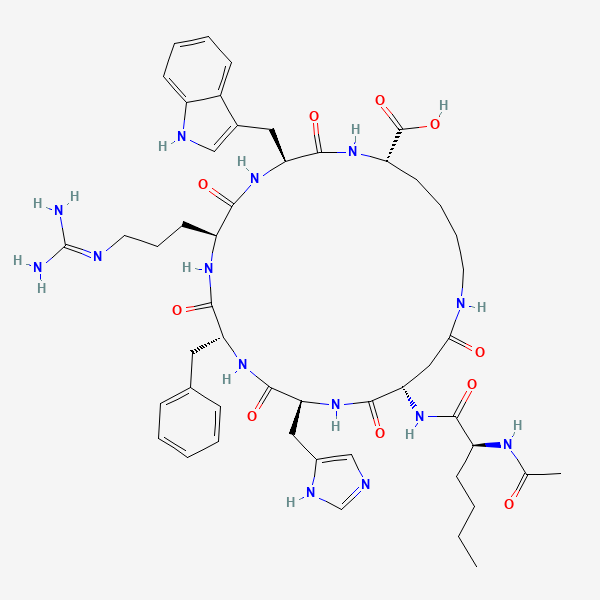
- Molecular formula
- C50H68N14O10
- Molecular weight
- 1025.2 g/mol
- IUPAC name
- (3S,6S,9R,12S,15S,23S)-15-[[(2S)-2-acetamidohexanoyl]amino]-9-benzyl-6-[3-(diaminomethylideneamino)propyl]-12-(1H-imidazol-5-ylmethyl)-3-(1H-indol-3-ylmethyl)-2,5,8,11,14,17-hexaoxo-1,4,7,10,13,18-hexazacyclotricosane-23-carboxylic acid
Verified external records:
References
More on PT-141
Everything else we've written about PT-141 — what the community reports, the explainers that cover it, and the terms it keeps running into.
- PT-141 peptide Reddit: libido effects and evidenceOn Reddit
- Peptides for ED: What Works & What Doesn'tExplainer
- What Peptides Increase Testosterone?Explainer
- Peptides for men: Goals, Options & SafetyExplainer
- Guide to peptides for women (incl. perimenopause)Explainer
- Do Peptides Raise Blood Pressure?Explainer
- What Is a Melanocortin Agonist?Explainer