Also known as: Rigin · N-Palmitoylrigin · Pal-GQPR · Palmitoyl-GQPR · Palmitoyl tetrapeptide-3
In-vitroUnclear⚠ none in humans
On this page
- What is palmitoyl tetrapeptide-7?
- How does palmitoyl tetrapeptide-7 affect IL-6?
- Does palmitoyl tetrapeptide-7 inhibit NF-κB?
- Does palmitoyl tetrapeptide-7 work on skin?
- What is its role in Matrixyl 3000?
- Is palmitoyl tetrapeptide-7 safe?
- Is palmitoyl tetrapeptide-7 FDA-approved or legal?
- What should you look for in a product?
- Evidence by outcome
- FDA & legal status
- Reported side effects
- Chemical identifiers
- References
- Related compounds
Palmitoyl Tetrapeptide-7 is a topical cosmetic lipopeptide designed to quiet inflammatory signaling in skin. Cell experiments show lower interleukin-6 after UV exposure, but they do not prove wrinkle reduction in people or direct NF-κB inhibition. The ingredient is legal in U.S. cosmetics, not an FDA-approved drug.
| Key fact | Direct answer |
|---|---|
| What it is | Synthetic Pal-GQPR, also called Rigin |
| Studied for | IL-6 suppression in cultured skin cells |
| Evidence tier | In-vitro; none in humans for the isolated ingredient |
| U.S. status (2026) | Unscheduled cosmetic ingredient; not an FDA-approved drug |
| How it is used | Low-concentration topical serums and creams |
| Main risk | Irritation from the peptide or, more often, the finished formula |
| Sport status | No therapeutic or performance use established |
What is palmitoyl tetrapeptide-7?
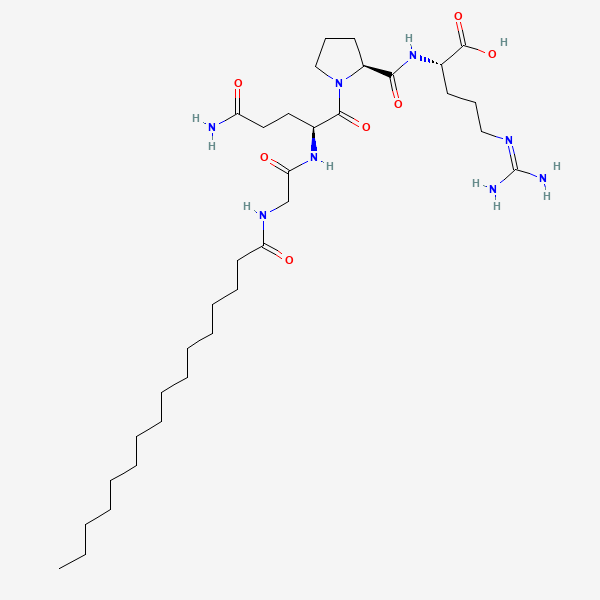
Palmitoyl tetrapeptide-7 is a four-amino-acid cosmetic peptide with a fatty tail added for topical formulation. The peptide sequence is glycine-glutamine-proline-arginine, shortened to GQPR; palmitic acid is attached at the N-terminus. PubChem records the formula C34H62N8O7, molecular weight 694.9 g/mol, CAS 221227-05-0, and PubChem CID 10078408.
The older name palmitoyl tetrapeptide-3 refers to the same molecule, not a separate three-amino-acid peptide. A U.S. patent lists both names against CAS 221227-05-0. Rigin is another established name. Ingredient lists now normally use the INCI name palmitoyl tetrapeptide-7.
How does palmitoyl tetrapeptide-7 affect IL-6?
Palmitoyl tetrapeptide-7 lowered interleukin-6 (IL-6), an inflammatory signaling protein, in cultured human keratinocytes and fibroblasts. In the manufacturer’s Pal-GQPR patent experiment, cells received 10 to 45 ppm before and after 35 mJ/cm² of UV exposure. IL-6 fell as concentration rose in both resting and UV-exposed cells.
That experiment is the useful center of the evidence, but its limits matter. The work came from the ingredient developer, appears in a patent rather than an independent peer-reviewed efficacy paper, and measured a laboratory marker. It did not test whether a person’s redness, wrinkle depth, elasticity, or skin barrier improved.
Does palmitoyl tetrapeptide-7 inhibit NF-κB?
Palmitoyl tetrapeptide-7 should not be called a proven NF-κB inhibitor. NF-κB is a transcription switch involved in inflammatory responses and can sit upstream of IL-6 production in stressed skin cells. The Pal-GQPR experiment measured secreted IL-6 by enzyme-linked immunosorbent assay; it did not measure NF-κB activation, nuclear movement, or gene binding.
The honest mechanism is therefore narrower: lower IL-6 in a cell model, consistent with dampened inflammatory signaling. Turning that into “blocks the NF-κB pathway” adds an unmeasured step. Cosmetic copy loves to promote a plausible pathway into a settled fact. The assay does not grant that promotion.
Does palmitoyl tetrapeptide-7 work on skin?
Palmitoyl tetrapeptide 7 skin evidence supports a laboratory effect, not a proven visible result from the isolated ingredient. The headline tier is in-vitro because the clean single-peptide finding comes from cultured cells. Human cosmetic reports often study finished formulas with moisturizers, preservatives, and other active ingredients, leaving no clean way to assign the result to this peptide.
That distinction is the point most search results skip. Lower IL-6 may help protect the extracellular matrix—the collagen-rich scaffolding that gives skin structure—but a biomarker is not a face. Independent, vehicle-controlled human testing of the isolated peptide would be the next meaningful rung.
What is its role in Matrixyl 3000?
Palmitoyl tetrapeptide-7 is the inflammation-focused half of the Matrixyl 3000 peptide pairing; palmitoyl tripeptide-1 is the collagen-signal half. Matrixyl 3000 blends the two, so trials of the blend cannot show which ingredient produced a change or whether both were necessary.
Do not confuse Matrixyl 3000 with Matrixyl, the site’s profile for palmitoyl pentapeptide-4. The shared trade-family name hides different molecules. This page does not recycle the blend’s wrinkle claims because the distinct, defensible story here is IL-6 suppression in cultured keratinocytes and fibroblasts.
Is palmitoyl tetrapeptide-7 safe?
Palmitoyl tetrapeptide-7 appears well tolerated at the low concentrations used topically, with a narrower safety record than the usual “gentle peptide” summary implies. The Cosmetic Ingredient Review assessment concluded the ingredient was safe under the cosmetic uses and concentrations reviewed, typically below 10 ppm.
A human repeated-insult patch test of a trade-name mixture containing 500 ppm was negative for irritation and sensitization. An in-vitro eye test classified a 500 ppm mixture as slightly irritating. Those findings support ordinary topical use, not swallowing or injecting the ingredient. A finished serum can also irritate because of fragrance, preservatives, solvents, or another active, so the ingredient list still matters.
Is palmitoyl tetrapeptide-7 FDA-approved or legal?
Palmitoyl tetrapeptide-7 is legal to use in U.S. cosmetics as of July 16, 2026, but it is not an FDA-approved drug. That is normal for skincare ingredients: FDA does not pre-approve cosmetics or their ingredients, apart from certain color additives. Companies must substantiate safety and label products properly under current cosmetic law.
Claims define the lane. “Improves the appearance of fine lines” is a cosmetic claim; claiming to treat inflammatory disease or change body structure can make a product a drug. For other topical research ingredients and their evidence tiers, use the cosmetic peptides hub.
What should you look for in a product?
Palmitoyl tetrapeptide-7 makes the most sense as a low-drama supporting ingredient, not a replacement for sunscreen or a proven wrinkle treatment. Check that the exact INCI name appears on the label, treat “Rigin” and “palmitoyl tetrapeptide-3” as aliases, and remember that placement on an ingredient list does not reveal the active concentration.
The most defensible expectation is modest: a topical formula built around a plausible cell-level inflammation signal with reassuring use-level safety. What remains open is the part shoppers care about most—how much visible improvement this one peptide produces on a real face. The evidence-grading guide explains why that answer stays at in-vitro until isolated human data arrive.
Evidence by outcome
Each outcome Palmitoyl Tetrapeptide-7 has been studied for, with the honest evidence grade and what the studies actually found. A tier never stands alone — the verdict rides with it.
| Outcome | Evidence | What was found |
|---|---|---|
| IL-6 suppression in cultured skin cells | In-vitroHelped⚠ none in humans | Manufacturer patent experiments found concentration-related reductions in IL-6 secretion from cultured human keratinocytes and fibroblasts before and after UV exposure. The experiment measured IL-6 in cells, not wrinkles in people and not direct NF-kappa B activity. |
| Wrinkles, firmness, and visible skin aging | In-vitroUnclear⚠ none in humans | Human cosmetic studies commonly test multi-ingredient formulas, especially Matrixyl 3000 with palmitoyl tripeptide-1. Those results cannot isolate the contribution of palmitoyl tetrapeptide-7, so the single ingredient remains unproven for visible outcomes in people. |
FDA & legal status
- United States: unscheduled (as of Jul 2026)
Palmitoyl tetrapeptide-7 is marketed as a cosmetic ingredient, not an FDA-approved drug or a controlled substance. FDA does not pre-approve cosmetic products or ingredients other than certain color additives; companies remain responsible for safety substantiation and proper labeling.
Reported side effects
| Effect | Frequency | Severity |
|---|---|---|
| Local irritation or sensitivity from the finished cosmetic formula | — | Usually mild; ingredient-specific frequency is not established |
| Eye irritation if the product enters the eye | — | A 500 ppm trade-name mixture was slightly irritating in an in-vitro ocular assay |
Chemical identifiers
References
- 1.Palmitoyl tetrapeptide-7 - compound record, CID 10078408 (PubChem)
- 2.Johnson et al. - CIR safety assessment of palmitoyl tetrapeptide-7 (doi:10.1177/1091581818807863)
- 3.Sederma patent US7998493B2 - cultured-cell IL-6 experiments with Pal-GQPR
- 4.Patent US7544375B1 - palmitoyl tetrapeptide-7 formerly called palmitoyl tetrapeptide-3
- 5.FDA - Cosmetics & U.S. Law