Also known as: Palmitoyl pentapeptide-4 · Pal-KTTKS · Palmitoyl pentapeptide-3 · Palmitoyl-Lys-Thr-Thr-Lys-Ser · N-Palmitoyl-KTTKS
Human (controlled)Helped
On this page
- What is Matrixyl?
- How does Matrixyl work?
- What does the research show?
- What the community reports
- Is Matrixyl safe? Side effects
- FDA & legal status (2026)
- How is Matrixyl used?
- Matrixyl vs retinol
- Frequently asked questions
- Who is Matrixyl for — and who should be cautious?
- Evidence by outcome
- FDA & legal status
- Reported side effects
- Chemical identifiers
- References
- Related compounds
- More on Matrixyl
Matrixyl is the trade name for palmitoyl pentapeptide-4, a topical peptide built from a five-amino-acid fragment of collagen. In skincare, Matrixyl is used to soften fine lines by signaling skin cells to make more collagen. Small controlled human studies show a modest effect; it is a legal cosmetic ingredient, not a drug.
What is Matrixyl?
Matrixyl is a cosmetic-ingredient brand name for palmitoyl pentapeptide-4, a lab-made peptide — a short chain of amino acids — designed for the skin. The peptide part is just five amino acids, lysine-threonine-threonine- lysine-serine, abbreviated Pal-KTTKS, and that sequence is a real fragment of type I collagen, the main structural protein in your skin. Bolted onto it is a palmitoyl group (a 16-carbon fatty acid), which makes the whole molecule greasy enough to slip through the skin’s water-repelling outer layer. Chemically it is a lipopeptide with the formula C39H75N7O10 and a weight of about 802 g/mol (PubChem CID 9897237). Unlike the injectable research peptides, Matrixyl lives in ordinary serums and creams you can buy off a shelf — it’s a cornerstone of the “peptide skincare” aisle.
How does Matrixyl work?
Matrixyl works as a matrikine — a fragment of collagen that acts like a message. Here’s the everyday version: when collagen in your skin breaks down, it leaves little peptide scraps behind, and your skin reads those scraps as a “we’ve taken damage, build more” signal. KTTKS is one of those scraps. Applying Matrixyl is like faking that repair signal on purpose, nudging the fibroblasts (your skin’s collagen-making cells) to ramp up collagen and other matrix proteins without any actual damage having happened. The palmitoyl tail is the delivery trick — a plain KTTKS fragment is too water-loving to cross the skin barrier, so the fatty-acid tail smuggles it through. That’s the mechanism. How strongly it plays out on a real face, versus in a lab dish, is the honest question the research section answers next.
What does the research show?
Matrixyl’s evidence splits cleanly into two tiers, and keeping them separate is the whole honesty game. In the lab, the story is strong: in cultured human skin fibroblasts, palmitoyl pentapeptide-4 increased collagen and matrix-protein production — that’s the in-vitro basis for the wrinkle claim, but a cell in a dish is a long way from a living face. On real skin, the evidence is thinner and more modest: a small set of controlled human facial studies reported a mild improvement in the look of fine lines and wrinkles versus a matching plain cream, and a PubMed search turns up only a handful of records — about six, four of them human-tagged (PubMed). Two honest caveats travel with that: the studies are few and small, and several are tied to the ingredient’s manufacturer, which is a real reason to hold the effect size loosely. There are no registered clinical trials for it (ClinicalTrials.gov). Our read: the mechanism is well-mapped and the human signal points the right way — the case for Matrixyl is “modest but real,” not “miracle in a jar,” and independent replication is what would move it up a tier. (More on how we grade evidence: our evidence-grading method.)
What the community reports
Outside the studies, Matrixyl has a large following among skincare enthusiasts, who tend to describe it as a low-drama, slow-burn ingredient — a little smoother texture and softer fine lines after a couple of months of daily use, without the peeling or irritation that stronger actives can bring. Those accounts are anecdotal: they aren’t controlled, people usually run Matrixyl alongside sunscreen, moisturizer and other actives, and you mostly hear from the people it pleased. They’re useful for understanding why the ingredient is popular, not for proving how much of the credit is Matrixyl’s.
Is Matrixyl safe? Side effects
Matrixyl is among the gentler cosmetic actives. At the low concentrations used in leave-on serums and creams, palmitoyl pentapeptide-4 rarely causes more than the occasional mild redness or irritation, and it lacks the sun-sensitivity and peeling associated with retinoids. It has a long, uneventful track record as an over-the- counter skincare ingredient. The honest limits: Matrixyl has been studied only as a topical — nobody has tested swallowing or injecting it, so those uses are uncharted — and as with any leave-on product, a patch test is sensible if your skin reacts easily. The real-world variability is in the products, not the molecule: peptide serums differ a lot in how much active they actually contain and how well it’s formulated to penetrate.
FDA & legal status (2026)
Matrixyl is a legal cosmetic ingredient in the United States, sold freely in over-the-counter skincare. It is not an FDA-approved drug — and it does not need to be. In the US, cosmetic ingredients other than color additives don’t require pre-market FDA approval, so palmitoyl pentapeptide-4 reaches shelves as a cosmetic, not a medicine (FDA — cosmetics). The practical catch is a labeling one: because it’s a cosmetic, the marketing is supposed to stay in “improves the appearance of” territory and not claim to treat a skin condition, which would make it a drug in the FDA’s eyes. This status is stable, but the dated breakdown lives in the status block above.
How is Matrixyl used?
Matrixyl is used topically — applied to the skin — not reconstituted or injected like the research peptides on this site. In practice it’s formulated into leave-on serums, moisturizers and eye creams at low active concentrations and used once or twice a day, typically as one layer in a routine rather than a standalone treatment. Because it’s gentle and non-irritating, Matrixyl is often paired with other actives (vitamin C, niacinamide, retinoids) — the peptide isn’t the diva of the routine. There’s no meaningful “dosing” to report the way there is for an injectable: the variable that matters is how much active a given product contains and how well it’s formulated to actually penetrate, which brands rarely disclose.
Matrixyl vs retinol
Matrixyl and retinol are the two names people compare most in anti-aging skincare, and they’re not really rivals — they’re different tools. Retinol (a vitamin-A derivative) has the deeper, better-replicated human evidence for wrinkles and skin renewal, but it comes with irritation, peeling and sun sensitivity, especially early on. Matrixyl works by a gentler collagen-signaling route with a lighter but thinner evidence base and almost no irritation. The plain-English version: retinol is the heavier hitter with more baggage; Matrixyl is the low-drama option many people layer in with it. For the honest evidence tiers side by side, that’s the trade to weigh.
Frequently asked questions
Does Matrixyl actually work?
Matrixyl has a modest, real signal, not a dramatic one. Small controlled human studies reported softer-looking fine lines versus a plain cream, and lab studies show it boosts collagen in skin cells. Expect a subtle improvement over a couple of months, not a transformation — and hold the effect size loosely, since the human studies are few and often industry-associated.
Is Matrixyl legal?
Yes. Palmitoyl pentapeptide-4 is a legal cosmetic ingredient in the United States, sold in ordinary over-the-counter skincare. It isn’t an FDA-approved drug, but cosmetic ingredients don’t require that approval, so there’s nothing “research use only” about buying a Matrixyl serum.
Is Matrixyl better than retinol?
Not better — different. Retinol has stronger, more replicated human evidence for wrinkles but causes irritation and sun sensitivity; Matrixyl is gentler with a lighter evidence base. Many people use both, layering the low-irritation peptide alongside the heavier-hitting retinoid.
What’s the difference between Matrixyl and Matrixyl 3000?
“Matrixyl” refers to palmitoyl pentapeptide-4 (Pal-KTTKS). “Matrixyl 3000” and “Matrixyl synthe’6” are later trade blends from the same maker that combine or swap in different peptides. They’re marketed as upgrades, but they aren’t the same single ingredient, so evidence for one doesn’t automatically transfer to another.
Can you take Matrixyl orally or by injection?
Matrixyl has only ever been studied as a topical, applied to the skin. There is no research on swallowing or injecting palmitoyl pentapeptide-4, so those routes are completely uncharted and not something the evidence supports.
Who is Matrixyl for — and who should be cautious?
Matrixyl fits the person who wants a gentle, evidence-backed-but-modest anti-aging peptide to layer into a routine — someone whose skin can’t tolerate retinol, or who wants to add a low-irritation collagen signal on top of one. The honest framing: the mechanism is well understood, the human effect is real but small and under-replicated, and the biggest variable is the product, not the molecule. Anyone expecting a retinol-level result, or a “collagen injection in a bottle,” is set up to be disappointed — Matrixyl is a quiet contributor, not a headliner. If your skin reacts easily, patch-test first; if you want the strongest wrinkle evidence, that’s still retinoid territory. For the wider skin-peptide landscape, see our cosmetic & skin peptides hub.
Evidence by outcome
Each outcome Matrixyl has been studied for, with the honest evidence grade and what the studies actually found. A tier never stands alone — the verdict rides with it.
| Outcome | Evidence | What was found |
|---|---|---|
| Fine lines & wrinkles (topical) | Human (controlled)Helped | Small controlled human facial-skin studies reported a modest improvement in the appearance of fine lines and wrinkles versus a matching vehicle cream over a couple of months of twice-daily use. The effect sizes are small, the studies are few, and several are tied to the ingredient's maker — so read this as an encouraging, industry-associated signal, not settled proof. |
| Collagen / extracellular-matrix stimulation (mechanism) | In-vitroHelped⚠ none in humans | In cultured human skin fibroblasts, palmitoyl pentapeptide-4 increased production of collagen and other matrix proteins. That is the proposed basis for the wrinkle effect, but a cell in a dish is not a living face — this shows a plausible mechanism, not a measured result in people. |
FDA & legal status
- United States: unscheduled (as of Jul 2026)
Palmitoyl pentapeptide-4 is not an FDA-approved drug — and in the US it does not need to be. Cosmetic ingredients (other than color additives) don't require pre-market FDA approval, so Matrixyl is legally sold as an ingredient in over-the-counter skincare. It is regulated as a cosmetic, which means the marketing may not cross into drug claims (e.g. "treats" a condition).
openFDA Drugs@FDA lists no approved product for Matrixyl as of 2026-07-15.
Reported side effects
| Effect | Frequency | Severity |
|---|---|---|
| Mild local irritation or redness (uncommon, as with many leave-on skincare actives) | — | — |
Chemical identifiers
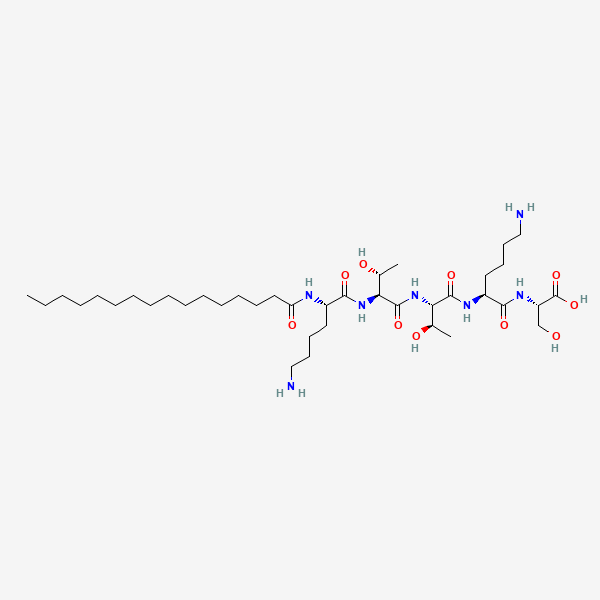
- Molecular formula
- C39H75N7O10
- Molecular weight
- 802.1 g/mol
- IUPAC name
- (2S)-2-[[(2S)-6-amino-2-[[(2S,3R)-2-[[(2S,3R)-2-[[(2S)-6-amino-2-(hexadecanoylamino)hexanoyl]amino]-3-hydroxybutanoyl]amino]-3-hydroxybutanoyl]amino]hexanoyl]amino]-3-hydroxypropanoic acid
Verified external records:
References
More on Matrixyl
Everything else we've written about Matrixyl — what the community reports, the explainers that cover it, and the terms it keeps running into.