Also known as: Pal-GHK · Palmitoyl-GHK · Palmitoyl oligopeptide · N-Palmitoyl-Gly-His-Lys · Biopeptide CL
In-vitroUnclear⚠ none in humans
On this page
- What is palmitoyl tripeptide-1?
- How does palmitoyl tripeptide-1 work?
- What does the research show?
- Hype vs. reality: is it “Botox in a jar”?
- What people report
- Is palmitoyl tripeptide-1 safe? Side effects
- FDA & legal status (2026)
- How is palmitoyl tripeptide-1 used?
- Palmitoyl tripeptide-1 vs GHK-Cu
- Frequently asked questions
- Who is palmitoyl tripeptide-1 for — and who should skip it?
- Evidence by outcome
- FDA & legal status
- Registered clinical trials
- Reported side effects
- Chemical identifiers
- References
- Related compounds
- More on Palmitoyl Tripeptide-1
Palmitoyl tripeptide-1 is a synthetic skin-care peptide — the natural GHK tripeptide (glycine-histidine-lysine) with a fatty palmitic-acid tail added so it can slip through the skin barrier. Lab studies link it to more collagen. It’s a legal cosmetic ingredient, not an FDA-approved drug, and its wrinkle-smoothing reputation rests mostly on cell studies and manufacturer testing, not independent human trials.
What is palmitoyl tripeptide-1?
Palmitoyl tripeptide-1 is a lab-made “lipopeptide” — a tiny 3-amino-acid peptide (glycyl-histidyl-lysine, the same GHK sequence your body already makes) with a 16-carbon palmitic-acid tail attached to one end. That greasy tail is the whole trick: pure GHK is water-loving and struggles to get through skin, while the fatty chain lets palmitoyl tripeptide-1 dissolve into the skin’s oily barrier and actually reach the living cells underneath. Chemically it’s a small molecule (formula C30H54N6O5, molecular weight about 578.8 g/mol, CAS 147732-56-7). You’ll see palmitoyl tripeptide-1 on serum and cream labels under its INCI name, and it’s one half of the widely sold “Matrixyl 3000” blend — it is a cosmetic ingredient, not a prescription medicine.
How does palmitoyl tripeptide-1 work?
Palmitoyl tripeptide-1 is described as a matrikine — a small fragment that acts like a repair message to the skin. Here’s the plain-English version: when skin collagen breaks down over the years, it releases short peptide pieces, and skin cells read those pieces as a “we’ve got damage, start rebuilding” signal. Palmitoyl tripeptide-1 is designed to mimic that signal, nudging dermal fibroblasts (the cells that build skin’s scaffolding) to crank out more collagen and other matrix proteins (PubChem CID 10231864). Think of it less like a hammer that rebuilds the wall and more like a text message asking the construction crew to show up. The honest caveat: this “signal peptide” story is built on cell and tissue models, and exactly how much palmitoyl tripeptide-1 does in a real human face — versus the cream’s moisturizer, the SPF, or time — has not been pinned down for the isolated peptide.
What does the research show?
Palmitoyl tripeptide-1’s evidence is strongest in the lab and thinnest in people. In cultured human skin cells and reconstructed-skin models, palmitoyl tripeptide-1 and its matrikine cousins increased collagen and matrix-protein output — a genuine, repeatable in-vitro result, and the reason the ingredient exists. The gap opens when you look for proof on actual skin: a PubMed search returns only a small handful of records, and most of the human ones test a finished formula that blends palmitoyl tripeptide-1 with other actives (classically palmitoyl tetrapeptide-7 in Matrixyl 3000), so they can’t tell you what this one peptide did on its own. A lot of the “clinical” support also comes from the ingredient’s manufacturer, which we treat as a commercial claim, not independent evidence. And a ClinicalTrials.gov search turns up no registered trials of the isolated compound. So the fair read: palmitoyl tripeptide-1 has a plausible mechanism and encouraging cell data, and it’s one of the better-behaved cosmetic peptides — but it has never been proven, in a clean human trial, to smooth wrinkles by itself.
Hype vs. reality: is it “Botox in a jar”?
Palmitoyl tripeptide-1 is not Botox in a jar, and it isn’t sold as one — that tagline belongs to a different family of cosmetic peptides (the “neuromodulating” ones like Argireline that are marketed to relax expression lines). Palmitoyl tripeptide-1 plays a different game entirely: it’s a collagen-support signal, so the realistic promise is gradual improvements in firmness and fine texture over weeks to months, not a frozen forehead in a week. The biggest honest mismatch in the marketing is certainty — brochures imply a proven anti-wrinkle effect, while the clean evidence sits at the cell-study level. Treat palmitoyl tripeptide-1 as a reasonable, low-risk “maybe it helps a bit over time” ingredient, not a guaranteed result.
What people report
Anecdotally, users of serums built around palmitoyl tripeptide-1 describe subtle, slow wins — skin that looks a little plumper or smoother after a couple of months of daily use — rather than anything dramatic. Those are personal impressions of whole products, not trials of the peptide: there’s no control group, no way to separate the peptide from the moisturizer or from simply using sunscreen consistently, and we only hear from people motivated to talk about it. Useful for setting expectations, useless as proof of efficacy.
Is palmitoyl tripeptide-1 safe? Side effects
Palmitoyl tripeptide-1 has a reassuringly boring safety record as a topical cosmetic. It’s been used as a leave-on skin ingredient for years without a signal of serious harm, and the peptide itself isn’t known to be irritating. When problems do come up, they’re the ordinary cosmetic kind — mild redness, stinging, or a contact-sensitivity reaction — and those usually trace back to a preservative, fragrance, or the base formula rather than palmitoyl tripeptide-1 specifically. The real unknown is off-label use: there is no meaningful human safety data for injecting palmitoyl tripeptide-1 or using it in any way other than on the surface of the skin, so “well tolerated in a cream” should not be read as “safe to inject.” Patch-testing a new product on a small area first is the sensible move for anyone with reactive skin.
FDA & legal status (2026)
Palmitoyl tripeptide-1 is legal to sell and use in cosmetics in the United States, and it is not an FDA-approved drug — which, for a skin-care peptide, is completely normal. Cosmetics don’t go through FDA pre-market approval the way drugs do (only color additives do), so palmitoyl tripeptide-1 sits in the ordinary cosmetic-ingredient lane: legal to formulate with, not a controlled substance, not “approved” because approval isn’t the mechanism. The one line that matters: a product can market palmitoyl tripeptide-1 for appearance (smoother, firmer-looking skin), but the moment a brand claims it changes skin’s structure or function, that’s a drug claim — and the ingredient’s regulatory footing would change with it. Status here is stable, unlike the research peptides; the dated breakdown is in the status block above.
How is palmitoyl tripeptide-1 used?
Palmitoyl tripeptide-1 is a topical ingredient — it’s formulated into serums, creams and eye products at low concentrations and applied to the skin, not reconstituted and injected like a research peptide. In practice it’s almost never used alone; it’s usually blended with other peptides (the Matrixyl 3000 pairing with palmitoyl tetrapeptide-7 is the common one) and layered into a normal routine alongside moisturizers and sunscreen. Because it’s a cosmetic, “dose” really means formula percentage rather than a milligram figure, and those percentages are set by the ingredient supplier and formulator, not by clinical dosing studies — so we frame them as manufacturing information, not a protocol. If you’re comparing this to the injectable research peptides, note that our reconstitution calculator and mixing-compatibility reference are built for those — palmitoyl tripeptide-1 as a skin-care ingredient doesn’t need either.
Palmitoyl tripeptide-1 vs GHK-Cu
Palmitoyl tripeptide-1 and GHK-Cu are close cousins, and people mix them up constantly. Both are built on the same tiny GHK peptide, but they take opposite approaches: GHK-Cu is GHK bound to a copper ion (the “copper peptide”), studied largely for wound healing and skin remodeling, while palmitoyl tripeptide-1 skips the copper and instead adds a fatty tail to help the peptide penetrate skin in a cream. Neither has a clean, isolated human anti-wrinkle trial, and both are best seen as plausible collagen-support ingredients rather than proven treatments. You can find both, plus Argireline and the rest of the skin peptides, on the cosmetic peptides hub.
Frequently asked questions
Does palmitoyl tripeptide-1 actually reduce wrinkles?
Palmitoyl tripeptide-1 may help a little, gradually, but it hasn’t been proven to. The collagen-boosting effect is solid in cell studies; the human wrinkle data almost always tests it inside a blended formula, so it can’t isolate this peptide’s own effect. Expect subtle, slow improvements at best — not a dramatic result.
Is palmitoyl tripeptide-1 the same as a copper peptide (GHK-Cu)?
No. Both start from the same GHK tripeptide, but GHK-Cu carries a copper ion, while palmitoyl tripeptide-1 carries a palmitic-acid (fatty) tail instead. They’re relatives with different chemistry, different penetration, and different research histories.
Is palmitoyl tripeptide-1 safe?
For topical use, palmitoyl tripeptide-1 is generally very well tolerated, with mild irritation being the main occasional complaint — usually from the formula rather than the peptide. There’s no reliable safety data for injecting it or using it non-topically, so keep it to the skin.
Is palmitoyl tripeptide-1 legal, and is it FDA-approved?
Palmitoyl tripeptide-1 is legal in cosmetics in the US and is not FDA-approved — because cosmetic ingredients don’t get FDA approval in the first place. It’s a legally marketed skin-care ingredient, not a drug and not a controlled substance.
Is palmitoyl tripeptide-1 banned in sport?
No. Palmitoyl tripeptide-1 is a topical cosmetic collagen peptide, not on the WADA Prohibited List and with no performance-enhancing mechanism, so it isn’t treated as a doping agent.
What is Matrixyl 3000?
Matrixyl 3000 is a trade-named cosmetic blend that pairs palmitoyl tripeptide-1 with a second peptide, palmitoyl tetrapeptide-7. Most of the human “clinical” data people cite for palmitoyl tripeptide-1 actually tested this blend, which is why it can’t cleanly credit results to the single peptide.
Who is palmitoyl tripeptide-1 for — and who should skip it?
Palmitoyl tripeptide-1 fits the person who wants a gentle, low-risk collagen-support ingredient in their routine and has realistic expectations — someone happy with “might help firmness and fine lines a bit over a few months,” layered under sunscreen, as part of a bigger skin-care picture. It’s one of the safer, more plausible cosmetic peptides, and it plays well with almost everything. Who should skip it: anyone expecting a proven, Botox-level wrinkle eraser (the clean evidence isn’t there), anyone with reactive skin who hasn’t patch-tested the specific product, and anyone tempted to inject it — that’s outside anything the ingredient has been studied for. What’s solid is the cell-level collagen signal and the strong topical safety record; what’s still uncertain is whether palmitoyl tripeptide-1, on its own, makes a visible difference on a real human face.
Evidence by outcome
Each outcome Palmitoyl Tripeptide-1 has been studied for, with the honest evidence grade and what the studies actually found. A tier never stands alone — the verdict rides with it.
| Outcome | Evidence | What was found |
|---|---|---|
| Collagen & extracellular-matrix production | In-vitroHelped⚠ none in humans | In cultured human skin fibroblasts and reconstructed-skin models, palmitoyl tripeptide-1 and closely related matrikine peptides increased production of collagen and other matrix proteins. That is a cells-in-a-dish finding — no trial has confirmed the same effect for the isolated peptide in living human skin. |
| Fine lines, wrinkles & skin firmness (headline use) | In-vitroUnclear⚠ none in humans | Palmitoyl tripeptide-1 is sold for smoother, firmer skin, but the human testing almost always uses a finished formula that blends it with other actives (most famously alongside palmitoyl tetrapeptide-7), so it cannot isolate palmitoyl tripeptide-1's own contribution — and much of that testing is run by the ingredient's maker rather than independent labs. |
FDA & legal status
- United States: unscheduled (as of Jul 2026)
Palmitoyl tripeptide-1 is a legally marketed cosmetic ingredient (INCI: Palmitoyl Tripeptide-1). Cosmetics do not receive FDA pre-market approval (only color additives do), so "not FDA-approved" is the normal state for a skin-care peptide — it is not a drug and not a controlled substance. Marketing it with a strong anti-aging *drug* claim (e.g. changing skin structure) would move it into drug territory and change its regulatory footing.
openFDA Drugs@FDA lists no approved product for palmitoyl tripeptide-1 as of 2026-07-15.
Registered clinical trials
One registered study mention Palmitoyl Tripeptide-1 on ClinicalTrials.gov (latest update 2026-10-19). A registered trial means a study is planned or underway — not that Palmitoyl Tripeptide-1 is approved or proven.
| Study | Status | Phase | Sponsor |
|---|---|---|---|
| AI-Personalized Skincare Regimen for Facial Photoaging in WomenNCT07879833 | completed | NA | MDalgorithms Inc. |
Reported side effects
| Effect | Frequency | Severity |
|---|---|---|
| Mild skin irritation, redness, or contact sensitivity (uncommon; usually formulation- or preservative-related) | — | — |
Chemical identifiers
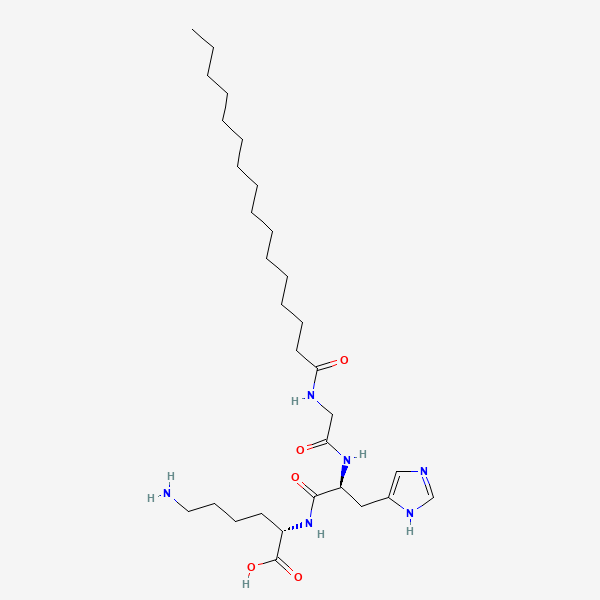
- Molecular formula
- C30H54N6O5
- Molecular weight
- 578.8 g/mol
- IUPAC name
- (2S)-6-amino-2-[[(2S)-2-[[2-(hexadecanoylamino)acetyl]amino]-3-(1H-imidazol-5-yl)propanoyl]amino]hexanoic acid
Verified external records:
References
More on Palmitoyl Tripeptide-1
Everything else we've written about Palmitoyl Tripeptide-1 — what the community reports, the explainers that cover it, and the terms it keeps running into.