Also known as: TP-5 · Thymopoietin pentapeptide · Thymopoietin 32-36 · Arg-Lys-Asp-Val-Tyr
Human RCTMixed
On this page
- What is thymopentin?
- How does thymopentin affect the immune system?
- What do the human trials actually show?
- Is thymopentin safe?
- Is thymopentin FDA-approved in 2026?
- What thymopentin dosage did studies use?
- How is thymopentin different from other thymic peptides?
- Evidence by outcome
- FDA & legal status
- Chemical identifiers
- References
- Related compounds
Thymopentin is a five-amino-acid immune-modulating peptide with real human trials and no clean overall win: eczema studies were positive, rheumatoid-arthritis studies were not, and HIV findings depended on the subgroup examined. The TP-5 peptide is not FDA-approved in the United States, and modern long-term safety evidence remains limited.
- What it is: synthetic Arg-Lys-Asp-Val-Tyr, sold historically as Timunox
- Evidence: Human RCT · mixed
- US status (July 2026): investigational, not FDA-approved
- Study use: injection schedules varied by disease and trial
- Main risk: an old, indication-specific safety record rather than modern long-term data
- Sport: not named on WADA’s 2026 list; a categorical classification could not be verified
What is thymopentin?
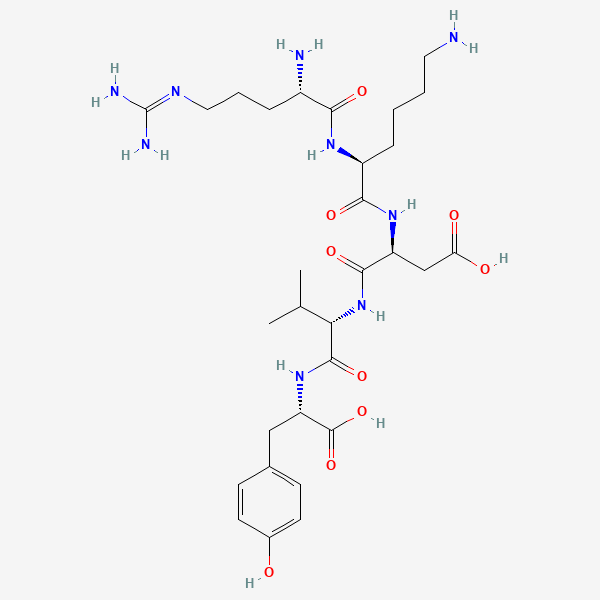
Thymopentin is a synthetic pentapeptide—a chain of five amino acids—corresponding to residues 32 through 36 of thymopoietin. Its sequence is Arg-Lys-Asp-Val-Tyr, or RKDVY in one-letter code. PubChem identifies the molecule as CID 451417, formula C30H49N9O9, molecular weight 679.8 g/mol, and CAS 69558-55-0 (PubChem). The thymopentin RKDVY sequence is the whole molecule, not shorthand for a longer peptide.
Timunox, Immunox, and Sintomodulina are names attached to thymopentin in regulatory and chemical records. Those names do not make a vial an FDA-approved US medicine. They mainly explain why older papers switch between “thymopentin,” “TP-5,” and “Timunox” without changing compounds.
How does thymopentin affect the immune system?
Thymopentin appears to influence T-cell differentiation and immune regulation, but “immune booster” is too blunt a label for what human trials measured. The historical model is that TP-5 reproduces immune activity attributed to a small segment of thymopoietin. The exact receptor-level human mechanism remains unsettled, so a laboratory immune signal should not be promoted into protection from infections or better immunity in healthy people.
The thymopentin immune story also has a timing problem. In a human-plasma experiment, intact TP-5 had an apparent in-vitro half-life of about 30 seconds as enzymes clipped RKDVY into shorter fragments (Tischio et al., PMID 395119). That is not a measured in-vivo half-life, but it helps explain why trials used repeated injections rather than treating TP-5 like a long-acting depot peptide.
What do the human trials actually show?
Thymopentin has human randomized evidence, but the result changes with the disease, which is why the fair verdict is mixed. In a two-center double-blind trial, 100 people with moderate-to-severe atopic dermatitis received daily subcutaneous thymopentin or placebo for six weeks. Both groups improved, but thymopentin produced a larger reduction in overall severity at week six; itching and redness also favored TP-5 (Leung et al., PMID 2185294).
Rheumatoid arthritis told the opposite story. A report compiling three short- and long-term clinical studies found no statistically significant improvement with TP-5; most patients did not improve or left because treatment was ineffective. The authors said earlier beneficial findings could not be confirmed (Veys et al., PMID 6384507). One positive skin trial plus several negative arthritis studies is not a universal immune benefit. It is evidence tied to specific patients, endpoints, routes, and eras.
The HIV record adds another layer. A 352-person double-blind trial used thymopentin alongside zidovudine and found different clinical outcomes depending on prior zidovudine exposure. CD4 counts and p24 antigen levels did not differ significantly overall, and adverse reactions were not increased (Goldstein et al., PMID 7859140). That subgroup-dependent result belongs in the “mixed” column, not on an immune-support label.
Is thymopentin safe?
Thymopentin looked reasonably tolerated in the older controlled trials, but those studies cannot establish long-term safety for present-day self-use. The atopic-dermatitis trial reported no serious adverse experiences in either arm, and the 48-week HIV trial found no increase in clinical adverse reactions or laboratory abnormalities. Reassuring, yes; a complete modern safety file, no.
The practical uncertainties are immune effects, injections, and product quality outside an approved supply chain. People with autoimmune disease, deliberate immune suppression, pregnancy, or several immune-active medicines were not established as safe populations by the trials above. The absence of a long adverse-event list in old abstracts should not be mistaken for proof of no side effects.
Is thymopentin FDA-approved in 2026?
Thymopentin is not FDA-approved for any indication in the United States as of July 16, 2026. FDA granted orphan designation to investigate thymopentin for sarcoidosis, but the agency’s own record says “Not FDA Approved for Orphan Indication” (FDA orphan-drug record). Orphan designation supports development; it is not marketing approval.
The clean label is therefore investigational, not an approved prescription drug or dietary supplement. The dated regulatory-status reference matters more than a vendor’s use of Timunox or “pharmaceutical grade.” A chemical identity record, including FDA’s UNII entry, also does not equal product approval.
Is thymopentin banned in sport?
Thymopentin is not named in the 2026 WADA Prohibited List, but that alone does not prove it is permitted. WADA’s S0 rule covers certain pharmacological substances without current human therapeutic approval by a governmental regulator. Because thymopentin has regulatory and marketing history outside the United States that was not cleanly resolved in the current WADA materials, this page does not assign a categorical banned-or-permitted badge. A tested athlete should obtain a compound-specific ruling from the relevant anti-doping authority.
What thymopentin dosage did studies use?
There is no evidence-based thymopentin dosage for general immune support. The positive eczema trial used daily subcutaneous injections for six weeks, while the HIV trial used 50 mg under the skin three times weekly for 48 weeks. Rheumatoid-arthritis programs tested different subcutaneous and intravenous schedules. Those are study regimens for defined diseases, not interchangeable instructions for a healthy person.
The range also exposes a common search-result failure: listing one dose without its indication makes old trial design look like a current protocol. TP-5 breaks down rapidly in plasma in vitro, yet simply injecting more or more often is not a conclusion the efficacy or safety data support.
How is thymopentin different from other thymic peptides?
Thymopentin is not a short name for thymosin alpha-1 or thymulin; the three molecules come from different parent systems and have different evidence records. Thymopentin is synthetic RKDVY, the five-residue active fragment associated with thymopoietin. Thymosin alpha-1 is a 28-amino-acid peptide also called thymalfasin, with a much broader human trial program and approval in some countries. Thymulin is a natural nine-amino-acid, zinc-dependent thymic hormone.
That distinction keeps “thymic peptide” from becoming one large evidence bucket. For the broader map, use the immune peptide hub; for how the trial tiers are assigned, see the evidence-grading guide. Similar origin stories do not create shared doses, approvals, or clinical effects.
Evidence by outcome
Each outcome Thymopentin has been studied for, with the honest evidence grade and what the studies actually found. A tier never stands alone — the verdict rides with it.
| Outcome | Evidence | What was found |
|---|---|---|
| Atopic dermatitis | Human RCTHelped | A 100-patient double-blind, placebo-controlled trial found a modest but statistically significant advantage for thymopentin after six weeks, including less itching and redness. This is a positive human trial, not proof of broad immune enhancement or an approved eczema treatment. |
| Rheumatoid arthritis | Human (controlled)No effect | A compilation of three short- and long-term clinical studies, including double-blind work, found no statistically significant improvement and did not confirm benefits reported elsewhere. |
| HIV adjunctive treatment | Human RCTMixed | A 352-person placebo-controlled trial produced different clinical results according to prior zidovudine exposure, while CD4 counts and p24 antigen levels did not differ significantly between treatment groups. |
FDA & legal status
- United States: investigational (as of Jul 2026)
Thymopentin is not an FDA-approved drug. FDA granted orphan designation for investigation in sarcoidosis, but the agency's record states that it is not FDA-approved for that orphan indication. Timunox is a historical/foreign brand name, not evidence of a current approved US product.
Chemical identifiers
References
- 1.PubChem Compound Summary for CID 451417, Thymopentin
- 2.Leung et al., 1990 — thymopentin in atopic dermatitis (PMID 2185294)
- 3.Veys et al., 1984 — thymopentin in rheumatoid arthritis (PMID 6384507)
- 4.Goldstein et al., 1995 — thymopentin with zidovudine in HIV (PMID 7859140)
- 5.Tischio et al., 1979 — TP-5 breakdown in human plasma (PMID 395119)
- 6.FDA orphan-drug record for thymopentin in sarcoidosis
- 7.WADA 2026 Prohibited List