Also known as: Cathelicidin LL-37 · hCAP-18/LL-37 · Ropocamptide · CAP-18 (human fragment)
Animal-onlyMixed⚠ none in humans
On this page
- What is LL-37?
- How does LL-37 work?
- What does the research show?
- The double edge — the part most sellers skip
- What the community reports
- Is LL-37 safe? Side effects
- FDA & legal status (2026)
- How is LL-37 used, and can it be mixed?
- LL-37 vs KPV
- Frequently asked questions
- Who is LL-37 for — and who should be cautious?
- Evidence by outcome
- FDA & legal status
- Registered clinical trials
- Chemical identifiers
- References
- Related compounds
- More on LL-37
LL-37 is the body’s own antimicrobial peptide — a 37-amino-acid piece of human cathelicidin that punches holes in bacteria, breaks up biofilms, and signals to your immune system. Sold as a research chemical, LL-37 is studied heavily in the lab, only lightly in people, and it is not FDA-approved. The biology is well mapped; the human proof for injecting it is thin.
If you’re here, odds are you’re wrestling with something stubborn — a sinus infection that keeps coming back, a gut that won’t settle, a wound that won’t close — and you read that LL-37, a natural antibiotic your own body already makes, might help. Here’s what LL-37 actually is, what the studies show, and where the honest gaps are.
What is LL-37?
LL-37 is a natural human antimicrobial peptide — a short, 37-amino-acid chain (sequence LLGDFFRKSKEKIGKEFKRIVQRIKDFLRNLVPRTES) that your own cells make and release to kill microbes. It is the only “cathelicidin” humans produce: your body stores it as a longer, inactive protein called hCAP-18, then snips off the active LL-37 tail where it’s needed — in skin, sweat, gut lining, airways and immune cells. The name is literal: two leucines (“LL”) start the chain, which is 37 residues long. At roughly 4.5 kilodaltons it’s larger than most research peptides. Unlike BPC-157 or KPV, LL-37 isn’t a lab invention you’re introducing from scratch — it’s a molecule you’re already full of. What’s sold online is a synthetic copy, and in the United States it exists only as a research chemical.
How does LL-37 work?
LL-37 works, at its core, like a charged hole-punch that prefers microbes. The peptide is strongly positively charged, and the outer membranes of bacteria, fungi and many viruses are negatively charged — so LL-37 is pulled toward a microbe’s surface like a magnet, folds into a shape that buries into the membrane, and tears it open, killing the cell (indexed LL-37 antimicrobial research). Your own cells are protected at normal levels because their membranes are more neutral and shielded by cholesterol. LL-37 has a second job, too: it talks to your immune system through receptors such as FPR2, calling in immune cells, tuning inflammation up or down, and nudging wound healing (indexed cathelicidin research). One neat, well-established detail worth knowing: vitamin D is the main switch that turns LL-37 production on, which is why so much LL-37 research is really vitamin D research. The honest caveat: this map is drawn mostly from cells and mice, and exactly how an injected dose behaves in a human body is not established.
What does the research show?
LL-37 has a huge research base — thousands of papers — but very little of it is about taking LL-37 as a therapy. In the lab, LL-37 kills a broad range of bacteria (including some antibiotic-resistant ones), fungi and enveloped viruses, and it disrupts biofilms, the slimy fortresses that make chronic infections so hard to clear (indexed LL-37 antimicrobial research). Mouse infection models point the same way. That’s the exciting part — but it’s dish-and-rodent evidence, so for the antimicrobial “immune-boosting” use LL-37 is actually sold for, there’s no human trial. The human studies that do exist are for narrower, local uses: a completed early-phase trial injected LL-37 into melanoma tumors to draw in immune cells (NCT02225366), and a Phase 2 study registered a topical LL-37 cream for diabetic foot ulcers (NCT04098562). LL-37 was even developed far enough as a wound drug to earn an official drug name, “ropocamptide.” None of that has established LL-37 as a proven treatment yet (registered LL-37 studies). So the honest read: the biology is one of the strongest stories in the antimicrobial- peptide field, and the first real human tests are the ones just beginning — the proof is arriving, not run out.
The double edge — the part most sellers skip
LL-37 cuts both ways, and that’s the single most important thing to understand before you buy it. The same membrane-disrupting power that kills microbes can damage your own cells at higher concentrations — in the lab, enough LL-37 will rupture human red blood cells. And on the immune side, LL-37 is not purely protective: it’s a recognized autoantigen in psoriasis (the immune system can attack it), and it runs high in rosacea, where it appears to drive the redness and inflammation rather than calm it (indexed cathelicidin research). This is why the honest verdict on LL-37 is “mixed,” not “miracle antibiotic.” More of a molecule your body tightly regulates isn’t automatically better — the regulation is the point.
What the community reports
LL-37 has a word-of-mouth following among people fighting chronic, biofilm-type problems — recurrent sinus infections, stubborn gut issues, “chronic Lyme”–style symptoms — who found it while researching natural antimicrobials. The commonly reported approaches are subcutaneous injections or nasal/topical use, often in short courses, aimed at “clearing” a lingering infection. These accounts are anecdotal — they aren’t controlled data, they carry survivorship bias (people who feel nothing tend to go quiet), and they can’t tell you how often LL-37 does nothing, or how often the double-edged inflammation side bites back. They explain why people are curious about LL-37; they don’t show that injecting it works.
Is LL-37 safe? Side effects
LL-37’s honest safety answer is “we don’t really know, and it’s double-edged.” Yes, LL-37 is a natural part of your immune system — but the amount and location matter enormously, and injecting extra is a different thing from the tightly controlled amounts your body releases where it’s needed. At higher concentrations LL-37 is cytotoxic to host cells and can rupture red blood cells in the lab, and elevated LL-37 is tied to inflammatory skin conditions like psoriasis and rosacea. Human safety data for supplemental LL-37 come only from a handful of small early trials, and there is no long-term human safety data at all. As with every research peptide, the most concrete real-world risk sits with the supply: research-chemical vials are unregulated, so on purity, the real dose, and sterility you’re trusting the seller rather than any regulator. Anyone with a history of psoriasis, rosacea or autoimmune disease has an extra, specific reason for caution here.
FDA & legal status (2026)
LL-37 is not FDA-approved, and it is not a legal dietary supplement either. In the United States, as of 2026, LL-37 is sold strictly as a research chemical, labeled “for research use only,” which is how vendors sidestep the rules that apply to drugs and supplements (FDA drug approvals). Interestingly, LL-37 has been through early clinical development as a wound-healing candidate — far enough to be assigned the international drug name “ropocamptide” — but no LL-37 product has been approved for any use. Nothing about the “research use only” label means LL-37 has been reviewed for safety or effectiveness; it hasn’t. Regulatory treatment of research peptides has been shifting quickly, so treat any status claim about LL-37 as dated and re-check it. The dated breakdown sits in the FDA & legal status block above.
How is LL-37 used, and can it be mixed?
LL-37 is typically sold as a lyophilized (freeze-dried) powder that has to be reconstituted with bacteriostatic water before use, though topical and nasal forms are marketed too. Getting a concentration right from a powder is pure arithmetic — our reconstitution & dosing calculator turns a vial size, a water volume and a target amount into the exact number of insulin-syringe units to draw. People also ask whether LL-37 can share a syringe with other peptides (it’s sometimes paired with healing or anti-inflammatory peptides like KPV or BPC-157); our mixing compatibility reference covers what’s commonly combined and where the honest answer is “not enough data.” One real chemistry note for LL-37 specifically: it’s a large, charged, membrane-active peptide, so it’s fussier to handle than a tiny peptide like KPV, and casually mixing it with other compounds in one vial is exactly where “not enough data” applies. Any LL-37 amounts you’ll see quoted online are community-reported, not clinically validated — there’s no established human dose, so we don’t publish a personalized protocol.
LL-37 vs KPV
LL-37 and KPV are the two immune-peptides people most often weigh against each other, and they’re both drawn from your own biology — but they do different jobs. LL-37 is an antimicrobial peptide: its headline power is directly killing microbes and busting biofilms, and it’s double-edged (it can also drive inflammation). KPV is an anti-inflammatory tripeptide from the hormone alpha-MSH: its evidence centers on quietly turning down inflammation in the gut and skin, with no membrane-killing action. Neither has human RCT proof for the use it’s sold for; both are research-chemical-only. If your problem is an active infection or biofilm, LL-37 is the one people research; if it’s inflammation you want calmed, KPV is the tidier story. You can see the rest of the category on the immune peptides hub.
Frequently asked questions
Is LL-37 proven to work in humans?
Not for the reason it’s usually sold. LL-37 has overwhelming lab evidence that it kills microbes and breaks up biofilms, plus mouse data, but no human trial has tested LL-37 as an antibiotic or immune booster. Small early human trials exist for other, local uses — a topical wound cream and injections into melanoma tumors — but none has established LL-37 as a proven treatment. We grade its headline antimicrobial use animal-only, with no human data for that use.
Is LL-37 legal?
LL-37 is legal to buy and sell as a research chemical in the United States, but it is not an approved drug or a legal dietary supplement, and it can’t be sold for human consumption. That’s why every vendor labels it “for research use only.”
What is LL-37 used for?
In the research literature, LL-37 is studied as a broad antimicrobial and immune signal, and in early trials for hard-to-heal wounds and as a cancer immunotherapy. Community users mostly reach for it to fight chronic, biofilm-type infections — but that use is unproven in people.
Is LL-37 safe to inject?
Honestly, it’s not well established. LL-37 is a natural immune peptide, but at higher concentrations it can damage your own cells and it’s tied to inflammatory conditions like psoriasis and rosacea. Human safety data are limited to a few small trials, there’s no long-term data, and the research-chemical supply is unregulated. People with autoimmune or inflammatory skin conditions have a specific extra reason to be cautious.
Is LL-37 banned in sport?
Treat it as banned. LL-37 isn’t named individually on WADA’s Prohibited List, but because it has no regulatory approval for human therapeutic use it falls under the S0 “non-approved substances” category, which is prohibited at all times for athletes under anti-doping rules.
Who is LL-37 for — and who should be cautious?
LL-37 draws in people fighting a chronic, won’t-quit infection — the sinus flare that keeps returning, the biofilm that shrugs off antibiotics, the gut that never fully settles — who read that a natural antibiotic their own body makes might help, and want to understand it before deciding. The honest framing: LL-37’s antimicrobial and anti-biofilm biology is one of the most compelling in the whole peptide space, and its first human tests are underway. But there’s no human trial for the systemic use people buy it for, LL-37 is truly double-edged (it can inflame as well as protect), long-term human safety data don’t exist, and the product you’d actually buy is unregulated. Anyone pregnant, managing psoriasis, rosacea or another autoimmune condition, or unwilling to accept real unknowns has every reason to wait for the human research to catch up to the biology.
Evidence by outcome
Each outcome LL-37 has been studied for, with the honest evidence grade and what the studies actually found. A tier never stands alone — the verdict rides with it.
| Outcome | Evidence | What was found |
|---|---|---|
| Antimicrobial & anti-biofilm activity | Animal-onlyMixed⚠ none in humans | In the lab, LL-37 ruptures the membranes of a broad range of bacteria (including some drug-resistant strains), fungi and enveloped viruses, and it breaks apart the biofilms that shield chronic infections — LL-37's oldest and most-replicated finding. Mouse infection models point the same direction. But this is dish-and-rodent work: no human trial has tested LL-37 given as an antibiotic, and at higher concentrations LL-37 also harms host cells, so the picture is mixed, not a clean win. |
| Chronic / hard-to-heal wound healing (topical) | Human observationalUnclear | LL-37 was actually developed as a wound-healing drug candidate — it even carries an assigned international nonproprietary name, "ropocamptide" — and a Phase 2 study registered a topical LL-37 cream for diabetic foot ulcers, tracking bacterial colonization and healing rate (NCT04098562). This is the most clinically advanced use, but confirmed, published efficacy is not established, so treat topical LL-37 for wounds as promising and unproven. |
| Cancer immunotherapy (intratumoral melanoma) | Human observationalUnclear | A completed early-phase (Phase 1/2) trial injected LL-37 directly into melanoma tumors to pull immune cells into the tumor (NCT02225366). That put LL-37 in human testing for this use — but as an early safety-and-mechanism study, not as a demonstrated cancer treatment. |
| Immune role in inflammatory disease (double-edged) | Human observationalMixed | In people, LL-37 cuts both ways. Higher cathelicidin/LL-37 activity is associated with fighting infection and with wound repair, but LL-37 is also a recognized autoantigen in psoriasis and is elevated in rosacea, where it appears to worsen the condition. These are associations from human studies, not proof that adding more LL-37 helps or harms any given person. |
FDA & legal status
- United States: research use only (as of Jul 2026)
LL-37 is not an FDA-approved drug and not a legal dietary supplement — in the United States it is sold only as a research chemical ("for research use only"). It has been through early clinical development (it holds the INN "ropocamptide") but no product has been approved. Regulatory treatment of research peptides is volatile; re-verify before relying on it.
openFDA Drugs@FDA lists no approved product for LL-37 as of 2026-07-15.
Registered clinical trials
20 registered studies mention LL-37 on ClinicalTrials.gov (latest update 2026-04-13). A registered trial means a study is planned or underway — not that LL-37 is approved or proven.
Chemical identifiers
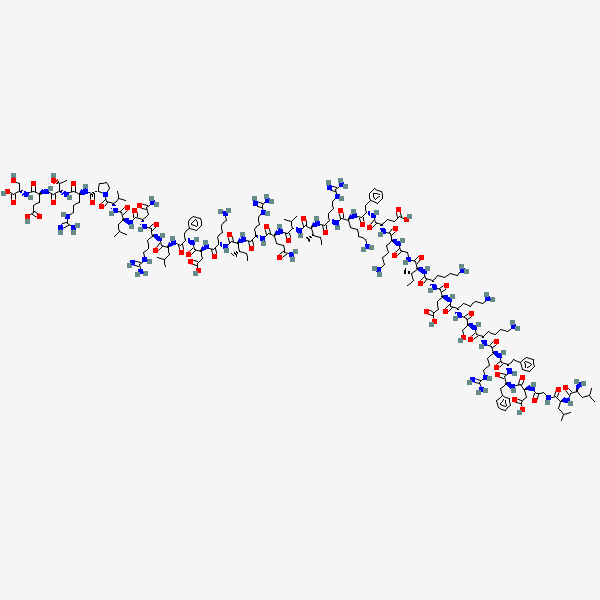
- Molecular formula
- C205H340N60O53
- Molecular weight
- 4493 g/mol
- IUPAC name
- (4S)-5-[[(2S)-6-amino-1-[[(2S,3S)-1-[[2-[[(2S)-6-amino-1-[[(2S)-1-[[(2S)-1-[[(2S)-6-amino-1-[[(2S)-1-[[(2S,3S)-1-[[(2S)-1-[[(2S)-5-amino-1-[[(2S)-1-[[(2S,3S)-1-[[(2S)-6-amino-1-[[(2S)-1-[[(2S)-1-[[(2S)-1-[[(2S)-1-[[(2S)-4-amino-1-[[(2S)-1-[[(2S)-1-[(2S)-2-[[(2S)-5-carbamimidamido-1-[[(2S,3R)-1-[[(2S)-4-carboxy-1-[[(1S)-1-carboxy-2-hydroxyethyl]amino]-1-oxobutan-2-yl]amino]-3-hydroxy-1-oxobutan-2-yl]amino]-1-oxopentan-2-yl]carbamoyl]pyrrolidin-1-yl]-3-methyl-1-oxobutan-2-yl]amino]-4-methyl-1-oxopentan-2-yl]amino]-1,4-dioxobutan-2-yl]amino]-5-carbamimidamido-1-oxopentan-2-yl]amino]-4-methyl-1-oxopentan-2-yl]amino]-1-oxo-3-phenylpropan-2-yl]amino]-3-carboxy-1-oxopropan-2-yl]amino]-1-oxohexan-2-yl]amino]-3-methyl-1-oxopentan-2-yl]amino]-5-carbamimidamido-1-oxopentan-2-yl]amino]-1,5-dioxopentan-2-yl]amino]-3-methyl-1-oxobutan-2-yl]amino]-3-methyl-1-oxopentan-2-yl]amino]-5-carbamimidamido-1-oxopentan-2-yl]amino]-1-oxohexan-2-yl]amino]-1-oxo-3-phenylpropan-2-yl]amino]-4-carboxy-1-oxobutan-2-yl]amino]-1-oxohexan-2-yl]amino]-2-oxoethyl]amino]-3-methyl-1-oxopentan-2-yl]amino]-1-oxohexan-2-yl]amino]-4-[[(2S)-6-amino-2-[[(2S)-2-[[(2S)-6-amino-2-[[(2S)-2-[[(2S)-2-[[(2S)-2-[[(2S)-2-[[2-[[(2S)-2-[[(2S)-2-amino-4-methylpentanoyl]amino]-4-methylpentanoyl]amino]acetyl]amino]-3-carboxypropanoyl]amino]-3-phenylpropanoyl]amino]-3-phenylpropanoyl]amino]-5-carbamimidamidopentanoyl]amino]hexanoyl]amino]-3-hydroxypropanoyl]amino]hexanoyl]amino]-5-oxopentanoic acid
Verified external records:
References
- 1.LL-37 (cathelicidin) — indexed research (PubMed, National Library of Medicine)
- 2.LL-37 antimicrobial and anti-biofilm activity — indexed research (PubMed)
- 3.LL-37 — registered clinical studies (ClinicalTrials.gov)
- 4.Intratumoral injections of LL-37 for melanoma (ClinicalTrials.gov NCT02225366)
- 5.Efficacy of LL-37 cream on diabetic foot ulcers (ClinicalTrials.gov NCT04098562)
- 6.FDA — human drug approvals and status
- 7.USADA / WADA Prohibited List — S0 non-approved substances
More on LL-37
Everything else we've written about LL-37 — what the community reports, the explainers that cover it, and the terms it keeps running into.