Also known as: Facteur Thymique Sérique · FTS · Serum thymic factor · Circulating thymic factor · Zinc-thymulin · Thymulin TFA salt
Human observationalMixed
On this page
- What does “thymulin TFA salt link peptide” mean?
- What is thymulin, and why does zinc matter?
- What does the human and animal research show?
- What the community reports
- Is thymulin TFA salt safe? Side effects and quality risks
- Is thymulin FDA-approved or banned in sport in 2026?
- How is research thymulin described, reconstituted, and measured?
- How is thymulin different from other thymic peptides?
- Frequently asked questions
- Who should skip thymulin TFA salt?
- Evidence by outcome
- FDA & legal status
- Chemical identifiers
- References
- Related compounds
- More on Thymulin
The thymulin tfa salt link peptide phrase is catalog shorthand, not the name of a special linked molecule: TFA is a manufacturing counterion, while zinc is the cofactor that switches thymulin on. If you found the phrase on a product page, ask whether the vial documents identity, counterion content, zinc state, purity, and sterility—not whether the label sounds technical.
What does “thymulin TFA salt link peptide” mean?
Thymulin TFA salt is the nine-amino-acid thymulin sequence supplied with trifluoroacetate ions after synthesis or purification. “Link peptide” is usually loose catalog wording unless the specification names an actual linker or conjugate. Neither phrase means the peptide already carries the zinc ion required for thymulin’s classic biological activity. That distinction is the whole query in one paragraph: TFA describes how synthetic material is supplied; zinc describes how thymulin becomes active.
| Key fact | Bottom line |
|---|---|
| Identity | Nine-residue thymulin/FTS sequence; TFA is a counterion |
| Biological switch | Zinc binding, best characterized at a 1:1 molar ratio |
| Headline evidence | Human observational · mixed |
| Healthy-person use | No modern controlled trial located |
| US status, July 2026 | Not FDA-approved; research-use-only market |
| Sport | Treat as prohibited under WADA S0 |
| Validated human dose | None for a catalog-labeled TFA-salt product |
The exact thymulin sequence is pGlu-Ala-Lys-Ser-Gln-Gly-Gly-Ser-Asn. It contains one lysine side chain that can carry a positive charge, so a negatively charged counterion may accompany the isolated synthetic peptide. TFA is common because trifluoroacetic acid is used during solid-phase peptide cleavage and reverse-phase high-performance liquid chromatography. A 2025 methods paper on TFA counterions in synthetic peptides found that counterion amount can alter formula-weight calculations and assay behavior; the authors argue that laboratories should measure and specify it rather than treat “TFA salt” as decorative fine print.
“Link” deserves its own reality check. A linker is a defined chemical spacer joining a peptide to a tag, surface, drug, or another molecule. If a certificate of analysis lists only thymulin’s nine-residue sequence and “TFA salt,” there is no documented linker. Catalog taxonomy has a habit of dressing like chemistry. The sequence, terminal modifications, measured mass, and counterion assay settle the question.
What is thymulin, and why does zinc matter?
Thymulin is a natural hormone released by thymic epithelial cells, the cells lining the thymus behind the breastbone. The peptide itself has nine residues, the formula C33H54N12O15, and a base molecular weight of about 858.9 daltons. Older papers call the zinc-free peptide facteur thymique sérique (FTS), serum thymic factor, or nonathymulin; they reserve “thymulin” for the biologically active zinc-bound form.
The cleanest experiment came in 1982. Researchers stripped metals from synthetic or natural FTS with a chelating resin and its activity disappeared in a T-cell rosette assay. Adding zinc restored activity, with a 1:1 zinc-to-peptide molar ratio producing the best activation (PMID 6957870). Think of the peptide as a folded pocket and zinc as the snap that holds the useful shape together. TFA is not that snap.
Thymulin helps immature T-cell precursors acquire mature features and participates in the two-way signaling between the thymus, immune system, and neuroendocrine system. Its exact receptor is still not settled. Production and circulating activity fall as the thymus shrinks with age, and zinc deficiency can leave more peptide in the inactive, zinc-free state. That biology explains the interest in immune aging; it does not by itself show that injecting more thymulin reverses aging.
For identity, the page retains the verified PubChem and registry links in its structured data. The base sequence is listed under CAS 63958-90-7 and PubChem records including CID 71300623. A TFA salt can weigh more per vial than the base peptide because counterions contribute mass, which is why “10 mg” without peptide-content and counterion data is an incomplete specification.
What does the human and animal research show?
Thymulin’s physiology is supported by decades of human measurements, but therapeutic evidence is small, old, and easy to overstate. A 1982 report treated only three immunodeficient children with intravenous synthetic FTS and observed immune-test and infection improvements; it had no control group. A 1987 rheumatoid-arthritis report was an open trial. Modern anti-inflammatory and longevity work is largely rodent research, and no registered trial located in the 2026 search tested today’s catalog-labeled thymulin TFA salt in healthy adults.
The broad PubMed index contains hundreds of thymulin records, including many human-tagged papers, but most human papers measure the body’s own hormone in disease or aging rather than test thymulin as a treatment.
| Question | Best evidence located | What it actually answers |
|---|---|---|
| Does zinc activate thymulin? | 1982 biochemical and cell-assay work; 1:1 zinc-to-FTS activation | Strong mechanism evidence, not a treatment trial |
| Can zinc status change thymulin activity in people? | 44 older adults in a 16-week crossover study; 20 mg/day zinc partly restored serum thymulin activity | Evidence about zinc supplementation in zinc-low older adults, not injected thymulin |
| Has synthetic FTS been given to people? | Three immunodeficient children received intravenous synthetic FTS in 1982 | A human signal with no placebo group and no healthy participants |
| Does thymulin treat rheumatoid arthritis? | A 1987 open FTS-Zn trial, published as a short report without an abstract | Human exposure, but not modern controlled efficacy evidence |
| Does thymulin reduce inflammatory pain? | A 2019 rat study reported less paw swelling and thermal hyperalgesia with changes in spinal inflammatory signaling | Animal-only evidence; it cannot establish human pain relief |
| Has thymulin TFA salt been clinically validated? | No matching interventional study located in the 2026 ClinicalTrials.gov search | No validated human dose, benefit, or long-term safety profile for that catalog form |
The zinc study in older adults is useful because it exposes a common category error. Twenty milligrams of zinc daily for 16 weeks partly restored measured thymulin activity in a 44-person crossover study (PMID 8460613). That shows a nutrient can affect the body’s own thymulin system; it does not show that zinc-thymulin injections work, and it says nothing about a TFA-salt vial.
The direct human treatment record is thinner. The three-child report described fewer or less severe infections alongside improved immune tests after intravenous synthetic FTS (PMID 6124716). Three patients, no randomization, and a specific immunodeficiency setting make it a lead, not a healthy-person immune-boost claim. That is why the headline grade remains Human observational · mixed, while immune aging and anti-inflammatory uses remain Animal-only · None-in-humans. The proof has room to arrive; it has not arrived through a modern thymulin TFA trial yet.
What the community reports
Thymulin has a modest biohacker following centered on immune support and “anti-aging,” often discussed as short courses of subcutaneous injections. These reports are Anecdotal · None-in-humans for the consumer use: there is no placebo group, product identity can vary, users often change several variables at once, and people who feel nothing are less likely to report back. They explain the search demand, not the effect size.
The TFA wording adds another blind spot to personal reports. Two vials can share a product name while differing in peptide content, counterion amount, zinc state, sterility, or degradation. A person cannot separate those variables from the molecule by noticing how they felt. Community experience can generate questions worth testing, but it cannot validate a salt form, a dose, or a supplier’s label.
Is thymulin TFA salt safe? Side effects and quality risks
Thymulin TFA salt does not have a modern human safety dataset for self-directed injection. The body makes thymulin, but “endogenous” is not a free safety pass: route, concentration, zinc state, counterion load, impurities, and sterility all change the exposure. Older human FTS reports are too small to define common adverse effects, rare harms, interactions, fertility effects, cancer risk, or long-term immune consequences.
The molecular question and the vial question should be kept separate. Thymulin changes immune signaling, so unwanted immune effects are plausible even though a specific harm rate has not been established. Anyone with active autoimmune disease, a history of cancer, an organ transplant, deliberate immunosuppression, pregnancy, or breastfeeding lacks the evidence needed to treat that uncertainty casually.
The vial risk is more concrete. A high-performance liquid chromatography purity percentage estimates how much chromatographic signal belongs to the main peak under one method; it does not establish identity, peptide content, TFA amount, zinc occupancy, endotoxin level, or sterility. For research procurement, a useful certificate of analysis should identify the exact sequence and termini, match measured mass to the expected peptide, quantify peptide and counterion content separately, report lot-specific purity, and state which sterility or endotoxin tests were actually performed. “Research grade” alone is a label, not a test result.
TFA also should not be marketed as a harmless stability upgrade. Counterion research shows that TFA content can change weighed potency calculations, peptide conformation, and biological assays. That does not prove a particular thymulin vial is toxic. It does mean a vendor should quantify the counterion instead of asking the buyer to assume every TFA-salt batch is equivalent.
Is thymulin FDA-approved or banned in sport in 2026?
Thymulin is not FDA-approved in the United States, and the July 2026 Drugs@FDA check located no approved thymulin product. Products advertised “for research use only” have not been reviewed by FDA for human safety, effectiveness, manufacturing quality, or dosing. That label describes the seller’s stated market; it does not turn an unapproved peptide into an approved medicine or establish that a particular sale or use complies with every applicable law.
The FDA drug database remains the right place to verify an approval claim. This page does not call thymulin a dietary supplement or a compounded-drug option. FDA states that compounded drugs are not FDA-approved, and a catalog vial is not made legitimate for human use merely because its page avoids treatment language. Regulatory status changes, so the dated frontmatter record should be rechecked rather than copied forever.
For tested athletes, the 2026 World Anti-Doping Agency list puts non-approved pharmacological substances under S0, prohibited at all times. Thymulin is not individually named, but no governmental approval for therapeutic human use was located during this review; the conservative status therefore remains prohibited under S0. Athletes should confirm the exact substance with their anti-doping organization before use, because a product-page synonym is a poor defense in a doping case.
How is research thymulin described, reconstituted, and measured?
Research thymulin is commonly sold as lyophilized powder, but a catalog description is not a validated clinical preparation. The amount of base peptide may differ from total salt mass, and “TFA salt” does not say whether zinc is already bound. A study protocol must define the sequence, counterion, zinc conditions, solvent, concentration, container, storage, and assay; borrowing an injection protocol from a different thymic peptide is not reproducible science.
The older human literature does not supply a standard healthy-person dose. The three-child study used intravenous synthetic FTS in a clinical immunodeficiency setting, while the open rheumatoid-arthritis report studied FTS-Zn. Neither validates a subcutaneous regimen for a current TFA product. One animal pharmacokinetic paper measured a 10.3 ± 0.6 minute serum half-life in a single sheep after injection, with the route absent from the abstract. That number stays labeled animal and should not be converted into a human schedule.
If a laboratory already has a verified vial and a defined target concentration, the reconstitution calculator performs the arithmetic of vial amount, diluent volume, and draw volume. It cannot verify the number printed on the vial or choose a dose. The mixing compatibility reference is similarly conservative: no direct stability evidence supports casually putting thymulin TFA salt and another peptide in one syringe. Different counterions, pH conditions, zinc, and excipients make “they both dissolve” a poor compatibility test.
How is thymulin different from other thymic peptides?
Thymulin is a nine-residue, zinc-dependent hormone; it is not thymosin alpha-1, thymosin beta-4, TB-500, thymopentin, thymostimulin, or the heterogeneous bovine extract sold as thymalin. Similar names have allowed vendors and summaries to borrow evidence across molecules. The quickest check is sequence length and identity: if the study used a different molecule, its outcome does not belong on a thymulin evidence card.
Thymosin alpha-1 is a 28-amino-acid immune peptide with a far larger human trial record and approvals outside the United States. Thymosin beta-4 is a 43-amino-acid actin-binding peptide studied mainly in tissue repair, with completed human work including the RGN-259 dry-eye program; TB-500 is associated with a fragment rather than zinc-thymulin. KPV is a three-amino-acid anti-inflammatory fragment derived from alpha-MSH, not a thymic hormone. Readers comparing immune signals can browse the immune peptide hub, but the names are neighbors, not aliases.
That distinction also protects the evidence tier. A randomized trial of thymopentin or thymosin alpha-1 cannot upgrade thymulin. The small 1982 FTS report can support human exposure to synthetic serum thymic factor, while the 2019 inflammatory-pain study stays rat evidence. Keeping the molecules separated makes thymulin look less clinically mature, but much more interesting for the right reason: it is a defined zinc-gated hormone waiting for a modern development program of its own.
Frequently asked questions
Thymulin questions usually collapse into identity, zinc, TFA, effectiveness, and legal status. The short answers below keep those lanes separate. The same nine-residue peptide can be described as a base sequence, a TFA salt, or a zinc-bound complex, but those labels are not interchangeable evidence claims.
Is thymulin TFA salt the active zinc-thymulin form?
Not necessarily. “TFA salt” identifies trifluoroacetate as a counterion associated with the synthetic peptide; it does not prove that zinc is bound in the 1:1 active complex. A specification should state zinc content or preparation conditions directly.
What does “link peptide” mean on a thymulin listing?
It may mean nothing more than a vendor category or awkward catalog phrase. A real linker should be named in the chemical structure, sequence annotation, terminal modification, or conjugation record. If none is documented, do not infer a hidden linker from the title.
Does thymulin actually work in humans?
Thymulin works as an endogenous thymic hormone, and tiny older human reports administered synthetic FTS or FTS-Zn in specific illnesses. No modern controlled trial shows that a thymulin TFA product boosts immunity, slows aging, or relieves pain in healthy people. The immune claim therefore remains human-observational and mixed, not human-RCT evidence.
Is zinc supplementation the same as taking thymulin?
No. Zinc can restore activity of the body’s existing thymulin system when zinc status is low; a 44-person older-adult study showed partial restoration of serum thymulin activity. That finding does not establish the effect of injected thymulin, and adding zinc to a vial is not a validated substitute for a characterized zinc-thymulin preparation.
Is thymulin TFA salt legal to use?
No FDA-approved thymulin drug was located in 2026, and “research use only” is not authorization for human treatment. Laws turn on the product, claims, seller, and use, so a broad “legal peptide” promise is not reliable. Tested athletes should also treat it as prohibited under WADA S0 unless their anti-doping authority says otherwise.
Does thymulin decline with age?
Circulating thymulin activity declines with thymic involution and can also fall with zinc deficiency. That makes the pathway a plausible target for immunosenescence research. It does not yet show that replacing thymulin restores youthful immune function or improves health outcomes in older adults.
Who should skip thymulin TFA salt?
Thymulin TFA salt is not for anyone seeking a clinically established immune booster, a validated anti-aging protocol, or a predictable consumer injectable. People who are pregnant or breastfeeding, have active autoimmune disease or a cancer history, take immunosuppressive drugs, have received an organ transplant, compete under anti-doping rules, or cannot verify a lot’s identity and sterility have specific reasons to stay away from current research-market material.
Thymulin still earns serious scientific interest. A nine-residue hormone whose activity depends on one zinc ion is an unusually crisp biological system, and the old human signals give modern researchers somewhere to start. What is missing is equally crisp: a characterized salt form, quantified zinc state, modern dose-escalation and pharmacokinetic work, controlled clinical endpoints, and long-term safety follow-up. Until those arrive, the useful action is to read the label correctly and refuse to let TFA, zinc, and “link” blur into one claim.
Evidence by outcome
Each outcome Thymulin has been studied for, with the honest evidence grade and what the studies actually found. A tier never stands alone — the verdict rides with it.
| Outcome | Evidence | What was found |
|---|---|---|
| Immune modulation / T-cell maturation (the headline use) | Human observationalMixed | Thymulin's job as a thymic hormone is well described, and older clinical work studied thymulin (as FTS / zinc-thymulin) in immune-deficiency and inflammatory conditions. But that human literature is largely decades old, small, and aimed at sick patients — not at boosting a healthy immune system, which is the use most people search for. Modern, high-quality human trials confirming a healthy-enhancement benefit are thin, so the headline use stays unconfirmed. |
| Age-related immune decline (immunosenescence) | Animal-onlyUnclear⚠ none in humans | Thymulin falls as the thymus involutes with age, and rodent work has explored restoring it to counter age-related immune and neuroendocrine decline. Promising in animals, unknown in humans — no human trial has shown that supplementing thymulin slows immune aging in people. |
| Anti-inflammatory / analgesic signaling | Animal-onlyMixed⚠ none in humans | In animal models, thymulin has been reported to dampen inflammatory and pain signaling, including in the brain. These are rodent and cell findings; there is no human trial testing thymulin as an anti-inflammatory or analgesic, so the effect is unknown in people. |
FDA & legal status
- United States: research use only (as of Jul 2026)
Thymulin is not an FDA-approved drug and not a legal dietary supplement — in the United States it is sold strictly as a research chemical ("for research use only"). An openFDA search returns no approved thymulin product. Status is dated; re-verify against FDA and ClinicalTrials.gov.
openFDA Drugs@FDA lists no approved product for thymulin as of 2026-07-15.
Chemical identifiers
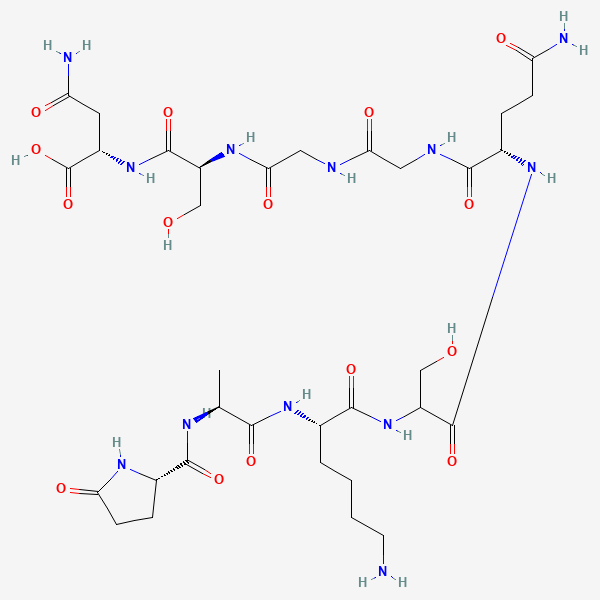
- Molecular formula
- C33H54N12O15
- Molecular weight
- 858.9 g/mol
- IUPAC name
- (2S)-4-amino-2-[[(2S)-2-[[2-[[2-[[(2S)-5-amino-2-[[2-[[(2S)-6-amino-2-[[(2S)-2-[[(2S)-5-oxopyrrolidine-2-carbonyl]amino]propanoyl]amino]hexanoyl]amino]-3-hydroxypropanoyl]amino]-5-oxopentanoyl]amino]acetyl]amino]acetyl]amino]-3-hydroxypropanoyl]amino]-4-oxobutanoic acid
Verified external records:
References
- 1.Thymulin — indexed research (PubMed, National Library of Medicine)
- 2.Thymulin — compound record (PubChem CID 71300623)
- 3.Thymulin — human-tagged studies (PubMed filter)
- 4.Thymulin — registered clinical studies (ClinicalTrials.gov)
- 5.FDA — drug approvals and status (Drugs@FDA)
- 6.Contribution of zinc and other metals to serum thymic factor activity
- 7.Synthetic serum thymic factor in three immunodeficient children
- 8.Low-dose zinc supplementation and thymulin activity in older adults
- 9.Thymulin treatment in a rat model of inflammatory pain
- 10.Analysis and exchange of TFA counterions in synthetic peptides
- 11.WADA 2026 Prohibited List
More on Thymulin
Everything else we've written about Thymulin — what the community reports, the explainers that cover it, and the terms it keeps running into.
- Thymulin Reddit: Zinc Thymulin & HairOn Reddit
- What Is a Bioregulator Peptide?Explainer