Also known as: Exendin-4 · Synthetic exendin-4 · AC2993
Human RCTHelped
On this page
- What is exenatide?
- How does exenatide work?
- What does the research show?
- Is exenatide safe? Side effects
- FDA & legal status (2026)
- How is exenatide dosed?
- Exenatide vs semaglutide and tirzepatide
- Frequently asked questions
- Who is exenatide for — and where does it fit?
- Evidence by outcome
- FDA & legal status
- Registered clinical trials
- Reported side effects
- Chemical identifiers
- References
- Related compounds
- More on Exenatide
Exenatide is a GLP-1 receptor agonist, a synthetic copy of exendin-4 — a peptide first isolated from Gila monster venom — that the FDA approved in 2005 to lower blood sugar in type 2 diabetes. Exenatide works by mimicking a gut hormone that tells the body to release insulin and quiets appetite. It is a real, approved prescription drug, not a research chemical.
What is exenatide?
Exenatide is a 39-amino-acid peptide (sequence HGEGTFTSDLSKQMEEEAVRLFIEWLKNGGPSSGAPPPS, molecular formula C184H282N50O60S, molecular weight about 4,187) and the first GLP-1 receptor agonist ever brought to market. Its story is a good one: it is a lab-made version of exendin-4, a hormone-like peptide found in the venom of the Gila monster, a venomous desert lizard. That natural molecule happens to look a lot like human GLP-1, the gut hormone that signals fullness after a meal — so drug developers borrowed it. Exenatide is sold under the brand names Byetta (twice-daily) and Bydureon (once-weekly), and it treats type 2 diabetes.
How does exenatide work?
Exenatide works by imitating GLP-1, one of the “incretin” hormones your gut releases after you eat. Think of GLP-1 as a short text message your intestine sends after a meal: release some insulin, hold back the sugar-raising hormone glucagon, slow the stomach down, and tell the brain we’re full. Your own GLP-1 is gone in about two minutes because an enzyme called DPP-4 chews it up almost immediately. Exenatide is built to shrug off DPP-4, so the same message keeps broadcasting for hours instead of seconds. Crucially, its insulin push is glucose-dependent — it only leans on the pancreas when blood sugar is actually high, which is a big part of why exenatide on its own rarely drives blood sugar dangerously low.
What does the research show?
Exenatide sits at the opposite end of the evidence spectrum from most research peptides: it has been studied in humans about as thoroughly as a peptide can be. A PubMed search returns roughly 4,400 records, including several hundred human randomized controlled trials, and ClinicalTrials.gov lists hundreds of registered studies. For its headline use — lowering blood sugar in type 2 diabetes — randomized trials showed exenatide reduced HbA1c (a three-month blood-sugar average) versus placebo, with modest weight loss alongside, which is exactly why the FDA approved it (FDA label, DailyMed). That is a human-RCT result with a positive verdict, not an animal signal.
Exenatide also had a second act that drew real attention: a possible Parkinson’s disease treatment. A small Phase 2 trial in 2017 reported that people with Parkinson’s on exenatide held their motor scores slightly better a year later — a signal big enough to launch a definitive trial. That trial, a two-year Phase 3 study run by University College London (NCT04232969), completed in 2024 and did not find a benefit over placebo. That is disappointing for exenatide specifically, but it is honest science doing its job — and the broader question of whether GLP-1 drugs protect the brain is still being tested with other compounds. The Lancet issued an expression of concern about the Phase 3 report on 27 June 2026. This is not a retraction: it flags concerns under investigation, and the paper stands unless or until further action is taken. The proof for exenatide-and-Parkinson’s didn’t arrive; the wider line of research is still open.
Is exenatide safe? Side effects
Exenatide’s safety answer is unusually well documented, because millions of people have taken it. The most common effect by far is nausea, especially in the first few weeks, which usually fades as the body adjusts; vomiting and diarrhea are also common. Hypoglycemia (blood sugar dropping too low) is mostly a risk when exenatide is combined with a sulfonylurea or insulin, not when it is used alone. The serious-but-uncommon risks are the ones worth knowing: the label warns about acute pancreatitis, and the once-weekly extended-release form (Bydureon) carries a boxed warning about thyroid C-cell tumors seen in rodents — a finding not established in humans, but the reason it is contraindicated for anyone with a personal or family history of medullary thyroid cancer or the MEN 2 syndrome. The once-weekly form can also leave small injection-site nodules. All of this is on the FDA prescribing information (DailyMed).
FDA & legal status (2026)
Exenatide is an FDA-approved prescription drug — the first of the GLP-1 receptor agonists, cleared as Byetta in 2005 and as the once-weekly Bydureon in 2012. That puts it in a completely different legal category from the research peptides much of this site covers: exenatide is dispensed by pharmacies with a prescription, not sold “for research use only.” The original branded Byetta product has since been discontinued, and newer GLP-1 drugs have taken most of its market, but the approval itself stands and exenatide remains available by prescription. The full dated status is in the regulatory block below. (Regulatory details change — re-check the current label.)
How is exenatide dosed?
The doses below are what appears on exenatide’s FDA label — information, not a personal prescription; only a prescriber sets an actual regimen. Byetta is injected under the skin as 5 micrograms twice daily for the first month, then 10 micrograms twice daily, given within an hour before the two main meals. Bydureon is 2 milligrams once a week, any time of day. Unlike the freeze-dried research peptides you reconstitute yourself with our reconstitution calculator, exenatide comes as a ready-to-use pen or a single-dose kit, so the arithmetic is done for you at the pharmacy — one reason it isn’t the kind of compound people mix in a vial at home.
Exenatide vs semaglutide and tirzepatide
Exenatide was the pioneer, but it is no longer the strongest option in its own class. Newer GLP-1 drugs — semaglutide (Ozempic, Wegovy) and the dual GLP-1/GIP agonist tirzepatide (Mounjaro, Zepbound) — deliver larger HbA1c reductions and substantially more weight loss, with once-weekly dosing that many people find easier. That’s why exenatide use has faded even though it still works. If you’re comparing options, see the GLP-1 hub and the head-to-head pages on exenatide vs semaglutide and exenatide vs liraglutide, plus the sibling pages on liraglutide, tirzepatide and retatrutide.
Frequently asked questions
Is exenatide the same as Ozempic or semaglutide?
No. Exenatide and semaglutide (Ozempic, Wegovy) are both GLP-1 receptor agonists — same class, same basic idea — but they are different molecules. Exenatide is based on Gila monster exendin-4; semaglutide is a modified copy of human GLP-1. Semaglutide is longer-acting and produces bigger blood-sugar and weight effects.
Is exenatide approved for weight loss?
Not on its own. Exenatide is FDA-approved for type 2 diabetes, and weight loss shows up as a welcome side effect in the trials, but it is not sold as a stand-alone obesity drug the way semaglutide (Wegovy) and tirzepatide (Zepbound) are. The weight effect with exenatide is real but generally smaller.
Is exenatide banned in sport?
No. GLP-1 receptor agonists, including exenatide, are not named on the WADA Prohibited List as of 2026. Because the list is updated every year, an athlete should still confirm against the current year’s version before relying on it.
How is exenatide taken?
Exenatide is injected under the skin. The twice-daily form (Byetta) is given before the two main meals; the once-weekly form (Bydureon) is a single injection any day of the week. It is not taken by mouth.
Why is Byetta discontinued if exenatide works?
The original Byetta brand was discontinued mainly because newer GLP-1 drugs outperformed it on blood sugar, weight, and convenience — not because exenatide stopped working or was found unsafe. The approval remains, and exenatide is still available by prescription.
Who is exenatide for — and where does it fit?
Exenatide is a prescription diabetes medicine, so “who it’s for” is a conversation with a doctor, not a self-experiment — which already sets it apart from most of the peptides people research on their own. Its real significance is historical and mechanistic: exenatide proved that borrowing a lizard-venom peptide to mimic a human gut hormone could safely lower blood sugar in people, and it opened the entire GLP-1 era that semaglutide and tirzepatide now lead. It still works, it is exceptionally well studied, and its risks are known and manageable. For most patients today the newer drugs simply do more — but exenatide is the one that showed the whole class was possible.
Evidence by outcome
Each outcome Exenatide has been studied for, with the honest evidence grade and what the studies actually found. A tier never stands alone — the verdict rides with it.
| Outcome | Evidence | What was found |
|---|---|---|
| Blood-sugar control in type 2 diabetes | Human RCTHelped | Exenatide lowered HbA1c versus placebo across multiple randomized trials in adults with type 2 diabetes, which is why the FDA approved it in 2005. This is the headline, approved use — human-RCT evidence, positive verdict. |
| Weight reduction | Human RCTHelped | In the same diabetes trials, exenatide produced modest weight loss (typically a few kilograms) alongside better blood sugar. Real and measured in humans, but smaller than newer GLP-1 drugs, and exenatide is not approved as a stand-alone weight-loss medicine. |
| Parkinson's disease (neuroprotection) | Human RCTMixed | An encouraging Phase 2 signal in 2017 drove real excitement, but the definitive two-year Phase 3 trial (NCT04232969), completed in 2024, did not find a benefit over placebo. Human-RCT evidence, but the neuroprotection case for exenatide specifically did not hold up in the larger trial. |
FDA & legal status
- United States: fda approved (as of Jul 2026) — approved for Type 2 diabetes mellitus (glycemic control)
FDA-approved since 2005 (Byetta, twice-daily) and 2012 (Bydureon, once-weekly). The original Byetta brand has since been discontinued and exenatide is available as a prescription product. It is a prescription medicine, not a research chemical or a supplement.
openFDA Drugs@FDA lists 2 approved products as of 2026-07-15.
Registered clinical trials
379 registered studies mention Exenatide on ClinicalTrials.gov (latest update 2026-10-20). A registered trial means a study is planned or underway — not that Exenatide is approved or proven.
Reported side effects
| Effect | Frequency | Severity |
|---|---|---|
| Nausea (often eases over the first weeks) | very common | usually mild to moderate |
| Vomiting and diarrhea | common | usually mild to moderate |
| Hypoglycemia — mainly when taken with a sulfonylurea or insulin | common in combination | mild to serious |
| Injection-site nodules (extended-release, once-weekly form) | common with Bydureon | usually mild |
| Acute pancreatitis | uncommon | serious — a labeled warning |
| Thyroid C-cell tumors (seen in rodents; boxed warning on the extended-release form) | not established in humans | serious if it applies |
Chemical identifiers
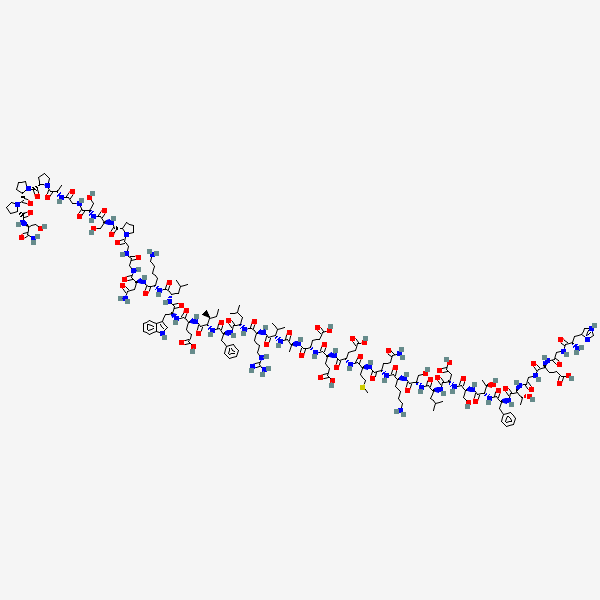
- Molecular formula
- C184H282N50O60S
- Molecular weight
- 4187 g/mol
- IUPAC name
- (4S)-5-[[2-[[(2S,3R)-1-[[(2S)-1-[[(2S,3R)-1-[[(2S)-1-[[(2S)-1-[[(2S)-1-[[(2S)-1-[[(2S)-6-amino-1-[[(2S)-5-amino-1-[[(2S)-1-[[(2S)-1-[[(2S)-1-[[(2S)-1-[[(2S)-1-[[(2S)-1-[[(2S)-1-[[(2S)-1-[[(2S)-1-[[(2S,3S)-1-[[(2S)-1-[[(2S)-1-[[(2S)-1-[[(2S)-6-amino-1-[[(2S)-4-amino-1-[[2-[[2-[(2S)-2-[[(2S)-1-[[(2S)-1-[[2-[[(2S)-1-[(2S)-2-[(2S)-2-[(2S)-2-[[(2S)-1-amino-3-hydroxy-1-oxopropan-2-yl]carbamoyl]pyrrolidine-1-carbonyl]pyrrolidine-1-carbonyl]pyrrolidin-1-yl]-1-oxopropan-2-yl]amino]-2-oxoethyl]amino]-3-hydroxy-1-oxopropan-2-yl]amino]-3-hydroxy-1-oxopropan-2-yl]carbamoyl]pyrrolidin-1-yl]-2-oxoethyl]amino]-2-oxoethyl]amino]-1,4-dioxobutan-2-yl]amino]-1-oxohexan-2-yl]amino]-4-methyl-1-oxopentan-2-yl]amino]-3-(1H-indol-3-yl)-1-oxopropan-2-yl]amino]-4-carboxy-1-oxobutan-2-yl]amino]-3-methyl-1-oxopentan-2-yl]amino]-1-oxo-3-phenylpropan-2-yl]amino]-4-methyl-1-oxopentan-2-yl]amino]-5-carbamimidamido-1-oxopentan-2-yl]amino]-3-methyl-1-oxobutan-2-yl]amino]-1-oxopropan-2-yl]amino]-4-carboxy-1-oxobutan-2-yl]amino]-4-carboxy-1-oxobutan-2-yl]amino]-4-carboxy-1-oxobutan-2-yl]amino]-4-methylsulfanyl-1-oxobutan-2-yl]amino]-1,5-dioxopentan-2-yl]amino]-1-oxohexan-2-yl]amino]-3-hydroxy-1-oxopropan-2-yl]amino]-4-methyl-1-oxopentan-2-yl]amino]-3-carboxy-1-oxopropan-2-yl]amino]-3-hydroxy-1-oxopropan-2-yl]amino]-3-hydroxy-1-oxobutan-2-yl]amino]-1-oxo-3-phenylpropan-2-yl]amino]-3-hydroxy-1-oxobutan-2-yl]amino]-2-oxoethyl]amino]-4-[[2-[[(2S)-2-amino-3-(1H-imidazol-4-yl)propanoyl]amino]acetyl]amino]-5-oxopentanoic acid
Verified external records:
References
- 1.Exenatide (Byetta, Bydureon) — FDA prescribing information (DailyMed)
- 2.Exenatide — indexed research (PubMed, National Library of Medicine)
- 3.Exenatide — registered clinical studies (ClinicalTrials.gov)
- 4.Expression of concern: once-weekly exenatide in Parkinson's disease — The Lancet
- 5.Drugs@FDA — exenatide approval history
More on Exenatide
Everything else we've written about Exenatide — what the community reports, the explainers that cover it, and the terms it keeps running into.
- Exenatide Reddit: Byetta Results & Side EffectsOn Reddit
- Peptide Drugs From Venom: Lizards to SnailsExplainer
- Peptide Immunogenicity: Antibodies to PeptidesExplainer
- Depot injectionGlossary
- ClearanceGlossary