Also known as: IBI362 · LY3305677 · IBI-362 · LY-3305677
Human RCTHelped
On this page
- What is mazdutide?
- How does mazdutide work?
- What does the research show?
- What else is mazdutide being studied for?
- Is mazdutide safe? Side effects
- FDA & legal status (2026)
- How is mazdutide dosed in studies?
- Mazdutide vs semaglutide and tirzepatide
- Frequently asked questions
- Who is mazdutide for — and who should be cautious?
- Evidence by outcome
- FDA & legal status
- Registered clinical trials
- Reported side effects
- Chemical identifiers
- References
- Related compounds
- More on Mazdutide
Mazdutide is a once-weekly injectable peptide that switches on two gut-hormone receptors at once — GLP-1 and glucagon — and in completed Phase 3 human trials it lowered body weight and improved blood-sugar control. Mazdutide is approved in China for weight management but is not FDA-approved in the United States.
What is mazdutide?
Mazdutide is a lab-made peptide drug, originally coded IBI362 (and LY3305677), built as a synthetic analog of oxyntomodulin — a natural gut hormone your body releases after a meal. Where the popular weight-loss drug semaglutide hits a single receptor (GLP-1), mazdutide is a dual agonist: it activates the GLP-1 receptor and the glucagon receptor. It is developed by Innovent Biologics in China (licensed from Eli Lilly) and given as a once-weekly injection under the skin. Chemically it is a large peptide (molecular formula C207H317N45O65, molecular weight ≈ 4,476), which is why it has to be injected rather than swallowed.
How does mazdutide work?
Mazdutide works by pressing two hormonal buttons at the same time. The GLP-1 button is the familiar one from Ozempic-style drugs: it quiets appetite, slows how fast the stomach empties, and nudges the pancreas to release insulin when blood sugar is high — so you feel full sooner and eat less. The glucagon button is the twist. Glucagon is best known for raising blood sugar, but it also appears to increase the rate at which the body burns energy and to help the liver clear stored fat. Think of GLP-1 as turning down how much fuel goes in, and the glucagon arm as turning up how much fuel gets spent. Pairing them is the whole design idea behind mazdutide, and it’s why researchers are also testing it in fatty-liver disease, not just weight (mazdutide research index, PubMed). The GLP-1 side is well understood; the exact size of the glucagon contribution in humans is still being worked out.
What does the research show?
Mazdutide sits in the strongest evidence tier on this site: Human RCT. Unlike most research peptides — which live on rat studies and forum posts — mazdutide has run through multiple randomized, placebo-controlled Phase 3 human trials, and China’s National Medical Products Administration approved it for chronic weight management in 2025 on the strength of that program. The two best-supported uses are weight loss and type 2 diabetes.
For weight loss, mazdutide completed a randomized, placebo-controlled Phase 3 trial in adults with obesity or overweight (NCT05607680), plus a dedicated higher-dose (9 mg) obesity study (NCT06164873). The China approval for weight management is the regulator’s read that those results were strong enough to market. Verdict: helped — this is genuine human RCT evidence for the headline use.
For type 2 diabetes, mazdutide finished Phase 3 diabetes trials (NCT05606913; NCT05628311) and a head-to-head Phase 3 comparison against semaglutide in Chinese adults with early type 2 diabetes and obesity (NCT06184568). The registered endpoints were the ones that matter for diabetes — HbA1c (a three-month blood-sugar average) and body weight. China’s NMPA approved mazdutide for glycemic control in adults with type 2 diabetes in September 2025, after approving the weight indication in June 2025 (Innovent announcement). How we grade this is explained on our evidence-grading methodology page.
One honest caveat on the whole record: mazdutide’s pivotal trials were run largely in Chinese populations by its developer, Innovent. That is normal for a China-first drug, but it means the funding is industry-linked and the results still need to be read alongside data from broader populations as the global program (run by Eli Lilly) reports out.
What else is mazdutide being studied for?
Mazdutide is being tested well beyond weight and diabetes, though these newer uses are early — most are trials that are running but have not reported results, so treat them as open questions, not answers. Registered mazdutide studies include metabolic-associated fatty liver disease and MASH (NCT06884293; NCT06937749), obstructive sleep apnea with obesity (NCT06931028), heart failure with preserved ejection fraction (NCT06862908), and — through Eli Lilly in the US — alcohol use disorder (NCT06817356). There are also studies in adolescents (NCT07255209) and polycystic ovary syndrome (NCT06519656). The fatty-liver angle is the most mechanistically interesting, because the glucagon arm is exactly the part expected to act on the liver — but until these trials read out, that’s a reasonable hypothesis, not a proven benefit.
Is mazdutide safe? Side effects
Mazdutide’s most common side effects are gastrointestinal, and they will be familiar to anyone who has read about GLP-1 drugs: nausea, diarrhea, vomiting, reduced appetite and constipation. In trials these were mostly mild to moderate and tended to ease as the body adjusted, which is why doses are stepped up slowly rather than started high. Because mazdutide also activates the glucagon receptor — the one that can raise blood sugar and heart rate — that arm is watched closely in trials; so far the diabetes results point to net blood-sugar lowering, but this is a real reason the drug is studied under medical supervision rather than self-experimented with. The bigger-picture honesty: mazdutide’s long-term safety record is still short, and most of its safety data comes from Chinese trial populations, so effects over many years and across broader groups are still being established (mazdutide safety literature, PubMed). As a class, GLP-1-based drugs also carry a rodent-derived thyroid-tumor caution and warnings around pancreatitis; whether every class concern applies to mazdutide specifically is something its own trial safety data will settle.
FDA & legal status (2026)
Mazdutide is not FDA-approved in the United States as of 2026. In the US it is an investigational drug — legal to study in registered clinical trials (Eli Lilly runs several, including obesity and alcohol use disorder), but not approved to prescribe, not a dietary supplement, and not something sold as an approved medicine (Drugs@FDA; US trials, ClinicalTrials.gov). The picture is different abroad: China’s NMPA approved mazdutide for chronic weight management in June 2025 (developed there by Innovent Biologics), and approved it for glycemic control in adults with type 2 diabetes that September (Innovent announcement). So mazdutide is an approved medicine in one major market and an investigational one in the US — an unusual split worth keeping straight. This status is in motion; re-check it, because the US program and additional Chinese indications are both advancing.
How is mazdutide dosed in studies?
Mazdutide is dosed as a once-weekly subcutaneous injection, and the doses named in its trials are informational — this is a prescription/investigational drug titrated under medical supervision, not a self-directed protocol. Registered mazdutide studies have tested fixed strengths such as 9 mg for weight management (NCT06164873) and up to 15 mg in tolerability work (NCT07000955), with doses started low and increased in steps to blunt the early nausea. Because mazdutide is delivered as a manufactured pen rather than a lyophilized research vial, the do-it-yourself reconstitution math that applies to gray-market peptides doesn’t apply here — there’s no mixing step for a patient to get wrong. We note the reported research doses only so you can read the trial literature; none of this is a recommendation to obtain or self-administer it.
Mazdutide vs semaglutide and tirzepatide
Mazdutide, semaglutide and tirzepatide are all injectable incretin drugs, but they pull different combinations of levers. Semaglutide (Ozempic/Wegovy) is a single GLP-1 agonist. Tirzepatide (Mounjaro/Zepbound) is a GLP-1 plus GIP dual agonist. Mazdutide is the odd one out — GLP-1 plus glucagon — which is why it draws extra interest for liver fat and energy expenditure rather than only appetite. A key practical difference in 2026: semaglutide and tirzepatide are FDA-approved and widely prescribed in the US, while mazdutide is approved only in China and still investigational here. Mazdutide ran a direct Phase 3 head-to-head against semaglutide in China (NCT06184568). For the fuller approved-drug comparison, see semaglutide vs tirzepatide, and the GLP-1 & metabolic peptides hub for the whole category.
Frequently asked questions
Does mazdutide actually work for weight loss?
Yes, in the sense that matters most: mazdutide cleared randomized, placebo-controlled Phase 3 human trials for weight management and was approved for that use in China. That is far stronger evidence than most peptides discussed online can claim. The fair caveats are that the pivotal data came largely from Chinese trial populations and from the drug’s own developer, and long-term outcomes are still accruing.
Is mazdutide legal in the US?
Mazdutide is not FDA-approved and cannot be legally prescribed or sold as a medicine in the United States. It is legal to study in registered clinical trials, where Eli Lilly is running the US program. It is not a dietary supplement, and anything marketed to US consumers as “mazdutide” is outside the approved-drug system.
Is mazdutide the same as semaglutide?
No. Semaglutide activates one receptor (GLP-1); mazdutide activates two (GLP-1 and glucagon). They are different molecules with different mechanisms. Mazdutide’s glucagon arm is the main reason it’s also being investigated for fatty-liver disease.
Is mazdutide banned in sport?
Mazdutide is not a classic performance-enhancing drug, and GLP-1/glucagon agonists are not named on the current WADA Prohibited List. That said, WADA’s list changes yearly and includes catch-all categories, so any competing athlete should check the current list and consult their anti-doping authority rather than rely on a general statement.
How is mazdutide taken?
Mazdutide is given as a once-weekly injection under the skin, with the dose increased gradually over weeks to reduce nausea. In its approved market it is a prescription medicine used under medical supervision.
Who is mazdutide for — and who should be cautious?
Mazdutide is aimed at the same audience as the other incretin drugs: adults dealing with obesity, stubborn weight, or type 2 diabetes who want to understand a newer option before it reaches their market. The honest framing is that mazdutide is one of the few compounds on this site with real Human RCT evidence and an actual regulatory approval behind it — a very different footing from a research-only peptide. But that approval is in China, not the US; the long-term and broad-population safety record is still short; and in the United States mazdutide is investigational, meaning the only legitimate access is a clinical trial. Anyone tempted to source it outside that system is buying an unapproved drug with all the purity and dosing risks that implies. If you’re in the US and interested, the grown-up move is to watch the Eli Lilly trial program and the FDA pipeline rather than chase a gray-market vial.
Evidence by outcome
Each outcome Mazdutide has been studied for, with the honest evidence grade and what the studies actually found. A tier never stands alone — the verdict rides with it.
| Outcome | Evidence | What was found |
|---|---|---|
| Weight loss (obesity / overweight) | Human RCTHelped | Mazdutide has completed multiple randomized, placebo-controlled Phase 3 trials in adults with obesity or overweight, and China's drug regulator approved it for chronic weight management on the strength of that program. This is the headline, most-studied use — real human RCT evidence, not animal or anecdotal. |
| Type 2 diabetes (blood-sugar control) | Human RCTHelped | Mazdutide has also completed randomized Phase 3 trials in adults with type 2 diabetes, including a head-to-head study against semaglutide. The registered endpoints centered on blood-sugar (HbA1c) reduction and weight; China's drug regulator approved it for glycemic control in adults with type 2 diabetes in 2025. |
FDA & legal status
- United States: investigational (as of Jul 2026)
Mazdutide is not FDA-approved in the United States. It is an investigational drug being studied by Eli Lilly in registered US clinical trials (for example, obesity and alcohol use disorder). It is not a dietary supplement and is not sold as an approved medicine here. Re-verify status, as trials are ongoing.
openFDA Drugs@FDA lists no approved product for mazdutide as of 2026-07-15.
Registered clinical trials
43 registered studies mention Mazdutide on ClinicalTrials.gov (latest update 2026-10-22). A registered trial means a study is planned or underway — not that Mazdutide is approved or proven.
Reported side effects
| Effect | Frequency | Severity |
|---|---|---|
| Nausea | Common (typical of GLP-1-based drugs; usually mild-moderate, dose-related) | — |
| Diarrhea | Common | — |
| Vomiting | Common | — |
| Decreased appetite | Common (and part of how the drug works) | — |
| Constipation | Reported | — |
Chemical identifiers
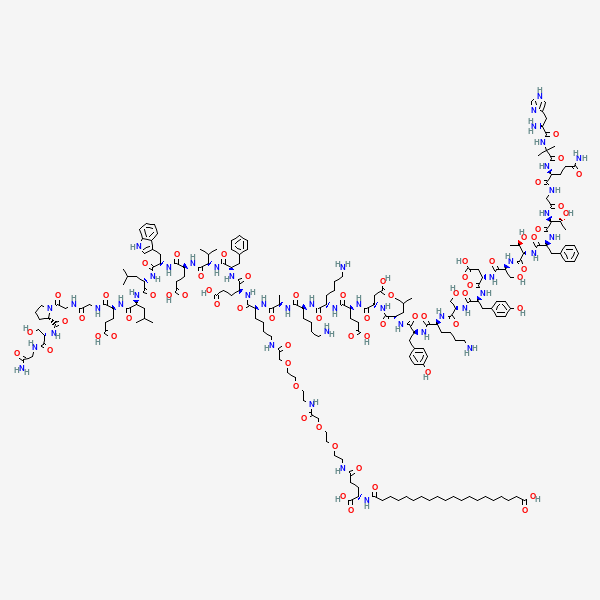
- Molecular formula
- C207H317N45O65
- Molecular weight
- 4476 g/mol
- IUPAC name
- 20-[[(1S)-4-[2-[2-[2-[2-[2-[2-[[(5S)-5-[[(2S)-2-[[(2S)-6-amino-2-[[(2S)-6-amino-2-[[(2S)-2-[[(2S)-2-[[(2S)-2-[[(2S)-2-[[(2S)-6-amino-2-[[(2S)-2-[[(2S)-2-[[(2S)-2-[[(2S)-2-[[(2S,3R)-2-[[(2S)-2-[[(2S,3R)-2-[[2-[[(2S)-5-amino-2-[[2-[[(2S)-2-amino-3-(1H-imidazol-4-yl)propanoyl]amino]-2-methylpropanoyl]amino]-5-oxopentanoyl]amino]acetyl]amino]-3-hydroxybutanoyl]amino]-3-phenylpropanoyl]amino]-3-hydroxybutanoyl]amino]-3-hydroxypropanoyl]amino]-3-carboxypropanoyl]amino]-3-(4-hydroxyphenyl)propanoyl]amino]-3-hydroxypropanoyl]amino]hexanoyl]amino]-3-(4-hydroxyphenyl)propanoyl]amino]-4-methylpentanoyl]amino]-3-carboxypropanoyl]amino]-4-carboxybutanoyl]amino]hexanoyl]amino]hexanoyl]amino]propanoyl]amino]-6-[[(2S)-1-[[(2S)-1-[[(2S)-1-[[(2S)-1-[[(2S)-1-[[(2S)-1-[[(2S)-1-[[(2S)-1-[[2-[[2-[(2S)-2-[[(2S)-1-[(2-amino-2-oxoethyl)amino]-3-hydroxy-1-oxopropan-2-yl]carbamoyl]pyrrolidin-1-yl]-2-oxoethyl]amino]-2-oxoethyl]amino]-4-carboxy-1-oxobutan-2-yl]amino]-4-methyl-1-oxopentan-2-yl]amino]-4-methyl-1-oxopentan-2-yl]amino]-3-(1H-indol-3-yl)-1-oxopropan-2-yl]amino]-4-carboxy-1-oxobutan-2-yl]amino]-3-methyl-1-oxobutan-2-yl]amino]-1-oxo-3-phenylpropan-2-yl]amino]-4-carboxy-1-oxobutan-2-yl]amino]-6-oxohexyl]amino]-2-oxoethoxy]ethoxy]ethylamino]-2-oxoethoxy]ethoxy]ethylamino]-1-carboxy-4-oxobutyl]amino]-20-oxoicosanoic acid
Verified external records:
References
- 1.Mazdutide — indexed research (PubMed, National Library of Medicine)
- 2.Mazdutide — registered clinical studies (ClinicalTrials.gov)
- 3.Phase 3 study of mazdutide (IBI362) in obesity or overweight (NCT05607680)
- 4.Phase 3 study of mazdutide (IBI362) in type 2 diabetes (NCT05606913)
- 5.Phase 3 mazdutide (IBI362) vs semaglutide in type 2 diabetes and obesity (NCT06184568)
- 6.FDA — Drugs@FDA approvals database (mazdutide not FDA-approved)
- 7.Innovent Announces Mazdutide Received Approval from China's NMPA for Glycemic Control in Adults with Type 2 Diabetes
More on Mazdutide
Everything else we've written about Mazdutide — what the community reports, the explainers that cover it, and the terms it keeps running into.