Also known as: Afamelanotide · Melanotan-1 · MT-1 · [Nle4, D-Phe7]-α-MSH · NDP-MSH · CUV1647
Human RCTHelped
On this page
- What is Melanotan I?
- How does Melanotan I work?
- What does the research show?
- Melanotan I vs Melanotan II
- Is Melanotan I safe? Side effects
- FDA & legal status (2026)
- How is Melanotan I used?
- Frequently asked questions
- Who is Melanotan I for — and who should be cautious?
- Evidence by outcome
- FDA & legal status
- Registered clinical trials
- Reported side effects
- Chemical identifiers
- References
- Related compounds
- More on Melanotan I
Melanotan I — the drug name is afamelanotide, sold as the prescription implant SCENESSE — is a synthetic copy of the body’s own tanning hormone (α-MSH) that makes skin produce more protective pigment. Unusually for a research peptide, it is FDA-approved (since 2019) for a rare light-sensitivity disease, and that approval rests on real human randomized trials.
What is Melanotan I?
Melanotan I is a lab-made, 13-amino-acid analog of alpha-melanocyte-stimulating hormone (α-MSH), the natural signal that tells your skin to tan. Its official drug name is afamelanotide, and its formula is C78H111N21O19 (molecular weight ~1,647). Chemists tweaked two spots on the natural hormone — swapping in a norleucine and a D-phenylalanine ([Nle4, D-Phe7]-α-MSH) — which makes Melanotan I far more stable and longer-acting than the fleeting natural version. It exists in two very different forms that people constantly mix up: the FDA-approved SCENESSE implant a doctor places under the skin, and a gray-market powder (“Melanotan 1”) sold online for people to reconstitute and inject themselves. Same molecule, completely different levels of oversight. Melanotan I sits in the melanocortin family of peptides.
How does Melanotan I work?
Melanotan I works by switching on one specific receptor — the melanocortin-1 receptor (MC1R) — that sits on the pigment-making cells (melanocytes) in your skin. Think of MC1R as the light switch for your tan: normally sunlight flips it, but Melanotan I flips it directly, no sun required. When MC1R turns on, melanocytes ramp up production of eumelanin, the dark brown-black pigment that both colors skin and absorbs UV like a built-in sunscreen. That is why the same drug produces two linked effects — visible tanning and genuine UV shielding. In people with erythropoietic protoporphyria, whose skin reacts painfully to light, that extra eumelanin buys pain-free time in daylight (FDA / SCENESSE label). Melanotan I is fairly selective for MC1R, which is what separates it from its cousin Melanotan II (more on that below).
What does the research show?
Melanotan I is one of the very few compounds on this site with human randomized-trial evidence behind its headline use. For erythropoietic protoporphyria (EPP), two multicenter, randomized, double-blind, placebo-controlled trials (74 patients in the EU, 94 in the US) tested the 16 mg implant every 60 days and found patients on afamelanotide spent more pain-free time in direct sunlight than those on placebo (Langendonk et al., NEJM 2015). A long-term observational study of 115 EPP patients backed up that the benefit and tolerability held over years of repeated dosing (Biolcati et al., 2015). Beyond EPP, the evidence steps down a tier: in vitiligo, controlled trials adding afamelanotide to narrow-band UVB phototherapy produced faster repigmentation at some sites, but the effect was uneven and it is not approved for that use. For plain cosmetic tanning, the pigment effect is real and measured in humans — but “it definitely tans you” is not the same claim as “it’s a safe way to tan,” and no trial has shown a Melanotan-I tan lowers skin-cancer risk. The full trial registry and our evidence-grading method explain how we separate those tiers.
Melanotan I vs Melanotan II
Melanotan I and Melanotan II are different molecules, and the difference matters more than the near-identical names suggest. Melanotan I (afamelanotide) is a linear peptide that is fairly selective for the MC1R pigment receptor — so its main job is tanning and photoprotection, and it’s the one that became an approved drug. Melanotan II is a smaller cyclic peptide that hits a broader set of melanocortin receptors, which is why it also drives the libido and appetite-suppressing effects (and more nausea and flushing) that Melanotan I largely doesn’t. In short: if someone is chasing the sexual-response effect, they’re usually talking about Melanotan II or PT-141/bremelanotide; if the goal is purely pigment, Melanotan I is the cleaner, better-studied MC1R tool. Neither gray-market powder is an approved product for tanning.
Is Melanotan I safe? Side effects
Melanotan I has a real human safety record — a genuine advantage over most research peptides — but it is not side-effect-free. In the approved-drug trials, the effects reported most were nausea, headache, fatigue, and skin darkening, most of them mild and short-lived (SCENESSE label, DailyMed). The one that deserves real attention is pigment-specific: Melanotan I darkens existing moles and can create new freckling, which is why the drug label tells prescribers to do full-body skin exams roughly twice a year. A darkening mole can either be harmless or be the earliest sign of a melanoma, and you do not want a tanning peptide masking that signal — this is the single most important safety point on the page. The gray-market powder adds a second, separate risk that has nothing to do with the molecule and everything to do with the supply chain: unregulated “research” vials vary in purity, dose accuracy, and sterility from vendor to vendor.
FDA & legal status (2026)
Melanotan I is unusual: it is FDA-approved, but only in one tightly-defined form. The FDA approved SCENESSE (afamelanotide) on October 8, 2019 as a 16 mg implant placed under the skin every two months, to increase pain-free light exposure in adults with EPP — the first-ever approved EPP treatment (Drugs@FDA, NDA 210797). That approval covers the prescription implant for that disease and nothing else. The powdered “Melanotan 1” sold online for self-injection is the same molecule but not the approved product — it’s not a supplement and not cleared for human use, and it’s marketed “for research use only.” Afamelanotide is also approved for EPP in the EU (2014) and Australia. The dated, jurisdiction-by-jurisdiction breakdown is in the status block below; treat any regulatory claim as dated and re-check it.
How is Melanotan I used?
In its approved form, Melanotan I isn’t self-administered at all: a clinician inserts the 16 mg SCENESSE implant under the skin above the hip every two months, and the pigment builds over the following days. The gray-market powder is a different story — it’s sold lyophilized (freeze-dried) and reconstituted with bacteriostatic water before subcutaneous injection, with community “tanning” doses far smaller than the implant and paired with brief sun exposure. We present that as information, not a protocol: the doses people report online are not clinically validated, and the mole risk above applies fully. If you’re working out concentrations from a research vial, the arithmetic lives in our reconstitution & dosing calculator, and whether it can share a syringe with anything else is covered in the mixing compatibility reference — where, for most melanocortin combinations, the honest answer is “not enough data.”
Frequently asked questions
Is Melanotan I FDA-approved?
Yes — but with a big caveat. The SCENESSE implant (afamelanotide) is FDA-approved for one rare disease, erythropoietic protoporphyria, and is prescription-only. The “Melanotan 1” powder people buy online to inject for a tan is the same molecule but is not the approved product and is sold only “for research use only.”
Does Melanotan I actually work for tanning?
Melanotan I reliably darkens skin — that’s a documented pharmacodynamic effect in humans, because increasing eumelanin is literally its mechanism. What’s not proven is that a Melanotan-I tan is safe as a cosmetic habit or that it protects against skin cancer. A darker tan is not evidence of protection.
Is Melanotan I the same as the sex-drive peptide?
No. That’s usually Melanotan II or PT-141 (bremelanotide), which hit a broader set of melanocortin receptors. Melanotan I is more selective for the MC1R pigment receptor, so it mainly tans and photoprotects without the strong libido effect.
What are the main risks of Melanotan I?
The most important is that it darkens existing moles and can create new ones, which can mask an early melanoma — the drug label recommends twice-yearly full-body skin exams. Nausea, headache and fatigue are the common milder effects. Gray-market powder adds purity and sterility risks the approved implant doesn’t have.
Is Melanotan I banned in sport?
Melanotan I’s status under WADA rules isn’t something we can state with a citable source, so we don’t claim one — check current WADA and USADA guidance directly if you’re a tested athlete. It is not a conventional performance-enhancing drug.
Who is Melanotan I for — and who should be cautious?
Melanotan I draws two very different crowds: EPP patients, for whom the approved implant is a genuine, trial-backed relief from a painful disease; and pale-skinned people who’ve read that a peptide can give them a tan without hours in the sun. The honest framing is that the science is strongest exactly where the drug is approved — photoprotection in EPP — and gets thinner as you move toward pure cosmetic tanning. Anyone with lots of moles or atypical moles, a personal or family history of skin cancer, or an unwillingness to commit to regular skin checks has real reason to be cautious, because the one effect Melanotan I guarantees is more pigment — including in moles you’d want a dermatologist watching closely.
Evidence by outcome
Each outcome Melanotan I has been studied for, with the honest evidence grade and what the studies actually found. A tier never stands alone — the verdict rides with it.
| Outcome | Evidence | What was found |
|---|---|---|
| Photoprotection in erythropoietic protoporphyria (EPP) | Human RCTHelped | Two multicenter, randomized, double-blind, placebo-controlled trials (EU n=74, US n=94) of the 16 mg implant found EPP patients on afamelanotide spent more pain-free time in daylight than those on placebo. This is the basis for the 2019 FDA approval — the headline use is human-RCT-backed. |
| Repigmentation in vitiligo (with NB-UVB) | Human (controlled)Mixed | In controlled human trials, adding afamelanotide to narrow-band UVB phototherapy produced faster and more complete repigmentation than NB-UVB alone at some body sites — an encouraging signal, but the effect was uneven and afamelanotide is not FDA-approved for vitiligo. |
| Skin tanning (cosmetic pigmentation) | Human (controlled)Helped | That afamelanotide darkens human skin is not in doubt — measured melanin density rises in controlled studies, which is exactly how it protects EPP skin. What is not established is that a Melanotan-I tan is safe long-term as a cosmetic, or that it lowers skin-cancer risk; darker skin is not proof of protection. |
FDA & legal status
- United States: fda approved (as of Jul 2026) — approved for Erythropoietic protoporphyria (EPP) — increasing pain-free light exposure in adults (SCENESSE 16 mg implant)
The FDA approved SCENESSE (afamelanotide) on October 8, 2019 as a 16 mg bioresorbable implant placed under the skin every 2 months — the first FDA-approved treatment for EPP. That approval covers the prescription implant only. The powdered "Melanotan 1" sold online for reconstitution and injection is the same molecule but is not the approved product, not a supplement, and is sold "for research use only." Afamelanotide is also approved in the EU (since 2014) and Australia for EPP.
openFDA Drugs@FDA lists 1 approved product as of 2026-07-15.
Registered clinical trials
23 registered studies mention Melanotan I on ClinicalTrials.gov (latest update 2026-07-27). A registered trial means a study is planned or underway — not that Melanotan I is approved or proven.
Reported side effects
| Effect | Frequency | Severity |
|---|---|---|
| Nausea | Common in trials | Usually mild and short-lived |
| Headache | Common in trials | Usually mild |
| Fatigue / drowsiness | Reported in trials | — |
| Skin hyperpigmentation, new freckling, and darkening of existing moles | — | Prompts the label's twice-yearly full-body skin-exam recommendation |
| Implant-site reactions (for the SCENESSE subcutaneous implant) | Reported in trials | — |
| Dizziness | Reported in trials | — |
Chemical identifiers
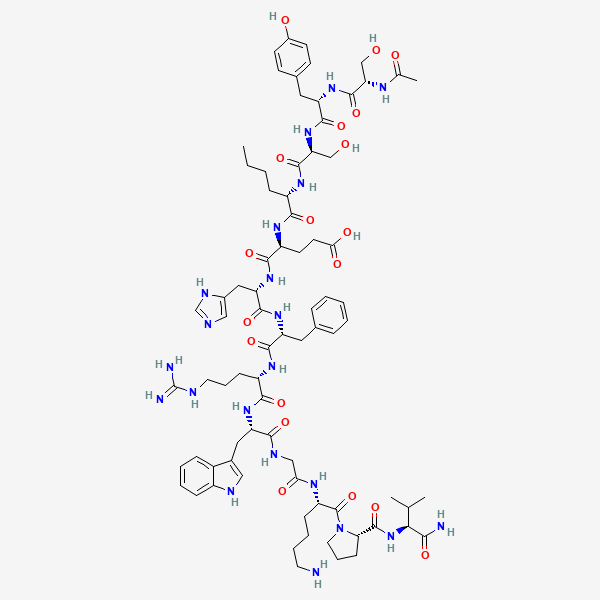
- Molecular formula
- C78H111N21O19
- Molecular weight
- 1646.8 g/mol
- IUPAC name
- (4S)-4-[[(2S)-2-[[(2S)-2-[[(2S)-2-[[(2S)-2-acetamido-3-hydroxypropanoyl]amino]-3-(4-hydroxyphenyl)propanoyl]amino]-3-hydroxypropanoyl]amino]hexanoyl]amino]-5-[[(2S)-1-[[(2R)-1-[[(2S)-1-[[(2S)-1-[[2-[[(2S)-6-amino-1-[(2S)-2-[[(2S)-1-amino-3-methyl-1-oxobutan-2-yl]carbamoyl]pyrrolidin-1-yl]-1-oxohexan-2-yl]amino]-2-oxoethyl]amino]-3-(1H-indol-3-yl)-1-oxopropan-2-yl]amino]-5-carbamimidamido-1-oxopentan-2-yl]amino]-1-oxo-3-phenylpropan-2-yl]amino]-3-(1H-imidazol-5-yl)-1-oxopropan-2-yl]amino]-5-oxopentanoic acid
Verified external records:
References
- 1.Langendonk et al. — Afamelanotide for Erythropoietic Protoporphyria (NEJM, 2015; PMID 26132941)
- 2.Drugs@FDA — SCENESSE (afamelanotide) implant, NDA 210797
- 3.SCENESSE (afamelanotide) prescribing information — DailyMed
- 4.Afamelanotide — registered clinical studies (ClinicalTrials.gov)
- 5.Biolcati et al. — Long-term observational study of afamelanotide in 115 EPP patients (PMID 25494545)
More on Melanotan I
Everything else we've written about Melanotan I — what the community reports, the explainers that cover it, and the terms it keeps running into.