Also known as: IMCIVREE · RM-493 · BIM-22493 · IRC-022493
Human RCTHelped
On this page
- What is setmelanotide?
- How does setmelanotide work?
- What does the research show?
- Is setmelanotide safe? Side effects
- FDA & legal status (2026)
- How is setmelanotide used?
- Setmelanotide vs the GLP-1 weight-loss drugs
- Frequently asked questions
- Who is setmelanotide for — and who isn’t it for?
- Evidence by outcome
- FDA & legal status
- Registered clinical trials
- Reported side effects
- Chemical identifiers
- References
- Related compounds
- More on Setmelanotide
Setmelanotide (brand name IMCIVREE) is an FDA-approved, once-daily injectable peptide that switches the brain’s hunger-control MC4R receptor back on. Setmelanotide is approved for a handful of rare genetic obesity disorders — where it produces real, human-trial weight loss and quiets relentless hunger — and it is not a general-purpose weight-loss drug for common obesity.
If you or someone in your family lives with obesity that started in early childhood and comes with a hunger that never switches off — the kind no diet touches — you may have run into setmelanotide as the first drug built for exactly that problem. Here’s what setmelanotide is, how it works, how strong the evidence is, and the honest risks, in plain English.
What is setmelanotide?
Setmelanotide is a small, lab-made peptide — a cyclic ring of 8 amino acids, formula C49H68N18O9S2, weighing about 1,117 daltons — designed to copy the body’s natural appetite-suppressing signal, α-MSH. Developed under the code RM-493 and sold by Rhythm Pharmaceuticals as IMCIVREE, setmelanotide is a fully approved prescription medicine, not a research chemical. What makes setmelanotide unusual is how narrow its job is: it was built to fix one specific broken circuit in the brain’s hunger-control system, and it is approved only for the rare genetic conditions where that circuit is the problem (DailyMed prescribing information).
How does setmelanotide work?
Setmelanotide works by turning on the melanocortin-4 receptor (MC4R), a switch deep in the hypothalamus that tells your body when to stop eating and how much energy to burn. Think of the hunger system as a relay race: leptin from your fat cells hands the baton to POMC neurons, which hand it to MC4R, which finally delivers the “you’re full” message. In conditions like POMC, PCSK1 or leptin-receptor (LEPR) deficiency, one of the earlier runners drops the baton, so the full signal never arrives and hunger stays switched on. Setmelanotide skips the broken hand-off and presses the MC4R button directly — restoring the satiety message from downstream of the defect. The same drug also lightly activates a cousin receptor, MC1R, which controls skin pigment; that off-target nudge is why setmelanotide can darken skin and moles (DailyMed).
What does the research show?
Setmelanotide is backed by genuine human randomized-controlled-trial evidence — a rarity on this site, and the strongest tier we grade — but that evidence is specific to rare genetic obesity, not obesity in general. Its FDA approval rests on two pivotal Phase 3 trials, one in POMC/PCSK1 deficiency (NCT02896192) and one in leptin-receptor deficiency (NCT03287960). Both used an open-label run-in followed by a randomized, placebo-controlled withdrawal period, and most participants lost roughly 10% or more of their body weight over about a year while their hunger scores fell. A separate randomized, placebo-controlled trial in Bardet-Biedl syndrome (NCT03746522) supported the 2022 expansion of setmelanotide’s approval to that condition. The honest boundary: in earlier studies of everyday, polygenic obesity, setmelanotide moved the scale only modestly — the whole reason it is aimed at broken genetics rather than at obesity across the board. Its wider research record, including trials now running in hypothalamic obesity and Prader-Willi syndrome, is indexed on PubMed.
Is setmelanotide safe? Side effects
Setmelanotide has real human safety data behind it, and its most common problems are manageable but worth knowing. In trials, the frequent complaints with setmelanotide were injection-site reactions, nausea, headache, and — distinctively — skin darkening, including the darkening of pre-existing moles, because the drug also touches the pigment receptor MC1R. That is why the label calls for a full skin exam before and during treatment. Setmelanotide also carries labeled warnings for spontaneous erections in males and changes in sexual arousal (both melanocortin effects), and for new or worsening depression and suicidal thoughts, which prescribers are told to monitor. Because setmelanotide is a real prescription drug, these risks come with dosing guidance and physician oversight — the opposite of the unregulated research-peptide situation (DailyMed prescribing information).
FDA & legal status (2026)
Setmelanotide is FDA-approved and legal as a prescription medicine. It is sold as IMCIVREE by Rhythm Pharmaceuticals under NDA 213793, first approved in 2020 for chronic weight management in obesity caused by POMC, PCSK1 or LEPR deficiency (confirmed by genetic testing), and expanded in 2022 to Bardet-Biedl syndrome. In plain terms: setmelanotide is a genuine, quality-controlled drug you get from a pharmacy with a prescription and a confirmed diagnosis — not a gray-market peptide. Anything sold online as “research setmelanotide” for general weight loss is neither the approved product nor an approved use. The full dated breakdown is in the FDA & legal status block above (Drugs@FDA record, NDA 213793).
How is setmelanotide used?
Setmelanotide is used as a once-daily subcutaneous injection, prescribed and dose-titrated by a physician — this section is information about how the approved drug is used, not a protocol to copy. Unlike the freeze-dried research peptides covered elsewhere on this site, setmelanotide (IMCIVREE) comes as a ready-to-use solution, so there is no mixing or reconstitution step. The label describes a gradual titration schedule, with the dose adjusted for age and response and injections rotated between sites; the specifics belong to a prescriber who has confirmed the underlying genetic diagnosis (DailyMed prescribing information).
Setmelanotide vs the GLP-1 weight-loss drugs
Setmelanotide and the GLP-1 drugs both cause weight loss, but they solve different problems and are not interchangeable. Setmelanotide is a precision drug for a small group of people whose MC4R hunger circuit is genetically broken, and it barely moves the needle in common obesity. The GLP-1 and dual/triple agonists — semaglutide, tirzepatide and the investigational retatrutide — work through the gut-hormone system and produce large weight loss in ordinary, polygenic obesity, where setmelanotide does not. If you are researching obesity drugs and don’t have one of the rare diagnoses, setmelanotide is almost certainly not the compound you’re looking for; those GLP-1 pages are. You can see how the whole melanocortin family fits together on the melanocortin peptides hub.
Frequently asked questions
Does setmelanotide work for regular weight loss?
Not meaningfully. Setmelanotide is approved and effective for obesity caused by specific broken genes in the MC4R pathway, where its Phase 3 trials showed real weight loss. In common, non-genetic obesity, earlier human studies found only modest effects — which is exactly why it isn’t approved or marketed for general weight loss.
Is setmelanotide FDA-approved?
Yes. Setmelanotide is FDA-approved as IMCIVREE (Rhythm Pharmaceuticals, NDA 213793) — first in 2020 for POMC, PCSK1 or LEPR deficiency obesity, then in 2022 for Bardet-Biedl syndrome. It is a prescription drug that requires a confirmed diagnosis, usually through genetic testing.
How is setmelanotide taken?
Setmelanotide is given as a once-daily injection under the skin, prescribed by a doctor who titrates the dose over time. It comes as a ready-to-use solution, so — unlike most peptides on this site — there is no reconstitution step.
Why does setmelanotide darken skin and moles?
Setmelanotide’s main target is the MC4R hunger receptor, but it also lightly activates MC1R, the receptor that controls skin pigment. That off-target effect can darken skin and pre-existing moles, which is why the label recommends a skin exam before and during treatment.
Is setmelanotide the same as Melanotan?
No. Setmelanotide is an FDA-approved MC4R-focused drug for rare genetic obesity. Melanotan I and II are unapproved tanning peptides that act more strongly on the pigment receptor MC1R — same melanocortin family, very different purpose and legal status.
Who is setmelanotide for — and who isn’t it for?
Setmelanotide is for a specific, often underserved group: people — frequently children — whose severe, early-onset obesity and unrelenting hunger trace back to a confirmed defect in the MC4R pathway (POMC, PCSK1 or LEPR deficiency, or Bardet-Biedl syndrome). For them, setmelanotide is one of the first treatments that addresses the actual biology rather than asking them to out-willpower a broken hunger switch, and the human-trial results are real. Setmelanotide is not for common obesity, not a general weight-loss shortcut, and not something to source outside a prescription — its benefits are tied to the specific genetics it was built for, and its skin, sexual and mood effects deserve a prescriber’s oversight.
Evidence by outcome
Each outcome Setmelanotide has been studied for, with the honest evidence grade and what the studies actually found. A tier never stands alone — the verdict rides with it.
| Outcome | Evidence | What was found |
|---|---|---|
| Weight loss in POMC / PCSK1 & LEPR deficiency obesity | Human RCTHelped | Setmelanotide's approval rests on two pivotal Phase 3 trials — one in POMC/PCSK1 deficiency (NCT02896192), one in LEPR deficiency (NCT03287960) — that used an open-label run-in with a randomized, placebo-controlled withdrawal period. Most participants lost roughly 10% or more of their body weight over a year. This is Human RCT evidence, the strongest tier we grade. |
| Weight & hunger in Bardet-Biedl syndrome | Human RCTHelped | A randomized, placebo-controlled Phase 3 trial in Bardet-Biedl syndrome (NCT03746522) found setmelanotide reduced both body weight and hunger scores versus placebo. That trial is the basis for setmelanotide's 2022 FDA approval in BBS. Human RCT evidence, in a specific rare-disease population. |
| Hyperphagia (relentless, hard-to-control hunger) | Human RCTHelped | Across its Phase 3 trials setmelanotide lowered scores on validated hunger questionnaires, not just the number on the scale — the drug's most distinctive effect is quieting the extreme hunger that defines these conditions. Human RCT evidence for the hunger endpoint specifically. |
| Common (non-genetic) obesity | Human RCTMixed | In earlier human studies of everyday, polygenic obesity, setmelanotide produced only modest weight change — which is exactly why it is targeted at broken MC4R-pathway genetics rather than obesity in general. It is not approved, and should not be expected to work, for common obesity. |
FDA & legal status
- United States: fda approved (as of Jul 2026) — approved for Chronic weight management in obesity due to POMC, PCSK1, or LEPR deficiency, Chronic weight management in obesity due to Bardet-Biedl syndrome
Setmelanotide is FDA-approved and sold by prescription as IMCIVREE by Rhythm Pharmaceuticals under NDA 213793. It was first approved in 2020 for obesity caused by POMC, PCSK1 or LEPR deficiency (confirmed by a genetic test) and expanded in 2022 to Bardet-Biedl syndrome. It is a genuine medicine for specific rare diseases — not a general weight-loss drug and not something sold legitimately as a "research chemical."
openFDA Drugs@FDA lists 1 approved product as of 2026-07-15.
Registered clinical trials
27 registered studies mention Setmelanotide on ClinicalTrials.gov (latest update 2026-08-10). A registered trial means a study is planned or underway — not that Setmelanotide is approved or proven.
Reported side effects
| Effect | Frequency | Severity |
|---|---|---|
| Skin hyperpigmentation and darkening of pre-existing moles (nevi) | Common | Full skin exam recommended before and during treatment |
| Injection-site reactions (redness, itching, bruising) | Very common | — |
| Nausea, vomiting, diarrhea and abdominal pain | Common | — |
| Headache | Common | — |
| Spontaneous penile erections in males; changes in sexual arousal in females | — | Labeled warning — a known melanocortin effect |
| Depression and suicidal ideation | — | Labeled warning — monitor for new or worsening mood symptoms |
Chemical identifiers
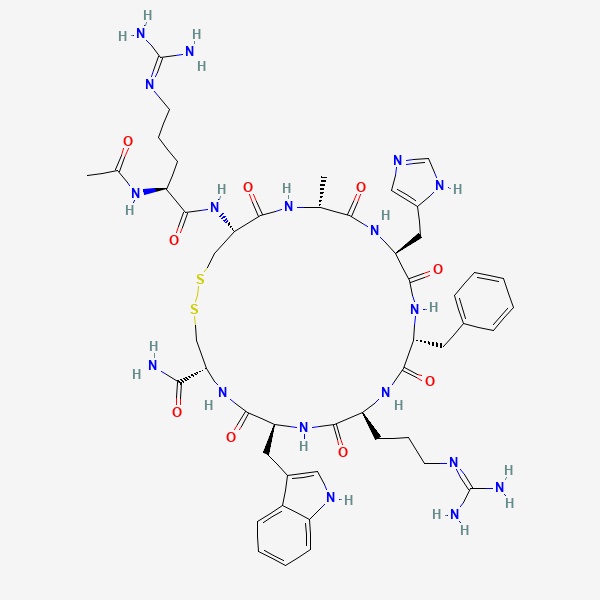
- Molecular formula
- C49H68N18O9S2
- Molecular weight
- 1117.3 g/mol
- IUPAC name
- (4R,7S,10S,13R,16S,19R,22R)-22-[[(2S)-2-acetamido-5-(diaminomethylideneamino)pentanoyl]amino]-13-benzyl-10-[3-(diaminomethylideneamino)propyl]-16-(1H-imidazol-5-ylmethyl)-7-(1H-indol-3-ylmethyl)-19-methyl-6,9,12,15,18,21-hexaoxo-1,2-dithia-5,8,11,14,17,20-hexazacyclotricosane-4-carboxamide
Verified external records:
References
- 1.IMCIVREE (setmelanotide) prescribing information — DailyMed
- 2.Drugs@FDA — setmelanotide (IMCIVREE) approval record, NDA 213793
- 3.Phase 3 trial in POMC/PCSK1 deficiency obesity (NCT02896192)
- 4.Phase 3 trial in LEPR deficiency obesity (NCT03287960)
- 5.Phase 3 trial in Bardet-Biedl and Alström syndromes (NCT03746522)
- 6.Setmelanotide — indexed research (PubMed, National Library of Medicine)
More on Setmelanotide
Everything else we've written about Setmelanotide — what the community reports, the explainers that cover it, and the terms it keeps running into.