Also known as: Melanostatine 5 · Melanostatine-5 · White 05 · 153N-6
In-vitroUnclear⚠ none in humans
On this page
- What is nonapeptide-1?
- How does nonapeptide-1 work?
- Does nonapeptide-1 skin brightening work in people?
- What do the nonapeptide 1 melasma trials actually show?
- Is nonapeptide-1 safe? Side effects
- Is nonapeptide-1 FDA-approved or legal in 2026?
- How is nonapeptide-1 used in skincare?
- How is nonapeptide-1 different from melanotan?
- Evidence by outcome
- FDA & legal status
- Chemical identifiers
- References
- Related compounds
Nonapeptide-1 is a synthetic nine-amino-acid cosmetic peptide designed to reduce pigment signaling at MC1R, the receptor that alpha-MSH uses to tell melanocytes to make melanin. Cell studies support that mechanism, but no human trial isolates the peptide itself. In the United States, nonapeptide-1 is used in topical cosmetics, not FDA-approved as a melasma drug.
Key facts
- What it is: A synthetic MC1R antagonist peptide, also called Melanostatine-5 and 153N-6.
- Studied for: Lowering melanin signaling and maintaining improvement in melasma as part of combination formulas.
- Evidence tier: In vitro · unknown · none in humans as a standalone ingredient.
- U.S. status (July 2026): An unscheduled cosmetic ingredient, not an FDA-approved drug.
- How it is used: Topically in finished serums, creams, and sunscreens; there is no validated peptide-only dose.
- Main risk: Standalone human safety is untested; irritation and allergy depend on the entire formula.
- Banned in sport? Nonapeptide-1 is not specifically named on WADA’s 2026 list, so this page does not assign a prohibited status.
What is nonapeptide-1?
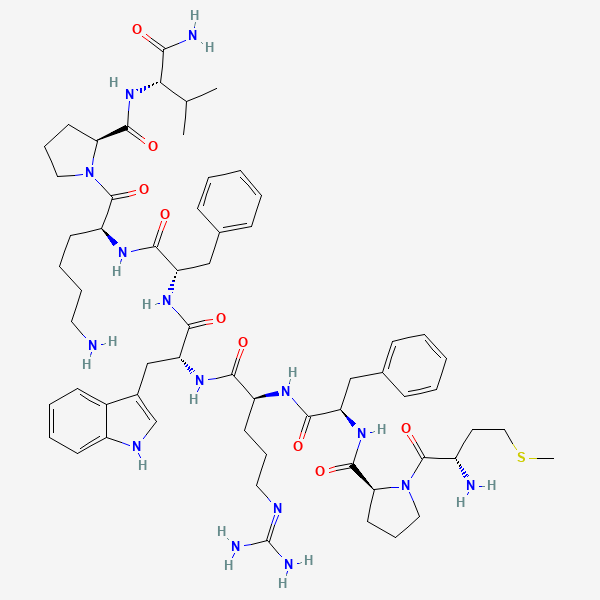
nonapeptide-1 is a lab-made chain of nine amino acids built to interfere with the skin’s pigment signal. PubChem confirms the sequence H-Met-Pro-D-Phe-Arg-D-Trp-Phe-Lys-Pro-Val-NH2, molecular formula C61H87N15O9S, molecular weight 1206.5, CAS 158563-45-2, and compound ID 10418849 (PubChem). The FDA substance record also maps the same molecule to UNII 64W45420K5 and the names Melanostatine 5 and White 05.
The name is literal: “nona” means nine. Two amino acids use the D configuration, a mirror-image arrangement that changes how a peptide fits a receptor. Nonapeptide-1 is a topical cosmetic ingredient, not a collagen peptide, injectable tanning drug, or approved treatment for pigment disorders. It belongs in the cosmetic peptide hub, with melanocortin biology as its secondary family.
How does nonapeptide-1 work?
nonapeptide-1 is designed to block alpha-melanocyte-stimulating hormone (alpha-MSH) at melanocortin-1 receptor, or MC1R. Alpha-MSH normally presses the “make pigment” button on a melanocyte. This MC1R antagonist peptide tries to occupy the button without pressing it, which should reduce downstream cyclic AMP signaling and the activity of pigment-making machinery.
The receptor claim has a real laboratory foundation. A 1997 binding study found that 153N-6, the research name for this sequence, preferred MC1R over the human MC3, MC4, and MC5 receptor subtypes (PubMed PMID 9574823). A 2022 cell study used nonapeptide-1 acetate as a comparator in UVA-exposed human keratinocytes and epidermal melanocytes; the experiment remained in cultured cells, not living skin (PubMed PMID 35645678).
Does nonapeptide-1 skin brightening work in people?
The case for nonapeptide-1 skin brightening stops short of peptide-specific human proof. Cell and receptor studies show the intended pathway can be interrupted. Human trials show that formulas containing the peptide can be studied. Neither result tells us how much brightening nonapeptide-1 contributes after the sunscreen, resorcinol, antioxidants, arbutin, glabridin, or other actives are removed.
Supplier pages commonly jump from “blocks MC1R in cells” to “lightens human skin.” That skips penetration, stability, concentration, and the other actives in the bottle. The honest headline tier is in vitro, with an unknown verdict for the standalone peptide.
What do the nonapeptide 1 melasma trials actually show?
The nonapeptide 1 melasma evidence comes from multi-ingredient products, not nonapeptide-1 alone. A 46-person randomized pilot tested a proprietary mixture containing phenylethyl resorcinol, nonapeptide-1, aminoethyl phosphinic acid, antioxidants, and sunscreen after both groups first used triple-combination melasma therapy. The mixture’s results leaned better than sunscreen, but between-group differences did not reach statistical significance.
Only 17 people in the active group and 14 controls completed that study. The authors reported one case of itching in the active-formula group, but a five-ingredient product cannot identify which ingredient caused it. Read the full maintenance trial and the limitation is hard to miss: this was a small product trial, not proof for the peptide.
A 2025 randomized trial enrolled 62 women and compared oral tranexamic acid plus hydroquinone with oral tranexamic acid plus a topical essence containing Cordyceps extract, arbutin, nonapeptide-1, and glabridin. Both groups improved, with no significant difference between them after 12 weeks (PubMed PMID 40590148). Crediting nonapeptide-1 alone would require ignoring three other topical actives and the oral drug shared by both groups.
Is nonapeptide-1 safe? Side effects
nonapeptide-1 does not have enough standalone human data to produce a reliable side-effect rate. The available human studies observed finished formulas, so they can describe how those products behaved but cannot prove the peptide caused an event or was harmless. No long-term trial has tested nonapeptide-1 alone on human skin.
The practical risks are therefore formulation-level risks: redness, itching, irritation, or an allergic reaction are possible with a new topical. Concentration, preservatives, fragrance, and stability all matter. A changing dark patch should not be self-labeled as melasma before a clinician has ruled out something else. Thin safety data is not a clean bill of health.
Is nonapeptide-1 FDA-approved or legal in 2026?
nonapeptide-1 is not FDA-approved to treat melasma, hyperpigmentation, or any other condition. In July 2026, it is an unscheduled ingredient used in topical cosmetics. FDA generally does not approve cosmetic products or ingredients before sale, except color additives, so “not FDA-approved” is normal for a cosmetic but still means no drug-level review of efficacy or safety occurred.
Claims matter too. A serum sold to improve uneven tone sits in cosmetic territory; a product marketed to treat melasma makes a disease-treatment claim and can be regulated as a drug. FDA’s current approval explainer makes the broader point: an ingredient listing does not equal approval. The UNII is an identity code, not a permission slip.
How is nonapeptide-1 used in skincare?
nonapeptide-1 is used topically inside finished skincare formulas, not reconstituted for injection. The published maintenance pilot applied its proprietary combination twice daily for 16 weeks, but that schedule belongs to the tested product. It is not a validated dose for raw nonapeptide-1, and the trial did not isolate a concentration-response relationship for the peptide.
Manufacturer use levels are formulation instructions, not clinical dosing evidence. A finished product also has stability and delivery work that raw peptide powder does not. There is no evidence-based case here for injecting or swallowing nonapeptide-1; the published research question is topical pigmentation.
How is nonapeptide-1 different from melanotan?
nonapeptide-1 and melanotan point at the same receptor family in opposite directions. Nonapeptide-1 antagonizes MC1R to reduce the alpha-MSH pigment signal; Melanotan II activates melanocortin receptors and is sold to darken skin. One tries to cover the doorbell, while the other keeps pressing it.
That mirror-image comparison is more useful than another generic “brightening peptide” list. The melanocortin agonist guide explains what receptor activation means, while Melitane shows a different cosmetic peptide marketed around alpha-MSH antagonism. Same signaling neighborhood, different molecules, and very different evidence should not be pooled into one claim.
Evidence by outcome
Each outcome Nonapeptide-1 has been studied for, with the honest evidence grade and what the studies actually found. A tier never stands alone — the verdict rides with it.
| Outcome | Evidence | What was found |
|---|---|---|
| Reduced melanogenesis / skin brightening | In-vitroUnclear⚠ none in humans | Receptor-binding studies and experiments in cultured human epidermal melanocytes support MC1R antagonism and reduced melanogenesis signaling. Human melasma trials have tested multi-ingredient products containing nonapeptide-1, so they cannot establish that this peptide works by itself. |
FDA & legal status
- United States: unscheduled (as of Jul 2026)
Nonapeptide-1 is not an FDA-approved drug or an approved melasma treatment. It is used as a topical cosmetic ingredient; FDA generally does not approve cosmetic products or ingredients before marketing, except color additives. An FDA UNII identifies the substance but does not imply regulatory approval.
Chemical identifiers
References
- 1.Nonapeptide-1 — PubChem compound record (CID 10418849)
- 2.Schiöth et al., 1997 — binding of 153N-6 to human melanocortin receptor subtypes (PMID 9574823)
- 3.Jiang et al., 2022 — nonapeptide-1 acetate in cultured skin cells (PMID 35645678)
- 4.Chatterjee et al., 2022 — proprietary combination versus sunscreen in melasma maintenance (PMID 34379946)
- 5.Shen et al., 2025 — multi-ingredient Cordyceps essence for melasma (PMID 40590148)
- 6.FDA — Is It Really 'FDA Approved'?
- 7.FDA Global Substance Registration System — nonapeptide-1 (UNII 64W45420K5)
- 8.World Anti-Doping Agency — 2026 Prohibited List