Also known as: Pal-Lys-Met(O2)-Lys · Pal-KMO2K · Matrixyl Synthe'6 · Matrixyl synthe'6 peptide
In-vitroUnclear⚠ none in humans
On this page
- What is palmitoyl tripeptide-38?
- How does palmitoyl tripeptide-38 work?
- What does the research actually show?
- What are the claimed palmitoyl tripeptide-38 benefits?
- Matrixyl vs Matrixyl 3000 vs Synthe 6: what changes?
- Is palmitoyl tripeptide-38 safe?
- Is palmitoyl tripeptide-38 FDA-approved or banned in sport?
- Does palmitoyl tripeptide-38 work for wrinkles?
- Evidence by outcome
- FDA & legal status
- Chemical identifiers
- References
- Related compounds
Palmitoyl tripeptide-38 is a topical cosmetic peptide sold for smoothing fine lines and supporting skin’s matrix, the scaffold that gives skin shape. The lab signal is promising, but no independent human randomized trial has isolated the peptide’s effect. In the United States it is an unreviewed cosmetic ingredient, not an FDA-approved drug.
What is palmitoyl tripeptide-38?
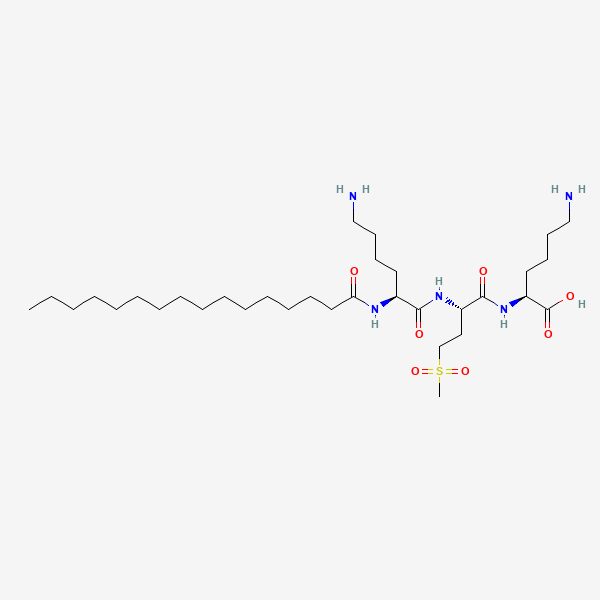
Palmitoyl tripeptide-38 is the three-amino-acid sequence Lys-Met(O2)-Lys with a 16-carbon palmitic-acid tail attached. The tail makes the peptide friendlier to the oily outer skin barrier. The sequence was derived from a motif found in collagen VI and laminin, two connective-tissue proteins. Its verified formula is C33H65N5O7S, molecular weight 675.97 g/mol, and CAS number 1447824-23-8 (PubChem CID 71587932).
Sederma developed the ingredient and sells it as Matrixyl Synthe’6. That trade name matters: a commercial Synthe’6 raw material or finished serum is not automatically the same thing as a study of purified palmitoyl tripeptide-38. Cosmetic marketing has a habit of letting those nouns share one lab coat.
How does palmitoyl tripeptide-38 work?
Palmitoyl tripeptide-38 is designed as a matrikine mimic, meaning a small peptide that resembles a fragment released when skin’s structural proteins break down. Fibroblasts, the cells that maintain the skin’s scaffold, can read such fragments as repair messages. Think of the peptide as a work order, not the building material itself.
The Matrixyl Synthe’6 claim comes from manufacturer-associated laboratory work using fibroblasts and contracted collagen lattices. Those assays reported higher production of collagen I, III and IV, fibronectin, hyaluronic acid and laminin-5. A review of topical anti-aging peptides confirms the sequence and describes human testing of formulas containing the peptide, but the six-part claim has not been independently established in a human face.
What does the research actually show?
Palmitoyl tripeptide-38 has in-vitro evidence and no isolated human efficacy trial located. That is narrower than “clinically proven.” The cell work says the signal can move laboratory markers; it does not say how much peptide crosses real skin, how long the signal lasts, or whether wrinkles visibly change because of this molecule alone.
A 2020 open-label study followed 35 women over 40 for 56 days and reported improvements after once-daily use. The catch is visible in the study title and formula: the serum contained 15% vitamin C, vitamin E and 5 parts per million palmitoyl tripeptide-38. With no peptide-only arm and no vehicle control, the study (PMID 33103342) cannot separate the peptide from two established antioxidants or the serum base.
Other published cosmetic studies make the same attribution problem worse by combining the peptide with apple stem-cell extract, urea, creatine, bakuchiol, hyaluronic acid or botanical blends. Human skin was studied, but isolated palmitoyl tripeptide-38 was not. No independent human randomized controlled trial of the single ingredient was located in PubMed or ClinicalTrials.gov during this review. The honest tier therefore stays in-vitro, none in humans for the isolated peptide.
What are the claimed palmitoyl tripeptide-38 benefits?
The claimed palmitoyl tripeptide-38 benefits are softer-looking wrinkles, better firmness and more hydrated-looking skin. Each claim follows logically from the six matrix components measured in lab assays: collagens provide structure, fibronectin helps organize the matrix, hyaluronic acid holds water, and laminin helps anchor the epidermis to the layer beneath it.
That mechanism gives researchers a sensible next question, not a finished verdict. A serum containing the Synthe 6 peptide may still improve how skin looks, but a multi-active serum cannot tell you which ingredient earned the credit. So far the gains have been measured for the whole formula, not for palmitoyl tripeptide-38 alone; the clean single-ingredient test that would put its name on the results is the obvious next step.
Matrixyl vs Matrixyl 3000 vs Synthe 6: what changes?
Matrixyl vs Matrixyl 3000 vs Synthe 6 is not a contest between three strengths of one peptide. They are different branded ingredients with different peptide contents. Treating every “Matrixyl” result as transferable is the central mistake this page is here to fix.
| Name on the front | What it actually contains | Evidence cannot be borrowed from |
|---|---|---|
| Matrixyl | Palmitoyl pentapeptide-4, also called Pal-KTTKS | Matrixyl 3000 or Synthe’6 |
| Matrixyl 3000 | Palmitoyl tripeptide-1 plus palmitoyl tetrapeptide-7 | Classic Matrixyl or Synthe’6 |
| Matrixyl Synthe’6 | Palmitoyl tripeptide-38 as the signature peptide | The other two Matrixyl products |
The names share a manufacturer and an anti-wrinkle pitch, not interchangeable clinical evidence. The wider cosmetic peptide hub keeps these signal peptides in their proper lanes.
Is palmitoyl tripeptide-38 safe?
Palmitoyl tripeptide-38 appears well tolerated in short studies of finished topical products, but peptide-specific human safety data are thin. No reliable rate for irritation, allergy or other adverse effects can be assigned to the isolated ingredient. A reaction to a serum may come from fragrance, preservatives, solvents or another active rather than the peptide.
Topical tolerance also says nothing about swallowing or injecting palmitoyl tripeptide-38; those routes have no established human safety record. For reactive skin, testing the finished product on a small area is more useful than assuming every ingredient bearing the word “peptide” is automatically gentle.
Is palmitoyl tripeptide-38 FDA-approved or banned in sport?
Palmitoyl tripeptide-38 is not an FDA-approved drug, and that is normal for a U.S. cosmetic ingredient. FDA does not pre-approve cosmetics or their ingredients other than color additives; companies remain responsible for safety and truthful labeling (FDA). As of July 16, 2026, this is an ordinary cosmetic-regulation question, not a controlled-drug question.
Palmitoyl tripeptide-38 is also not prohibited in sport. USADA names it explicitly among cosmetic peptide ingredients that are not prohibited, while warning that actual growth factors in cosmetics can be banned regardless of route (USADA). That unusually clear answer is better than guessing from the word “peptide.”
Does palmitoyl tripeptide-38 work for wrinkles?
Palmitoyl tripeptide-38 has a plausible lab mechanism, but no independent human trial has shown that the isolated peptide reduces wrinkles. Finished products containing it have produced encouraging signals, although their other active ingredients prevent a clean attribution. The next useful study is simple: peptide versus matching vehicle, blinded, with enough participants and independent funding.
Evidence by outcome
Each outcome Palmitoyl Tripeptide-38 has been studied for, with the honest evidence grade and what the studies actually found. A tier never stands alone — the verdict rides with it.
| Outcome | Evidence | What was found |
|---|---|---|
| Extracellular-matrix production | In-vitroHelped⚠ none in humans | Manufacturer-associated cell and contracted-collagen-lattice assays report increases in collagen I, III and IV, fibronectin, hyaluronic acid and laminin-5. Independent replication and confirmation in living human skin have not been located. |
| Fine lines and wrinkles from the isolated peptide | In-vitroUnclear⚠ none in humans | Human studies have evaluated finished formulas containing palmitoyl tripeptide-38 alongside vitamins, plant extracts or other active ingredients. Those studies cannot assign any measured change to this peptide alone. |
FDA & legal status
- United States: unscheduled (as of Jul 2026)
An unreviewed cosmetic ingredient, not an FDA-approved drug or a controlled substance. FDA does not pre-approve cosmetic ingredients other than color additives; marketers remain responsible for product safety and labeling.
Chemical identifiers
References
- 1.Palmitoyl lysyldioxymethionyllysine - PubChem CID 71587932
- 2.FDA Global Substance Registration System - Palmitoyl Tripeptide-38
- 3.Schagen, 2017 - Topical Peptide Treatments with Effective Anti-Aging Results
- 4.Lintner et al., 2020 - multi-ingredient serum study (PMID 33103342)
- 5.FDA - Does the FDA approve cosmetics before they go on the market?
- 6.USADA - Peptides and Growth Factors in Cosmetics: Are They Banned?