Also known as: TH9507 · TH-9507 · GHRH(1-44) analog · hexenoyl-GHRH
Human RCTHelped
On this page
- What people actually use tesamorelin for — and what they report
- What is tesamorelin?
- How does tesamorelin work?
- Does tesamorelin actually work? What the science says
- Is tesamorelin safe? Side effects
- FDA & legal status (2026)
- Tesamorelin dosing: what was studied, and what people run
- Tesamorelin vs other GH secretagogues (and GLP-1s)
- Frequently asked questions
- Who tesamorelin is — and isn’t — for
- Evidence by outcome
- FDA & legal status
- Registered clinical trials
- Reported side effects
- Chemical identifiers
- References
- Related compounds
- More on Tesamorelin
You didn’t come here for a chemistry lecture. You came because your waist thickened — after a bulk, or just after 40 — the scale isn’t telling the whole story, and tesamorelin keeps coming up as the peptide that goes after exactly that deep belly fat.
Tesamorelin is a GHRH-analog peptide that’s FDA-approved to shrink visceral belly fat — the deep fat packed around your organs — with large human trials, not just anecdotes, behind that one specific job. The honest catch, up front: it was approved only for HIV-associated belly fat, everyone else runs it off-label, and it barely touches the pinchable layer or the number on the scale.
That gap — a precise tool wearing a general-fat-burner reputation — is the whole story of tesamorelin, so let’s start where the reader actually lives: with what people run it for and what they say happened.
What people actually use tesamorelin for — and what they report
Tesamorelin has a remarkably specific street job: shrink the gut. People reach for it when the waist won’t budge — the post-bulk pooch, the midlife “GH belly,” the stubborn deep fat that survives a decent diet — and a smaller group runs it as a gentler growth-hormone lever for sleep, recovery, and skin, the same reasons people run CJC-1295 or ipamorelin, which it’s often stacked with. The modern off-label buyer in one line: lean-ish, past 35, and annoyed at a belly that doesn’t match the rest of them.
What they report — the wins. The signature result people describe is the one the trials predict: the gut goes down while the scale stays put. Waist off, midsection tighter, shirts fitting better — some patient reviews describe several inches off the waistline over roughly three months with body weight barely moving. Regulars call it “recomposition, not weight loss,” and they mean it as a compliment. Almost nobody reports a fast result; the common arc is nothing obvious for the first month or two, then a waistband that’s quietly looser around month three.
And the letdowns — this is the part worth reading. The recurring disappointment comes from people chasing a visible six-pack. Tesamorelin goes after the fat you can’t pinch, so someone who wanted the soft lower-belly layer gone loses deep fat they couldn’t see and keeps the layer they can — one reviewer even reported the pinchable fat creeping up while the deep fat fell. The flat scale frustrates anyone who signed up expecting weight loss. And the effect is rented, not owned: stop running it, and the gut tends to come back.
The doses people actually run (anecdotal — not a validated protocol): the community mostly mirrors the clinical number — 2 mg subcutaneously each evening, in 8-to-12-week runs while eating in a deficit — and some dial back to 1 mg when the water retention or a climbing IGF-1 gets uncomfortable. The side effects people flag most are the fluid ones: puffy hands and feet, and a pins-and-needles or carpal-tunnel feeling in the hands at night, plus achy joints and the occasional creep in blood sugar (full detail in the safety section below).
One more honest note, this one about sourcing. Tesamorelin is a big, fiddly 44-amino-acid peptide with an unusual chemical cap, which makes it harder to synthesize cleanly than a short peptide like ipamorelin — so “underdosed” and “didn’t feel like the real vial” is a live complaint about gray-market product, separate from whether the molecule itself works.
And the standard caveat on all of it: the people who post are the people who felt something. Plenty of quiet buyers who saw nothing never write it up, so read “most reports are positive” as “most reports from people who came back to post” — a smaller claim than it first looks.
What is tesamorelin?
Tesamorelin is a synthetic 44-amino-acid copy of growth-hormone-releasing hormone (GHRH), the signal your hypothalamus uses to tell the pituitary gland to release growth hormone. A trans-3-hexenoyl group caps the front of the chain and shields it from rapid enzyme breakdown — the small tweak that turned a signal your body clears in minutes into a once-daily prescription drug, sold as Egrifta SV and Egrifta WR.
The chemistry, for the record: about 5,136 daltons, molecular formula C221H366N72O67S, first developed as TH9507. That last detail is what sets tesamorelin apart from almost everything sold beside it — the branded version isn’t a research chemical, it’s been FDA-approved since 2010 for reducing excess abdominal fat in adults with HIV-associated lipodystrophy.
The approval is deliberately narrow. The FDA label says Egrifta is not for weight-loss management and calls it weight neutral — so a smaller waist can arrive without a friendlier number on the scale. That isn’t the drug failing. It’s the drug doing the one precise job it was built and tested for.
How does tesamorelin work?
Tesamorelin binds GHRH receptors on the pituitary and asks the gland to release your own growth hormone in natural pulses, which in turn raises insulin-like growth factor 1 (IGF-1). It sits one step upstream of injected human growth hormone. Think thermostat, not space heater: injected GH pumps heat straight into the room, while tesamorelin nudges the existing furnace to cycle on.
That upstream position doesn’t make it risk-free. The effect still runs through the GH/IGF-1 axis, which is exactly why the fat changes people want and the label warnings they don’t — fluid retention, glucose intolerance, persistently high IGF-1 — come off the same lever. The current Egrifta WR prescribing information tells prescribers to monitor IGF-1 and glucose rather than treat “it’s your own GH” as an automatic safety net.
The result is unusually targeted. Trials found tesamorelin shrank visceral adipose tissue — the deep fat around the organs — without a matching loss of the subcutaneous fat you can pinch. So it doesn’t spot-reduce a soft lower-belly fold; it changes a compartment you’d normally need a CT or MRI scan to even see.
Does tesamorelin actually work? What the science says
Short version: yes — for the one thing it’s approved for, tesamorelin clears the strongest evidence tier we grade, Human RCT, and it isn’t close. Where the community and the science part ways is who got studied. The pivotal trials enrolled adults with HIV-associated fat accumulation, so the visceral-fat result is airtight there and an educated extrapolation for the lean-ish person running it off-label. Here’s the actual data, kept tight.
Visceral fat — repeatable and real. A 404-person randomized trial ran the historical 2 mg dose once daily: deep visceral fat fell 10.9% versus 0.6% on placebo at six months, and people who stayed on a full year reached roughly 18%. Waist shrank and body-image scores improved, while the pinchable subcutaneous layer didn’t budge — the selectivity, quantified (PMID 20101189). A pooled Phase 3 analysis of 806 people landed at a 15.4% effect by week 26, which is where the endlessly-repeated “15 to 18%” figure comes from.
Liver fat — a smaller real signal, same caveat. In a 12-month trial of 61 adults with HIV and fatty liver, tesamorelin cut liver-fat fraction 4.1 points more than placebo — a 37% relative drop — and pushed 35% of the treated group below the 5% fat threshold versus 4% on placebo. Encouraging for HIV-associated fatty liver, but not yet proof it treats the garden-variety kind (PMID 31611038). That precise question is now being tested directly.
Cognition — early and mixed. A 20-week trial gave 1 mg nightly to 152 adults aged 55 to 87 (66 of them with mild cognitive impairment). The combined groups nudged up on a cognitive composite, mostly on executive function; visual memory didn’t move and verbal memory only trended (PMID 22869065). Human RCT tier, mixed verdict — a signal worth chasing, not a settled anti-aging claim.
My read: for shrinking a measured visceral-fat depot, tesamorelin is one of the very few peptides in this whole reference that clears the human-RCT bar for its headline use. The open question was never “does it work” — it’s “was it proven in your population, for the fat you actually care about.” Everything past visceral and liver fat — sleep, recovery, skin, longevity — is still riding on mechanism and anecdote, not trials.
Is tesamorelin safe? Side effects
Tesamorelin has something almost no research peptide has: a real human safety record, built from FDA trials. That makes the warnings specific rather than a blank “well tolerated.” The tradeoffs come off the same GH/IGF-1 lever that drives the fat loss, so the common complaints are predictable — injection-site reactions, joint pain, muscle aches, peripheral edema (fluid in the hands, feet, and ankles), and tingling, numbness, or a carpal-tunnel feeling in the hands, which is often that fluid pressing on the nerve.
The label puts numbers on it. Injection-site reactions hit 17% of Egrifta recipients versus 6% on placebo in the original trials. IGF-1 climbs and can stay up: by week 26, 47% of treated people had IGF-1 above a +2 standard-deviation score and 36% above +3; among those continuing to week 52 the figures were 34% and 23%. Persistently high IGF-1 is a monitoring flag, not a bonus — it is the number prescribers watch, and the reason some users voluntarily drop to 1 mg.
Blood sugar gets its own line. Five percent of Egrifta recipients versus 1% on placebo crossed to an HbA1c of at least 6.5% by week 26 in the label analysis. The fatty-liver trial found no group difference in fasting glucose or HbA1c at 12 months, so this is “risk varies,” not “tesamorelin always raises blood sugar.” Baseline and periodic glucose checks are part of the approved-drug framework for exactly this reason, and anyone with prediabetes or diabetes has the most to watch.
Tesamorelin is contraindicated outright in several groups: active cancer (raising IGF-1 could feed an existing tumor), a disrupted hypothalamic-pituitary axis (pituitary tumor or surgery, head irradiation), pregnancy, and known hypersensitivity to tesamorelin or mannitol. A history of malignancy, poorly controlled glucose, acute critical illness, and diabetic retinopathy all call for clinician-level review before starting.
One drug-interaction note the label flags, separate from peptide stacking: the Egrifta WR prescribing information says growth hormone can change how the liver’s CYP450 enzymes clear other drugs, including corticosteroids and sex steroids, and that GH blocks the enzyme converting cortisone to cortisol — so anyone on glucocorticoid replacement may need a dose adjustment. Insulin or other glucose-lowering therapy is worth reviewing with a prescriber if control shifts.
Two things the record does not show, stated plainly: tesamorelin has no established cardiovascular-outcome benefit — the label says long-term cardiovascular safety has not been established, and no trial has shown it prevents heart attacks or extends life. Reducing a metabolically unfriendly fat depot is biologically appealing, but appealing is not the same as proven to save lives.
The second safety lane is the one the trials cannot measure. Everything above describes FDA-approved Egrifta. Gray-market “research” vials are not those formulations: purity, true dose, sterility, and storage are not guaranteed, and a label printed onto an online vial does not copy the manufacturing controls with it. On a large 44-residue peptide that is genuinely hard to make clean, that is not a hypothetical — it is the most common real-world complaint about the compound.
FDA & legal status (2026)
Tesamorelin is FDA-approved in the United States as Egrifta SV and Egrifta WR — but only for reducing excess abdominal fat in adults with HIV-associated lipodystrophy. As of July 17, 2026, that remains its sole approved indication. Every other use — bodybuilding fat loss, anti-aging, general obesity, ordinary fatty liver, cognition — is off-label. The prescription drug and an online “research use only” vial share a molecule name, not an approval and not a quality guarantee.
So the honest 2026 picture runs in two lanes. By prescription, you get the labeled, quality-controlled product with the trial data behind it. From a gray-market vendor, you get a legally murky research chemical whose identity, purity, dose, and sterility no certificate of analysis can truly vouch for on your behalf. We sell nothing, so there is no supplier list hiding after the safety paragraph — buyer-education is the entire offer.
For tested athletes the answer is short and firm: tesamorelin is a growth-hormone-releasing factor, prohibited at all times, in and out of competition, under WADA class S2. A prescription does not erase anti-doping rules, and a therapeutic use exemption is a separate process. Check the live WADA list and Global DRO rather than a vendor’s “legal peptide” language.
Tesamorelin dosing: what was studied, and what people run
Tesamorelin dosing depends on the formulation, and “2 mg daily” is no longer the whole answer. The pivotal trials behind the visceral-fat evidence used an older 1 mg-per-vial product at 2 mg once daily; today’s Egrifta SV delivers 1.4 mg daily and Egrifta WR delivers 1.28 mg daily, each engineered to match the historical exposure. The off-label community, as noted up top, mostly still runs the old 2 mg number in the evening. These are reported study, label, and community doses — not a personal protocol.
| Source or formulation | Reported daily amount | Preparation and context | What the number means |
|---|---|---|---|
| Pivotal Phase 3 trials | 2 mg subcutaneous | Historical 1 mg-per-vial Egrifta | Study dose behind the visceral-fat evidence |
| Egrifta SV, 2 mg vial | 1.4 mg (0.35 mL) subcutaneous | Mix one vial with 0.5 mL supplied Sterile Water; use immediately | Current single-dose formulation; not interchangeable with WR |
| Egrifta WR, 11.6 mg vial | 1.28 mg (0.16 mL) subcutaneous | Mix with 1.3 mL supplied Bacteriostatic Water; vial supplies seven daily doses | Current weekly-reconstitution formulation; not interchangeable with SV |
| Cognition RCT | 1 mg subcutaneous | Nightly for 20 weeks | Investigational research dose, not an approved cognitive regimen |
Two errors that table heads off: a vial labeled “2 mg” does not mean the SV dose is the whole vial, and WR’s 11.6 mg vial is not one injection — it is seven. Dose, concentration, diluent, storage, and beyond-use date travel together, and pulling one number out of that system is how an arithmetic slip becomes a biology problem. It is injected subcutaneously into the abdomen, sites rotated away from the navel, bruises, and scar tissue; SV mixes with the supplied Sterile Water and is used immediately, while WR mixes with the supplied Bacteriostatic Water and is discarded after seven days. Both labels say swirl or roll, never shake, and neither says to refrigerate the mixed product. The reconstitution calculator checks the concentration arithmetic; it cannot make one formulation’s instructions valid for the other.
On timing and stacking: no approved label requires fasted-morning or bedtime dosing — the cognition trial happened to dose 30 minutes before bed, but that is a study detail, not a rule. And stacking tesamorelin with ipamorelin, CJC-1295, HGH, or a GLP-1 is common internet practice with zero controlled human trials behind any specific combination; mechanistic overlap makes the blend sound tidy while making the fluid, IGF-1, and glucose effects harder to pin on any one input. Same-syringe mixing is a separate chemistry question the labels do not answer, so the peptide mixing compatibility reference leaves those pairs at “insufficient data” rather than inventing a recipe.
Tesamorelin vs other GH secretagogues (and GLP-1s)
Tesamorelin stands apart from the other growth-hormone peptides for one reason: Phase 3 human data for visceral fat and an actual FDA approval. Sermorelin is a shorter GHRH fragment, CJC-1295 is an investigational GHRH analog, ipamorelin works at the ghrelin receptor, and MK-677 is an oral ghrelin-mimetic — all nudge GH, none carries tesamorelin’s approval or its controlled fat evidence. The broader growth-hormone peptide hub maps the whole family without pretending shared mechanism means shared proof.
But “more proof” is not “bigger pump.” No head-to-head trial shows tesamorelin beating those peptides for physique, recovery, sleep, or muscle — its edge is the quality of evidence for one narrow outcome, not a promise it out-performs the others in the gym. People chasing broad GH feel-good effects often prefer the CJC-1295/ipamorelin pairing; people who specifically want to shrink a measured gut reach for tesamorelin.
GLP-1 drugs answer a different question entirely. They cut appetite and total body weight; tesamorelin is weight-neutral and re-shapes one fat depot. If you want the scale to fall, that is the GLP-1 job. If you have stubborn visceral fat and the scale is beside the point, that is the tesamorelin question — which is why the two increasingly show up in the same conversation rather than as rivals.
Frequently asked questions
Does tesamorelin actually work for belly fat?
Yes — for the deep visceral belly fat measured in its human RCTs, where it cut the fat around the organs by roughly 15 to 18% over six months. The catch is which belly fat: it did not shrink the pinchable subcutaneous layer, so “belly fat” is too broad a word. If your goal is a flatter deep gut on a scan, tesamorelin has the evidence; if it’s a visible six-pack, it targets the wrong compartment.
Does tesamorelin cause weight loss?
Mostly no, and that surprises people. The FDA label calls tesamorelin weight-neutral: your waist or scanned visceral fat can fall while the scale barely moves, because it re-shapes a fat depot rather than cutting total body weight. Anyone who wants a big drop on the scale is describing the GLP-1 job, not this one.
How long does tesamorelin take to work?
Months, not weeks. In the trials IGF-1 rose by about week 13, the clearest average visceral-fat reduction showed up at week 26, and continued use held or deepened it through week 52. Community reports track the same slow arc — little obvious change early, then a looser waistband around month three.
What dose of tesamorelin do people use?
The approved products are formulation-specific: Egrifta SV is 1.4 mg once daily and Egrifta WR is 1.28 mg once daily, both engineered to match the historical 2 mg trial dose. The off-label community mostly runs that older 2 mg figure in the evening, sometimes dropping to 1 mg for side effects. These are reported doses, not a personal protocol, and SV and WR are not interchangeable.
Is tesamorelin legal, and is it banned in sport?
Tesamorelin is a legal prescription drug for its one FDA-approved indication; the “research use only” vials sold online are not approved Egrifta and sit in a much grayer legal spot. For athletes it is a hard no — WADA class S2 prohibits growth-hormone- releasing factors at all times, so a tested competitor must treat it as banned unless a valid therapeutic use exemption applies.
What happens when you stop tesamorelin?
The visceral fat tends to come back. In the randomized extension, people switched from tesamorelin to placebo re-accumulated the fat they had lost — a controlled result far more reliable than any “permanent cycle” promise, even though it cannot predict one person’s exact rebound speed. The effect lasts about as long as the treatment does.
Who tesamorelin is — and isn’t — for
Tesamorelin fits a specific person: someone with genuine deep visceral fat — the post-bulk gut, the midlife GH belly — who cares more about waist and metabolic health than the number on the scale, and who is willing to run it like the drug it is, with glucose and IGF-1 checks. For that person it is one of the very few peptides in this whole reference that can point to human RCTs for its headline job, which is a rare and genuinely reassuring thing to be able to say about a compound sold in this corner of the internet.
It is a poor fit for anyone chasing a visible six-pack (it leaves the pinchable layer alone), anyone expecting the scale to plunge (it is weight-neutral by design), and anyone with active cancer, a pituitary disorder, or a pregnancy — those are hard contraindications, not cautions. Tested athletes are out. And anyone buying gray-market should know they are trusting a vendor on a big peptide that is easy to underdose.
So, back to that thickening waist you walked in with. If it is the deep, organ-hugging kind, tesamorelin is that unusual thing in the peptide world — a compound whose biggest claim was actually tested in people and held up, with the honest limits mapped just as clearly: the scale won’t move, the pinch stays, and the gut returns if you stop. You don’t have to guess where the evidence stands on this one. For once, it is already in.
Evidence by outcome
Each outcome Tesamorelin has been studied for, with the honest evidence grade and what the studies actually found. A tier never stands alone — the verdict rides with it.
| Outcome | Evidence | What was found |
|---|---|---|
| Visceral (abdominal) fat reduction | Human RCTHelped | Two pivotal Phase 3 randomized trials in people with HIV-associated lipodystrophy are the basis for tesamorelin's FDA approval: the historical 2 mg study formulation reduced deep visceral abdominal fat by roughly 15% over 26 weeks, while placebo groups changed little. This is Human RCT evidence, the strongest tier we grade. |
| Liver fat (NAFLD) in people with HIV | Human RCTHelped | In randomized trials of adults with HIV and fatty liver, tesamorelin lowered liver fat and slowed the progression of liver scarring (fibrosis) versus placebo. The evidence is Human RCT, but studied in an HIV population — whether it transfers to garden-variety fatty liver is now being tested directly. |
| Cognition / memory in aging | Human RCTMixed | Randomized trials in older adults and people with mild cognitive impairment reported modest gains on some thinking tests after tesamorelin, but the cognitive picture is early and inconsistent. Human RCT tier, mixed verdict — promising signal, not a settled result. |
FDA & legal status
- United States: fda approved (as of Jul 2026) — approved for Reduction of excess abdominal fat in HIV-associated lipodystrophy
FDA-approved since 2010 and sold by prescription as Egrifta SV and Egrifta WR by Theratechnologies, under BLA 022505. The current formulations are not substitutable: SV is labeled at 1.4 mg daily and WR at 1.28 mg daily. Its only approved use is reducing excess belly fat in HIV-associated lipodystrophy. Every other use — bodybuilding fat loss, anti-aging, generic fatty liver — is off-label, and the "research chemical" tesamorelin sold online for those purposes is not FDA-approved or quality-controlled.
openFDA Drugs@FDA lists 1 approved product as of 2026-07-15.
Registered clinical trials
24 registered studies mention Tesamorelin on ClinicalTrials.gov (latest update 2026-05-19). A registered trial means a study is planned or underway — not that Tesamorelin is approved or proven.
Reported side effects
| Effect | Frequency | Severity |
|---|---|---|
| Arthralgia (joint pain) | Common | — |
| Injection-site reactions (redness, itching, pain, bruising) | Common | — |
| Peripheral edema / fluid retention (swelling in hands, feet, legs) | Common | — |
| Myalgia and paresthesia (muscle aches, tingling or numbness) | Common | — |
| Raised blood glucose / worsened glucose tolerance | — | Can worsen or unmask diabetes; monitor blood sugar |
| Hypersensitivity / allergic reactions | Uncommon | Can be serious — discontinue if it occurs |
| Increased IGF-1 (theoretical concern for promoting existing tumors) | — | Serious consideration — contraindicated in active malignancy |
Chemical identifiers
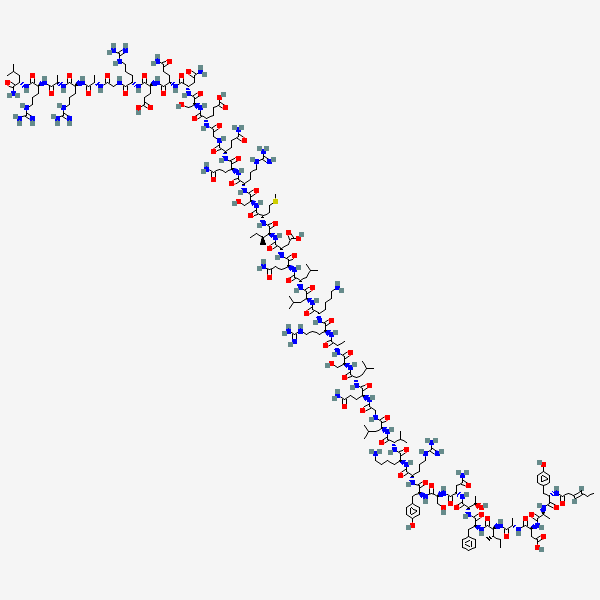
- Molecular formula
- C221H366N72O67S
- Molecular weight
- 5136 g/mol
- IUPAC name
- (4S)-4-[[2-[[(2S)-5-amino-2-[[(2S)-5-amino-2-[[(2S)-2-[[(2S)-2-[[(2S)-2-[[(2S,3S)-2-[[(2S)-2-[[(2S)-5-amino-2-[[(2S)-2-[[(2S)-2-[[(2S)-6-amino-2-[[(2S)-2-[[(2S)-2-[[(2S)-2-[[(2S)-2-[[(2S)-5-amino-2-[[2-[[(2S)-2-[[(2S)-2-[[(2S)-6-amino-2-[[(2S)-2-[[(2S)-2-[[(2S)-2-[[(2S)-4-amino-2-[[(2S,3R)-2-[[(2S)-2-[[(2S,3S)-2-[[(2S)-2-[[(2S)-3-carboxy-2-[[(2S)-2-[[(2S)-2-[[(E)-hex-3-enoyl]amino]-3-(4-hydroxyphenyl)propanoyl]amino]propanoyl]amino]propanoyl]amino]propanoyl]amino]-3-methylpentanoyl]amino]-3-phenylpropanoyl]amino]-3-hydroxybutanoyl]amino]-4-oxobutanoyl]amino]-3-hydroxypropanoyl]amino]-3-(4-hydroxyphenyl)propanoyl]amino]-5-carbamimidamidopentanoyl]amino]hexanoyl]amino]-3-methylbutanoyl]amino]-4-methylpentanoyl]amino]acetyl]amino]-5-oxopentanoyl]amino]-4-methylpentanoyl]amino]-3-hydroxypropanoyl]amino]propanoyl]amino]-5-carbamimidamidopentanoyl]amino]hexanoyl]amino]-4-methylpentanoyl]amino]-4-methylpentanoyl]amino]-5-oxopentanoyl]amino]-3-carboxypropanoyl]amino]-3-methylpentanoyl]amino]-4-methylsulfanylbutanoyl]amino]-3-hydroxypropanoyl]amino]-5-carbamimidamidopentanoyl]amino]-5-oxopentanoyl]amino]-5-oxopentanoyl]amino]acetyl]amino]-5-[[(2S)-1-[[(2S)-4-amino-1-[[(2S)-5-amino-1-[[(2S)-1-[[(2S)-1-[[2-[[(2S)-1-[[(2S)-1-[[(2S)-1-[[(2S)-1-[[(2S)-1-amino-4-methyl-1-oxopentan-2-yl]amino]-5-carbamimidamido-1-oxopentan-2-yl]amino]-1-oxopropan-2-yl]amino]-5-carbamimidamido-1-oxopentan-2-yl]amino]-1-oxopropan-2-yl]amino]-2-oxoethyl]amino]-5-carbamimidamido-1-oxopentan-2-yl]amino]-4-carboxy-1-oxobutan-2-yl]amino]-1,5-dioxopentan-2-yl]amino]-1,4-dioxobutan-2-yl]amino]-3-hydroxy-1-oxopropan-2-yl]amino]-5-oxopentanoic acid
Verified external records:
References
- 1.EGRIFTA (tesamorelin) prescribing information — DailyMed
- 2.Drugs@FDA — tesamorelin (Egrifta) approval record, BLA 022505
- 3.Pivotal Phase 3 trial — tesamorelin in HIV-associated lipodystrophy (NCT00123253)
- 4.Tesamorelin effects on liver fat and histology in HIV (NCT02196831)
- 5.Tesamorelin — indexed research (PubMed, National Library of Medicine)
- 6.WADA Prohibited List — peptide hormones & growth factors (via USADA)
- 7.EGRIFTA WR prescribing information — current 1.28 mg formulation
- 8.EGRIFTA SV prescribing information — current 1.4 mg formulation
- 9.Randomized trial and safety extension for visceral fat (PMID 20101189)
- 10.Randomized trial of tesamorelin for HIV-associated fatty liver (PMID 31611038)
- 11.Controlled tesamorelin trial in older adults and mild cognitive impairment (PMID 22869065)
More on Tesamorelin
Everything else we've written about Tesamorelin — what the community reports, the explainers that cover it, and the terms it keeps running into.
- Tesamorelin Reddit: Belly Fat & EvidenceOn Reddit
- How to Tell If Peptides Are BadExplainer
- What Peptides Are FDA Approved? The Real ListExplainer
- Peptide Side Effects: An Honest GuideExplainer
- How to take peptides: the beginner's guideExplainer
- Subcutaneous vs Intramuscular PeptidesExplainer
- What Is Peptide Therapy? How It WorksExplainer
- Needle gaugeGlossary
- ReconstitutionGlossary
- Sterile water for injectionGlossary