Also known as: CJC-1295 without DAC · CJC-1295 no DAC · Mod GRF 1-29 · GRF(1-29) · tetrasubstituted GRF 1-29
MechanisticUnclear⚠ none in humans
On this page
- What is modified GRF 1-29?
- How does modified GRF 1-29 work?
- What does the research show?
- What the community reports
- Is modified GRF 1-29 safe? Side effects
- FDA & legal status (2026)
- Is modified GRF 1-29 banned in sport?
- How is modified GRF 1-29 used, and can it be mixed?
- Modified GRF 1-29 vs CJC-1295 with DAC
- Frequently asked questions
- Who modified GRF 1-29 is for — and who should be cautious
- Evidence by outcome
- FDA & legal status
- Reported side effects
- Chemical identifiers
- References
- Related compounds
- More on Modified GRF 1-29
Modified GRF 1-29 — the short-acting, no-DAC form of CJC-1295 — is a synthetic GHRH analog: a lab-made copy of the signal that tells your pituitary to release its own growth hormone. It isn’t FDA-approved and is sold only as a research chemical. The mechanism is well understood; direct human proof for this exact peptide is still thin — early days, not a dead end.
If you’re reading this, odds are you’ve seen modified GRF 1-29 (or “CJC-1295 no DAC”) stacked with a peptide like ipamorelin and want to know what it actually is, whether it works, and what the risks are — in plain English, before you decide anything.
What is modified GRF 1-29?
Modified GRF 1-29 is a synthetic peptide — a short, lab-made chain of amino acids (the building blocks of proteins) — that copies the first 29 amino acids of GHRH, your brain’s own “release growth hormone” signal (growth-hormone-releasing hormone). Four amino-acid swaps are built in so the molecule resists being chewed up by enzymes, which lets it last a little longer than the natural fragment. Modified GRF 1-29 is the same base molecule as CJC-1295 without DAC — the two names refer to the same short-acting peptide. In the United States it is not a medicine and not a supplement; it exists only as a research chemical.
How does modified GRF 1-29 work?
Modified GRF 1-29 works as a secretagogue — a compound that doesn’t hand you a hormone, it presses the button that makes your own gland release its own supply. Modified GRF 1-29 binds the GHRH receptor on your pituitary (the docking port your natural GHRH normally uses) and prompts the gland to fire off a pulse of growth hormone. Think of it as tapping the same doorbell your body already uses, rather than pumping growth hormone in from outside. Because it clears fast — on the order of minutes — the effect is a short pulse, which is why people dose it more like a nudge than a flood, and often pair it with a second peptide that pushes GH release through a different door.
What does the research show?
Modified GRF 1-29’s evidence is a case of “great mechanism, missing trial.” No published human study has tested modified GRF 1-29 itself for raising growth hormone, building muscle, or anything else — a ClinicalTrials.gov search returns no registered trials for it. What does exist is strong evidence for the family it belongs to: GHRH analogs raise growth hormone and IGF-1 in people. The closely related DAC version, CJC-1295, produced sustained rises in GH and IGF-1 in healthy adults in a 2006 study (Teichman et al., 2006). Modified GRF 1-29 hits the same receptor, so it’s reasonable to expect a GH pulse — but that’s reasoning from the pathway, not an outcome measured for this exact peptide. We grade the headline use mechanistic-hypothesis with a none-in-humans flag: promising biology, unproven in a human trial. And that gap is thin because the testing is only starting, not because modified GRF 1-29 was tried and came up empty.
What the community reports
Outside any lab, modified GRF 1-29 has a large following among lifters and anti-aging enthusiasts, almost always run alongside a growth-hormone-releasing peptide (a GHRP) such as ipamorelin. The commonly reported pattern is a small subcutaneous dose — a shot into the fat just under the skin — taken before bed or fasted, to piggyback on the body’s own nightly GH pulse. These accounts are anecdotal: they aren’t controlled data, they lean on people who chose to post, and they can’t tell you how often modified GRF 1-29 does nothing. They’re useful for understanding why people are interested, not for proving it works.
Is modified GRF 1-29 safe? Side effects
Modified GRF 1-29’s honest safety answer is “we don’t have much human data on this exact peptide.” Most of what we can say is borrowed from sermorelin — the FDA-approved GHRH analog it’s based on — and from general GH-secretagogue use, where the common complaints are mild and local: redness or itching at the injection site, a warm flush spreading over the face after a shot, the occasional headache, and some water retention or tingling in the hands (sermorelin label, DailyMed). Raising growth hormone and IGF-1 also carries the theoretical questions any GH-raising compound does — most discussed is whether nudging IGF-1 upward could feed something you wouldn’t want to grow, which is unproven in either direction. The most practical real-world risk skews toward the source: research-chemical vials are unregulated, so purity, dose accuracy and sterility vary vendor to vendor.
FDA & legal status (2026)
Modified GRF 1-29 is not FDA-approved, and it is not a legal dietary supplement. In the United States it is sold strictly as a research chemical, labeled “for research use only” — a legal disclaimer that limits the seller’s liability, not a quality or safety guarantee. Its parent molecule, sermorelin, is separately an approved GHRH-analog medicine, but that approval does not extend to modified GRF 1-29. Regulatory attention on growth-hormone peptides is active in 2026, so treat any status claim as dated and re-check it; the dated breakdown is in the FDA & legal status block below.
Is modified GRF 1-29 banned in sport?
Yes — modified GRF 1-29 is prohibited at all times for athletes under anti-doping rules. WADA’s Prohibited List places GHRH and its analogues in category S2 (peptide hormones and growth factors), and that entry explicitly covers CJC-1295 both with and without DAC — the no-DAC form being modified GRF 1-29 — along with sermorelin and tesamorelin (WADA/USADA Prohibited List). Because it’s on the list out of competition too, there is no “safe window” for a tested athlete.
How is modified GRF 1-29 used, and can it be mixed?
Modified GRF 1-29 comes as a lyophilized (freeze-dried) powder that has to be reconstituted — mixed with bacteriostatic water — before use, then given as a subcutaneous injection. Getting the concentration right is pure arithmetic; our reconstitution & dosing calculator turns “5 mg vial, 2 mL water, target dose” into the exact number of insulin-syringe units to draw. Modified GRF 1-29 is one of the most common peptides people ask about combining in a single shot — it’s almost always paired with a GHRP like ipamorelin (the basis of the popular CJC-1295 + ipamorelin stack and the sermorelin + ipamorelin stack). Our mixing compatibility reference covers what people commonly combine and where the honest answer is “not enough data.” Any reported dose here is information about what studies or the community describe — never a personal prescription.
Modified GRF 1-29 vs CJC-1295 with DAC
Modified GRF 1-29 and CJC-1295 with DAC are the same base peptide with one big difference: how long it sticks around. “DAC” is a Drug Affinity Complex — a grappling-hook piece bolted on that grabs a large blood protein (albumin) so the body clears the peptide slowly, stretching its half-life to days and producing a steady, long GH “bleed.” Modified GRF 1-29 has no such hook, so it clears in minutes and gives a short, sharp pulse that looks more like your body’s natural rhythm — which is exactly why many people prefer it and dose it more often. Both belong to the growth-hormone peptide hub; for how a GHRH analog is typically paired against a GHRP, see the CJC-1295 vs ipamorelin comparison.
Frequently asked questions
Is modified GRF 1-29 the same as CJC-1295?
Modified GRF 1-29 is the same base molecule as CJC-1295 without DAC — the short-acting version. When people say “CJC-1295” without qualifying it, they often mean the long-acting DAC version, which is the same peptide plus an albumin-binding piece that makes it last for days instead of minutes.
Does modified GRF 1-29 actually raise growth hormone?
Almost certainly, based on how it works — modified GRF 1-29 binds the same pituitary receptor GHRH uses, and GHRH analogs as a class raise growth hormone in humans. What’s missing is a trial of this exact peptide measuring the size and duration of that pulse, so we grade it mechanistic-hypothesis, not proven.
Is modified GRF 1-29 legal?
Modified GRF 1-29 is sold legally in the United States as a research chemical, but it is not an approved drug or a legal dietary supplement and cannot be sold for human consumption. That’s why every vendor labels it “for research use only.”
Is modified GRF 1-29 banned in sport?
Yes. Modified GRF 1-29 sits in WADA’s S2 category as a GHRH analog and is prohibited at all times — in and out of competition — for athletes subject to anti-doping rules.
How do people take modified GRF 1-29?
In the community it’s reconstituted with bacteriostatic water and injected subcutaneously, usually in a small dose before bed or fasted, and very often alongside a GHRP such as ipamorelin. These are reported patterns, not a validated protocol.
Modified GRF 1-29 vs sermorelin — what’s the difference?
Both are GHRH(1-29) analogs that press the same pituitary button. Sermorelin is the original, FDA-approved medicine; modified GRF 1-29 is a research-chemical version with four amino-acid swaps engineered to resist breakdown and last a bit longer.
Who modified GRF 1-29 is for — and who should be cautious
Modified GRF 1-29 draws in people chasing better recovery, body composition, sleep or skin through a gentle nudge to their own growth hormone, usually as half of a GHRH-plus-GHRP pairing. The honest framing: the mechanism is one of the cleaner stories in the peptide space — it copies a signal your body already uses — and GHRH analogs do raise GH in humans. But the human efficacy proof for this peptide isn’t in, there’s no long-term human safety record, and the product you’d actually buy is unregulated. Anyone pregnant, managing a cancer history, or unwilling to accept real unknowns has every reason to wait for better data.
Evidence by outcome
Each outcome Modified GRF 1-29 has been studied for, with the honest evidence grade and what the studies actually found. A tier never stands alone — the verdict rides with it.
| Outcome | Evidence | What was found |
|---|---|---|
| Boosting your own growth hormone & IGF-1 | MechanisticUnclear⚠ none in humans | GHRH analogs as a class raise growth hormone and IGF-1 in people — the closely-related DAC version, CJC-1295, did exactly that in a 2006 study in healthy adults. Modified GRF 1-29 hits the same pituitary receptor, so the mechanism is well grounded. But no published human trial has measured modified GRF 1-29's own effect on growth hormone or how long it lasts at the doses people actually use. |
| Muscle growth, fat loss & recovery | MechanisticUnclear⚠ none in humans | Modified GRF 1-29 is used to raise growth hormone in the hope of better body composition and faster recovery. Those downstream results have never been tested for this peptide in a human trial — the case rests on the GH pathway, not on outcome data. Promising mechanism, unproven in people. |
| Anti-aging (skin, sleep, recovery) | MechanisticUnclear⚠ none in humans | Modified GRF 1-29 is marketed for skin, sleep and "feeling younger" through a nightly growth-hormone pulse. No human study has tested modified GRF 1-29 for any of these endpoints. This is a reasonable hypothesis from GH biology, not a demonstrated effect. |
FDA & legal status
- United States: research use only (as of Jul 2026)
Modified GRF 1-29 is not an FDA-approved drug and not a dietary supplement — it is sold only as a research chemical, "for research use only." (Its parent molecule, sermorelin, is a separately approved GHRH-analog medicine; modified GRF 1-29 itself is not.) Regulatory attention on GH-releasing peptides is active — re-verify this status periodically.
openFDA Drugs@FDA lists no approved product for modified GRF 1-29 as of 2026-07-15.
Reported side effects
| Effect | Frequency | Severity |
|---|---|---|
| Injection-site reactions — redness, swelling, itching, or a warm flush right at the spot | commonly reported | — |
| Facial flushing or a spreading warmth shortly after the injection | reported | — |
| Headache or lightheadedness | reported | — |
| Water retention, or tingling/numbness in the hands | reported with GH-raising peptides | — |
Chemical identifiers
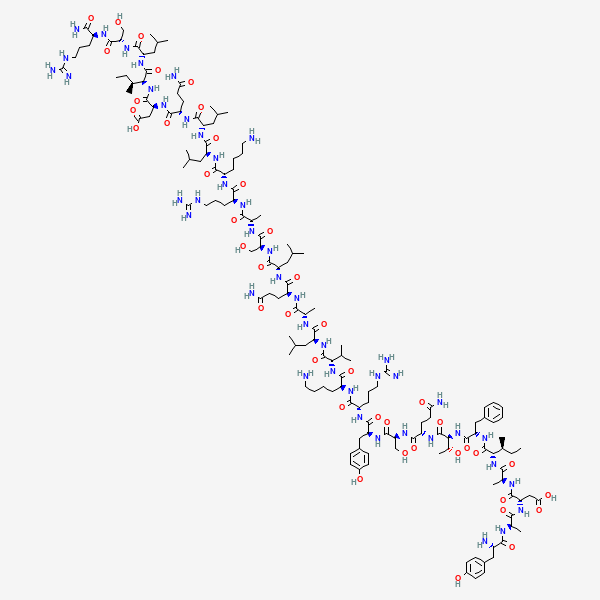
- Molecular formula
- C149H246N44O42S
- Molecular weight
- 3357.9 g/mol
- IUPAC name
- (3S)-4-[[(2S)-1-[[(2S,3S)-1-[[(2S)-1-[[(2S,3R)-1-[[(2S)-4-amino-1-[[(2S)-1-[[(2S)-1-[[(2S)-1-[[(2S)-6-amino-1-[[(2S)-1-[[(2S)-1-[[2-[[(2S)-5-amino-1-[[(2S)-1-[[(2S)-1-[[(2S)-1-[[(2S)-1-[[(2S)-6-amino-1-[[(2S)-1-[[(2S)-1-[[(2S)-5-amino-1-[[(2S)-1-[[(2S,3S)-1-[[(2S)-1-[[(2S)-1-[[(2S)-1-amino-5-carbamimidamido-1-oxopentan-2-yl]amino]-3-hydroxy-1-oxopropan-2-yl]amino]-4-methylsulfanyl-1-oxobutan-2-yl]amino]-3-methyl-1-oxopentan-2-yl]amino]-3-carboxy-1-oxopropan-2-yl]amino]-1,5-dioxopentan-2-yl]amino]-4-methyl-1-oxopentan-2-yl]amino]-4-methyl-1-oxopentan-2-yl]amino]-1-oxohexan-2-yl]amino]-5-carbamimidamido-1-oxopentan-2-yl]amino]-1-oxopropan-2-yl]amino]-3-hydroxy-1-oxopropan-2-yl]amino]-4-methyl-1-oxopentan-2-yl]amino]-1,5-dioxopentan-2-yl]amino]-2-oxoethyl]amino]-4-methyl-1-oxopentan-2-yl]amino]-3-methyl-1-oxobutan-2-yl]amino]-1-oxohexan-2-yl]amino]-5-carbamimidamido-1-oxopentan-2-yl]amino]-3-(4-hydroxyphenyl)-1-oxopropan-2-yl]amino]-3-hydroxy-1-oxopropan-2-yl]amino]-1,4-dioxobutan-2-yl]amino]-3-hydroxy-1-oxobutan-2-yl]amino]-1-oxo-3-phenylpropan-2-yl]amino]-3-methyl-1-oxopentan-2-yl]amino]-1-oxopropan-2-yl]amino]-3-[[(2S)-2-[[(2S)-2-amino-3-(4-hydroxyphenyl)propanoyl]amino]propanoyl]amino]-4-oxobutanoic acid
Verified external records:
References
- 1.Teichman et al., 2006 — CJC-1295 (the DAC analog of GHRH) raised GH & IGF-1 in healthy adults (PubMed)
- 2.Modified GRF 1-29 — indexed research (PubMed, National Library of Medicine)
- 3.Modified GRF 1-29 — registered clinical studies (ClinicalTrials.gov)
- 4.Sermorelin (GHRH analog) label — side-effect & regulatory context (DailyMed)
- 5.WADA Prohibited List — S2 peptide hormones & GH-releasing factors (USADA)
More on Modified GRF 1-29
Everything else we've written about Modified GRF 1-29 — what the community reports, the explainers that cover it, and the terms it keeps running into.