Also known as: Omberacetam · GVS-111 · N-phenylacetyl-L-prolylglycine ethyl ester · SGS-111
Note: Noopept is not a peptide — it's covered here because people research it right alongside peptides.
Human (controlled)Helped
On this page
- What is Noopept?
- How does Noopept work?
- What does the research show?
- What the community reports
- Is Noopept safe? Side effects
- FDA & legal status (2026)
- How is Noopept taken, and can it be mixed?
- Noopept vs Semax
- Frequently asked questions
- Who is Noopept for — and who should be cautious?
- Evidence by outcome
- FDA & legal status
- Reported side effects
- Chemical identifiers
- References
- Related compounds
- More on Noopept
Noopept (omberacetam) is a synthetic nootropic — a dipeptide-derived small molecule, not a true peptide — that improved memory and attention about as much as piracetam in controlled studies of patients with mild cognitive impairment, at roughly a thousandth of the dose. Noopept is not FDA-approved, and its benefit in already-healthy people has never been tested.
What is Noopept?
Noopept is a lab-made compound (chemical name N-phenylacetyl-L-prolylglycine ethyl ester; formula C17H22N2O4, molecular weight 318.4) that Russian researchers designed in the 1990s to act like the classic nootropic piracetam — but at a dramatically smaller dose. Here’s the label that trips people up: Noopept is built from two amino acids (proline and glycine) with a phenylacetyl group and an ethyl ester bolted on, so it’s a dipeptide derivative, not a genuine peptide in the way BPC-157 or semaglutide are. Functionally it behaves like a small-molecule drug you swallow, not an injectable peptide. In Russia, where it was developed, Noopept is a prescription medicine; in the United States it is sold only as a research chemical or “nootropic.”
How does Noopept work?
Noopept doesn’t switch on a single receptor — which is exactly why its story is still half-written. The best-supported piece, from rat studies, is that Noopept raises two of the brain’s own repair-and-growth signals, nerve growth factor (NGF) and brain- derived neurotrophic factor (BDNF), in the hippocampus — the region that files new memories (Ostrovskaya et al., 2008). Think of NGF and BDNF as fertilizer for neurons and their connections; more fertilizer, in theory, means sturdier wiring. Noopept is also broken down in the body into cycloprolylglycine, a dipeptide the brain already makes, and it appears to modulate the glutamate system (the AMPA and NMDA receptors that underpin learning). The honest caveat: every step of this chain is best-documented in animals, and the precise way Noopept works in a human brain has not been established.
What does the research show?
Noopept sits in an unusual spot for a research nootropic — it actually has human clinical data, just narrow data. In a controlled comparative study, patients with mild cognitive impairment from vascular disease or head injury improved on Noopept roughly as much as on piracetam, with gains in memory, attention and mood, and Noopept did it at about a thousandth of the dose (Neznamov & Teleshova, 2009). That’s a controlled human study — real people, a comparison drug — but there was no placebo arm, the trials were small, and this literature comes largely from one research tradition, so independent Western replication is thin (Ostrovskaya et al., 2002). The gap that matters most for the people searching “Noopept”: that patient evidence does not tell you what Noopept does in an already-healthy brain. Nobody has run that trial. The rest of the exciting material — the NGF/BDNF boost, the neuroprotection — is animal-only and unproven in humans. A PubMed search returns a little over a hundred records, about a quarter tagged human, and zero that clear the strict randomized-controlled-trial filter (indexed research).
What the community reports
Outside the clinic, Noopept has a devoted following among students, programmers and biohackers who take it as an oral “smart drug,” usually describing a subtle lift in focus, verbal fluency and mental stamina rather than a dramatic jolt. Some also report a mild mood lift and a sharper sense of visual detail. These accounts are anecdotal and none-in-humans for the enhancement use — they are personal stories, not trials, they carry heavy survivorship bias (people who felt nothing rarely post), and they cannot tell you how often Noopept does nothing at all. A recurring, worth-hearing theme in those same reports is the flip side: taken too late or at too high a dose, Noopept can make people irritable or wreck their sleep. Useful for understanding why interest is high; not evidence that it works.
Is Noopept safe? Side effects
Noopept’s honest safety answer is “reassuring but thin.” In the clinical studies that exist, it was generally well tolerated, with side effects that were mild and reversible — the most common being irritability, disturbed sleep, headache, and, in people who already had high blood pressure, a rise in blood pressure (Neznamov & Teleshova, 2009). Allergic skin reactions turn up occasionally. The real limits are what wasn’t studied: there is no long-term human safety data, no trial in healthy adults, and no pregnancy or pediatric data — so pregnancy, breastfeeding, uncontrolled hypertension and significant liver or kidney problems are all sensible reasons to steer clear. As with any compound sold as a research chemical, the product you’d actually buy is unregulated, so its purity and the accuracy of the dose rest on the seller’s word alone. Noopept’s side-effect profile is gentle on paper; the caution is about the gaps, not a long list of harms.
FDA & legal status (2026)
Noopept is not FDA-approved for anything, and it is not a legal dietary supplement either. Because it is not a vitamin, mineral, botanical or amino acid, Noopept doesn’t fit the supplement definition, yet it is widely sold in the United States as a “nootropic” — a gray zone the FDA has pushed back on with warning letters treating such products as unapproved drugs. Noopept is federally unscheduled, so it is legal to possess. It is worth knowing that Noopept is a different animal abroad: in Russia, where it was developed, it is an approved prescription medicine. Treat any status claim as dated and re-check it — the full dated breakdown is in the FDA & legal status block below.
How is Noopept taken, and can it be mixed?
Noopept is an oral drug, which sets it apart from the injectable peptides on this site — there is no vial to reconstitute and no needle involved, so our reconstitution & dosing calculator (built for lyophilized injectable peptides) doesn’t apply here. In the human studies, Noopept was given by mouth at 10 mg twice a day (about 20 mg daily), sometimes up to 30 mg daily, in courses of roughly one-and-a-half to three months (Neznamov & Teleshova, 2009). Those are doses reported in cited research, in cognitively-impaired patients — information, not a personalized protocol, and not a validated dose for healthy people. Community users often take it sublingually and report starting low; because Noopept can disturb sleep, the common-sense note is to avoid dosing late in the day.
Noopept vs Semax
Noopept and Semax are the two most-searched compounds in the nootropic / mental-health category, and people often weigh them against each other. In short: Noopept is an oral dipeptide-derived molecule with a small base of controlled human data in cognitive-impairment patients, while Semax is an actual peptide (a fragment of ACTH) usually given as a nasal spray and studied more for stroke recovery and acute cognitive stress. Neither has a modern placebo-controlled RCT in healthy people. If you’re comparing the broader nootropic peptides, the honest through-line is that human evidence is strongest in patient populations and thinnest for everyday enhancement.
Frequently asked questions
Is Noopept a peptide?
Not really — and this is the most common misconception. Noopept is derived from a dipeptide (proline-glycine) but chemically it’s a modified small molecule with a phenylacetyl group and an ethyl ester, and it behaves like an oral small-molecule drug, not an injectable peptide. Calling it “a peptide” is a useful shorthand that’s technically wrong.
Does Noopept actually work?
For patients with mild cognitive impairment, controlled studies found Noopept improved memory and attention comparably to piracetam (Neznamov & Teleshova, 2009). For making an already-healthy person sharper — the reason most people look it up — there is no human trial. So: promising in patients, unproven in the healthy.
Is Noopept legal in the US?
Noopept is federally unscheduled, so it’s legal to possess, and it’s sold openly as a “nootropic.” But it is not FDA-approved and not a lawful dietary supplement, which is why vendors sell it “for research use only” and the FDA has objected to it being marketed as a drug.
Is Noopept banned in sport?
Noopept is not specifically named on the WADA Prohibited List as of 2026, and because it’s an approved medicine in some countries the “non-approved substances” catch-all is unlikely to apply. That said, tested athletes should confirm current status directly with their anti-doping authority, since supplement contamination is a real risk.
How is Noopept taken?
By mouth. Human studies used 10 mg twice daily (about 20 mg/day) for one-to-three-month courses; the community often doses sublingually and avoids taking it late because it can disturb sleep. These are doses reported in research and community use — information, not a recommendation.
Who is Noopept for — and who should be cautious?
Noopept draws in two very different crowds: people (or their families) dealing with genuine age- or injury-related cognitive decline, where the controlled human data actually lives, and healthy biohackers chasing an edge, where the data essentially doesn’t. The honest framing: Noopept has more human clinical footing than most compounds in the nootropic category, its side-effect profile is mild, and its base dose is tiny — but the enhancement use is unproven, there’s no long-term safety data, and the version you’d buy in the US is unregulated. Anyone pregnant or breastfeeding, managing uncontrolled blood pressure, or with significant liver or kidney disease has every reason to skip it and wait for evidence that isn’t there yet.
Evidence by outcome
Each outcome Noopept has been studied for, with the honest evidence grade and what the studies actually found. A tier never stands alone — the verdict rides with it.
| Outcome | Evidence | What was found |
|---|---|---|
| Cognitive symptoms in mild cognitive impairment (vascular / post-traumatic) | Human (controlled)Helped | In a controlled comparative study, patients with mild cognitive disorders from vascular or head-injury causes improved on Noopept about as much as on piracetam, at roughly 1,000× lower a dose. This was a controlled human study without a placebo arm, largely from one research tradition — encouraging for patients, not proof of a benefit in healthy people. |
| Cognitive enhancement in already-healthy adults (the biohacker use) | MechanisticUnclear⚠ none in humans | Noopept's popularity rests on making sharp, healthy people sharper — and that specific use has essentially no human trial behind it. The reasoning is drawn from patient studies and animal data, not from testing healthy volunteers. Treat the "smart-drug" claim as a hypothesis, not a finding. |
| Neuroprotection / nerve-growth-factor (NGF & BDNF) support | Animal-onlyUnclear⚠ none in humans | In rats, Noopept raised NGF and BDNF in the hippocampus and protected neurons in several injury models. Rats are not people, the doses and routes don't transfer directly, and no human study has confirmed a neuroprotective effect. |
FDA & legal status
- United States: research use only (as of Jul 2026)
Not an FDA-approved drug and not a lawful dietary-supplement ingredient — Noopept is not a vitamin, mineral, botanical or amino acid, so it does not fit the supplement definition. It is federally unscheduled (legal to possess), and it is sold openly as a "nootropic" or research chemical. Re-verify: the FDA has issued warning letters over nootropics marketed as unapproved drugs.
openFDA Drugs@FDA lists no approved product for Noopept as of 2026-07-15.
Reported side effects
| Effect | Frequency | Severity |
|---|---|---|
| Irritability or restlessness | — | usually mild and reversible |
| Trouble sleeping (worse when taken late in the day) | — | usually mild |
| Headache | — | usually mild |
| Raised blood pressure — reported mainly in people who already have hypertension | — | mild-to-moderate; a reason for caution if you're hypertensive |
| Allergic skin reactions | — | uncommon |
Chemical identifiers
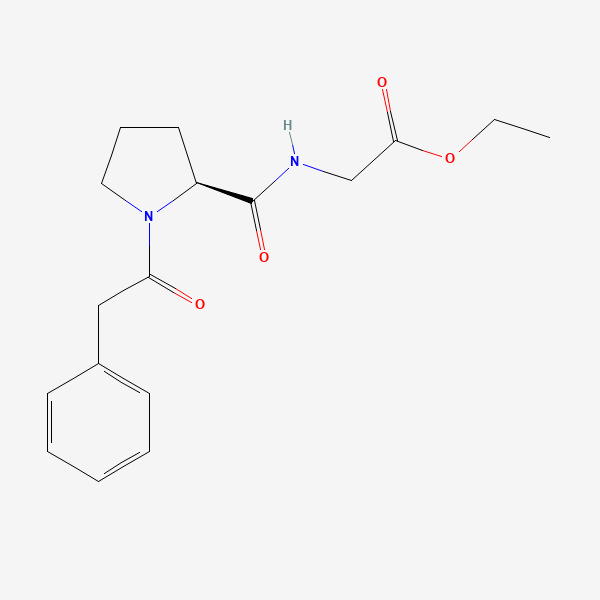
- Molecular formula
- C17H22N2O4
- Molecular weight
- 318.4 g/mol
- IUPAC name
- ethyl 2-[[(2S)-1-(2-phenylacetyl)pyrrolidine-2-carbonyl]amino]acetate
Verified external records:
References
- 1.Noopept — indexed research (PubMed, National Library of Medicine)
- 2.Neznamov & Teleshova, 2009 — Noopept vs piracetam in mild cognitive disorders (Neurosci Behav Physiol)
- 3.Ostrovskaya et al., 2008 — Noopept stimulates NGF and BDNF in rat hippocampus (Bull Exp Biol Med)
- 4.Ostrovskaya et al., 2002 — review of noopept's nootropic and neuroprotective properties (Eksp Klin Farmakol)
- 5.FDA — approved drug information (Noopept is not an FDA-approved drug)
More on Noopept
Everything else we've written about Noopept — what the community reports, the explainers that cover it, and the terms it keeps running into.
- Noopept Reddit: Effects, Dosage & EvidenceOn Reddit
- NootropicGlossary