Also known as: Examorelin · EP-23905 · His-D-2-Me-Trp-Ala-Trp-D-Phe-Lys-NH2 · L-Histidyl-2-methyl-D-tryptophyl-L-alanyl-L-tryptophyl-D-phenylalanyl-L-lysinamide
Human RCTHelped
On this page
- What is hexarelin?
- How does hexarelin work?
- What does the research show?
- Is hexarelin safe? Side effects
- FDA & legal status (2026)
- How is hexarelin used, and can it be mixed?
- Hexarelin vs other GH secretagogues
- Hype vs reality
- Frequently asked questions
- Who is hexarelin for — and who should be cautious?
- Evidence by outcome
- FDA & legal status
- Reported side effects
- Chemical identifiers
- References
- Related compounds
- More on Hexarelin
Hexarelin is a synthetic growth-hormone-releasing peptide (a GHRP) that, in placebo-controlled human studies, reliably triggers a short, sharp pulse of the body’s own growth hormone. Hexarelin is not FDA-approved and is sold only as a research chemical. That GH spike is real and human-proven — but it fades within weeks of daily use, and no trial shows it builds muscle.
What is hexarelin?
Hexarelin is a lab-made peptide — a chain of six amino acids (His-D-2-Me-Trp-Ala-Trp-D-Phe-Lys-NH2, molecular weight 887) built as a more potent cousin of the earlier peptide GHRP-6. Hexarelin belongs to the “growth-hormone secretagogue” family: compounds that don’t add growth hormone from outside but signal your own pituitary to release more of it. Hexarelin is one of the ghrelin-mimetic “GHRPs” — the pulse-triggering half of the growth-hormone secretagogue family. It was created as a drug candidate under the name examorelin, studied heavily in the 1990s, then shelved before it ever reached the market. Today hexarelin exists only as a research chemical.
How does hexarelin work?
Hexarelin works by binding the growth hormone secretagogue receptor (GHS-R1a) — the same receptor the hunger hormone ghrelin uses — in the pituitary and hypothalamus. Picture the pituitary as a bell: hexarelin is a hand that gives it a firm strike, and a pulse of growth hormone rings out, peaking around 30 minutes after a dose (human route-comparison study). Hexarelin has a second, separate job most GH peptides don’t: it also binds the CD36 receptor on heart cells, which is the route behind its cardiac effects in animals and appears to work independently of growth hormone (CD36 mechanism study). The plain-English version: one hand rings the GH bell, the other hand does something directly to heart tissue.
What does the research show?
Hexarelin splits cleanly into one thing that is well-proven in humans and several things that aren’t. The proven part: hexarelin reliably raises growth hormone in people. In placebo-controlled human studies, a single injection produced a large, dose-dependent GH spike, and this has been replicated across intravenous, subcutaneous, intranasal and oral routes (route-comparison study). That is stronger human evidence than most research peptides can claim. Here is the honest map of what each use has actually earned:
| Use | Best evidence so far | What it showed |
|---|---|---|
| Raising growth hormone (headline) | Human RCT | Reliable, dose-dependent GH spike within ~30 min in placebo-controlled human studies. |
| Building muscle / body composition | Mechanistic-hypothesis + None-in-humans | No human trial. The “GH is anabolic, so hexarelin builds muscle” chain is unproven for hexarelin. |
| Heart protection (cardioprotection) | Animal-only + None-in-humans | In rats, hexarelin improved cardiac output via CD36 after heart attack. No human outcome trial. |
The most important caveat sits inside the proven part. Hexarelin’s GH effect desensitizes — with continuous daily dosing the growth-hormone response shrinks over time. A study that gave hexarelin over 16 weeks found the GH response fell as treatment went on, though the blunting was partial and recovered after a four-week break (Rahim & Shalet, 1998). So hexarelin’s best-documented human effect is also a fading one. The cardiac work is real but animal-only for now: in rats, hexarelin improved cardiac output and limited damage after an induced heart attack through the CD36 receptor, an effect that vanishes in CD36-deficient animals (cardiovascular review) — promising biology, but not something demonstrated in a human trial.
Is hexarelin safe? Side effects
Hexarelin’s honest safety answer is: better human data than most peptides for the short term, and no long-term data at all. In the human studies hexarelin was generally well tolerated acutely, but it does more than raise growth hormone — hexarelin also nudges up prolactin, ACTH and cortisol, in a dose-dependent way (dose-response study). That matters because chronically elevated prolactin and cortisol are not effects most people are chasing. Commonly reported near-term effects include transient facial flushing or tingling, increased hunger, water retention, and — with continued daily use — fatigue and the GH desensitization described above. The deeper problem is what nobody has measured: there is no long-term human safety study for the physique or anti-aging use hexarelin is actually bought for. Add the research-chemical reality — unregulated vials with variable purity, dosing accuracy and sterility — and the practical risk often has more to do with the source than the molecule.
FDA & legal status (2026)
Hexarelin is not FDA-approved, and it is not a legal dietary supplement. As of 2026, hexarelin (International Nonproprietary Name “examorelin”) has never been approved as a medicine anywhere — it was developed as a drug candidate in the 1990s and shelved before reaching market. In the United States hexarelin is sold strictly as a research chemical, which is why every vendor labels it “for research use only.” Enforcement around research peptides is shifting, so treat any status claim as dated and re-check it. The dated, per-jurisdiction breakdown is in the FDA & legal status block below.
How is hexarelin used, and can it be mixed?
Hexarelin comes as a lyophilized (freeze-dried) powder that has to be reconstituted with bacteriostatic water before use. In the human research literature, hexarelin was given by injection at doses on the order of 1–2 micrograms per kilogram of body weight (a common provocative-test dose), and it was also studied intranasally and orally; in the community, subcutaneous doses of roughly 100 micrograms are commonly reported. These are doses reported in studies and community accounts, not a recommended protocol — the desensitization data are the reason people cycle it rather than run it continuously. Getting a concentration right from a vial is pure arithmetic — our reconstitution & dosing calculator turns “5 mg vial, 2 mL water, 100 mcg target” into the exact number of insulin-syringe units. People also ask whether hexarelin can share a syringe with other peptides; our mixing compatibility reference covers what is commonly combined and where the honest answer is “not enough data.”
Hexarelin vs other GH secretagogues
Hexarelin sits in the ghrelin-mimetic “GHRP” branch of the growth-hormone secretagogues — the peptides that trigger a pulse — alongside relatives like GHRP-6, GHRP-2 and ipamorelin, while GHRH analogs such as sermorelin, CJC-1295 and the FDA-approved tesamorelin work through a different receptor to raise the baseline. In practice hexarelin is the hardest-hitting and also the most prone to desensitization and to raising cortisol and prolactin — which is why many people favor cleaner, more selective options. For how the pulse-and-baseline pairing is usually thought about, see the CJC-1295 vs ipamorelin comparison and the classic CJC-1295 + ipamorelin stack; the gentler sermorelin + ipamorelin stack is the more conservative cousin of the same idea.
Hype vs reality
The biggest hexarelin claim online is that it builds slabs of muscle, and it deserves a straight answer: hexarelin is proven to raise growth hormone in humans, but it is not proven to build muscle in humans. Those are two different claims, and the gap between them is where the hype lives. No human trial has measured hexarelin’s effect on muscle mass, strength or fat. The mechanism is plausible — a GH pulse is anabolic in principle — but “raises a hormone that’s involved in growth” is a hypothesis about physique, not a demonstrated result, and hexarelin’s fast desensitization actively undercuts the story. The second overclaim is “more GH is always better.” Hexarelin also raises cortisol and prolactin, so the endocrine picture is messier than a clean growth-hormone boost.
Frequently asked questions
Does hexarelin actually work?
Hexarelin definitely works for one thing: raising growth hormone. Placebo-controlled human studies show a reliable, dose-dependent GH spike. Whether that translates into the muscle, fat-loss or anti-aging outcomes people want is unproven — no human trial has tested those, and the GH effect fades with daily use.
Is hexarelin legal?
Hexarelin is legal to buy and sell as a research chemical in the United States, but it is not an FDA-approved drug and not a legal dietary supplement, and it cannot be sold for human consumption. That is why vendors list it “for research use only.”
Is hexarelin banned in sport?
Yes. Hexarelin is a growth-hormone secretagogue, a class the World Anti-Doping Agency prohibits by name under category S2 at all times — both in and out of competition — for athletes subject to anti-doping rules.
Why do people cycle hexarelin instead of using it continuously?
Because hexarelin’s growth-hormone effect desensitizes. A 16-week human study found the GH response shrank with continuous daily dosing, then recovered after a four-week break. That fading response is the reason short, targeted cycles are the common pattern rather than daily long-term use.
How is hexarelin taken?
In the research literature hexarelin was injected (intravenously or subcutaneously) and also tested intranasally and orally, after being reconstituted with bacteriostatic water. The subcutaneous injection is what most community use looks like.
Who is hexarelin for — and who should be cautious?
Hexarelin draws in lifters and biohackers chasing a growth-hormone boost for recovery, sleep and body composition — usually people who’ve read the wild pump-and-PR anecdotes and want to understand the compound before deciding. The honest framing: hexarelin’s core effect (a real GH pulse) is one of the better-documented facts in the research-peptide space. But the physique payoff isn’t proven in a human trial, the GH effect desensitizes within weeks, hexarelin also raises cortisol and prolactin, and the product you’d buy is unregulated. Anyone pregnant, managing a cancer history, or unwilling to accept real unknowns has every reason to sit this one out — and any athlete under anti-doping rules should treat it as a hard no.
Evidence by outcome
Each outcome Hexarelin has been studied for, with the honest evidence grade and what the studies actually found. A tier never stands alone — the verdict rides with it.
| Outcome | Evidence | What was found |
|---|---|---|
| Stimulating growth-hormone release | Human RCTHelped | Placebo-controlled human studies show hexarelin triggers a large, dose-dependent spike in growth hormone within about 30 minutes of an injection — this is hexarelin's best-proven, most-replicated effect in people. The catch: with continuous daily use the GH response fades (partial, reversible desensitization), so a proven acute spike is not the same as a sustained one. |
| Building muscle or improving body composition | MechanisticUnclear⚠ none in humans | No human trial has tested whether hexarelin's growth-hormone spikes actually build muscle, cut fat, or change body composition. The reasoning is a chain — hexarelin raises GH, GH is anabolic, therefore muscle — but each link past the GH spike is unproven for hexarelin, and the fast desensitization works against it. Grade it a hypothesis, not a result. |
| Heart protection (cardioprotection) | Animal-onlyMixed⚠ none in humans | In rat models of heart attack and heart failure, hexarelin improved cardiac output and limited damage through the CD36 receptor, independent of growth hormone — the effect disappears in CD36-deficient animals. Human data are limited to short acute-hemodynamic observations; there is no outcome trial in people, so this stays animal-only. |
FDA & legal status
- United States: research use only (as of Jul 2026)
Hexarelin (International Nonproprietary Name "examorelin") was developed as a drug candidate in the 1990s but was never brought to market and has never been FDA-approved for any use. It is not a dietary supplement either — in the United States it is sold strictly as a research chemical. Re-verify this status periodically, as enforcement around research peptides is in flux.
openFDA Drugs@FDA lists no approved product for Hexarelin as of 2026-07-15.
Reported side effects
| Effect | Frequency | Severity |
|---|---|---|
| Transient rise in prolactin, ACTH and cortisol after dosing | expected, dose-dependent | usually mild and short-lived |
| Reduced growth-hormone response with continuous daily use (desensitization) | with sustained daily dosing | partial and reversible after a break |
| Facial flushing, warmth or tingling shortly after injection | — | transient |
| Increased appetite / hunger | — | mild |
| Water retention and mild puffiness | — | mild |
Chemical identifiers
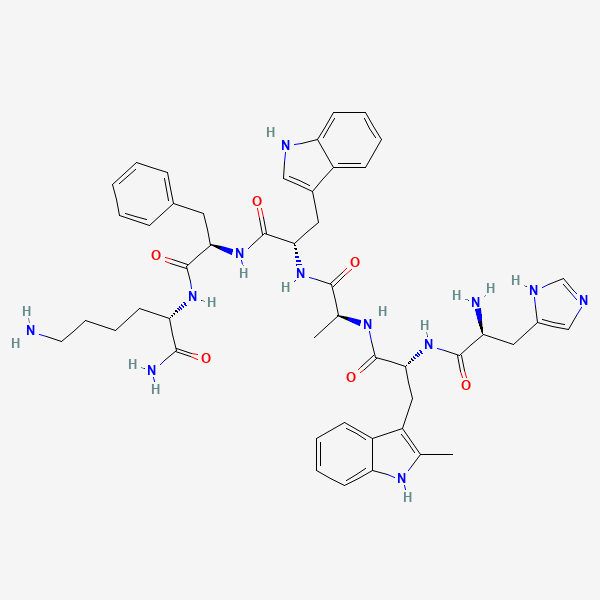
- Molecular formula
- C47H58N12O6
- Molecular weight
- 887 g/mol
- IUPAC name
- (2S)-6-amino-2-[[(2R)-2-[[(2S)-2-[[(2S)-2-[[(2R)-2-[[(2S)-2-amino-3-(1H-imidazol-5-yl)propanoyl]amino]-3-(2-methyl-1H-indol-3-yl)propanoyl]amino]propanoyl]amino]-3-(1H-indol-3-yl)propanoyl]amino]-3-phenylpropanoyl]amino]hexanamide
Verified external records:
References
- 1.Hexarelin's GH-releasing activity in humans (IV, SC, intranasal, oral) — PubMed
- 2.Hexarelin-induced GH, cortisol and prolactin release: a dose-response study — PubMed
- 3.Does desensitization to hexarelin occur? (Rahim & Shalet, 1998) — PubMed
- 4.The cardiovascular action of hexarelin (review) — PubMed
- 5.CD36 mediates the cardiovascular action of GH-releasing peptides in the heart — PubMed
- 6.WADA Prohibited List — S2 growth hormone secretagogues (USADA)
- 7.Hexarelin — indexed research (PubMed, National Library of Medicine)
- 8.Drugs@FDA — no approved hexarelin product listed
More on Hexarelin
Everything else we've written about Hexarelin — what the community reports, the explainers that cover it, and the terms it keeps running into.
- Hexarelin Reddit: Strongest GHRP, Real TalkOn Reddit
- Receptor desensitizationGlossary
- Receptor desensitizationGlossary
- ToleranceGlossary