Also known as: Lys-Pro-Val · Lysine-Proline-Valine · alpha-MSH(11-13)
Animal-onlyHelped⚠ none in humans
On this page
- What people actually use KPV for — and what they report
- What is KPV?
- How does KPV work?
- Does KPV actually work? What the science says
- Is KPV safe? Side effects
- FDA & legal status (2026)
- How people use KPV: doses, routes, and mixing
- KPV vs BPC-157
- Frequently asked questions
- Who KPV is for — and who should skip it?
- Evidence by outcome
- FDA & legal status
- Chemical identifiers
- References
- Related compounds
- More on KPV
If you’re here, odds are your gut has been picking fights — a colitis flare that won’t settle, IBS that reacts to everything, or that vague “everything’s inflamed” feeling — and KPV keeps coming up as the small peptide that might turn the volume down. So here’s the straight version, with nothing to sell you.
KPV is a three-amino-acid fragment of the hormone alpha-MSH that people use to calm inflammation — most often a cranky gut (IBD- and colitis-type problems), sometimes skin flares. In mouse models of colitis it quieted the inflamed gut over and over, even taken orally. The catch: all of that evidence is preclinical, there’s no human trial, and it isn’t FDA-approved. And because “less inflammation” isn’t something you feel the way you feel caffeine, KPV is also one of the harder peptides to judge from your own couch — which is exactly why the community reports below matter, and where their limits are.
What people actually use KPV for — and what they report
KPV has a smaller, more specific following than the big healing peptides, and it clusters into three camps: the gut crowd (IBD, ulcerative colitis, IBS, “leaky gut,” food reactivity), the histamine/MCAS crowd, and people chasing calmer skin. What ties them together is one job — turn inflammation down — and the reason people reach for KPV specifically is that it’s the anti-inflammatory piece of alpha-MSH without the skin-darkening or appetite effects of the whole hormone.
Oral vs injected — the thing everyone actually argues about. For gut problems, the community leans hard toward oral capsules, and the logic is smarter than “swallowing a peptide” first sounds. The goal isn’t to get KPV into your bloodstream; it’s to get it onto inflamed gut lining as it passes through. Swallowed KPV acts locally on the intestinal wall, which is exactly where a colitis flare lives. People running it for whole-body inflammation are the ones who inject it subcutaneously (more predictable dosing), and the skin crowd mostly reaches for topical creams, where the pitch is calming a flare without the skin-thinning that long-term steroids bring. That three-way split — oral for gut, injected for systemic, topical for skin — shows up again and again across peptide forums and gut-health communities.
The BPC-157 pairing. The single most common thing people stack KPV with is BPC-157, and the community’s mental model is tidy: KPV turns the inflammation down, BPC-157 patches the lining back up, often one in the morning and the other at night. It shows up inside bigger “gut-healing” stacks too. Worth being clear-eyed, though — nobody has tested that combination in a human, so “they work great together” is a theory people like, not a result anyone measured.
The doses people actually run (anecdotal — not a validated human protocol): injected, the common range is 200–500 mcg per day subcutaneously, sometimes nudged toward 1 mg for stubborn flares, usually starting around 200 mcg for a week to check tolerance. Oral doses run higher — often 500 mcg to a few milligrams a day — precisely because a swallowed peptide gets partly chewed up in digestion, so more has to go in for the same local effect. Cycles cluster at 4–8 weeks, stretched to 8–12 for chronic gut issues. None of these numbers come from a human trial; they’re crowd conventions, passed peer to peer, and they carry exactly the reliability that implies.
What they report — the wins and the flat runs. The gut reports carry the most conviction: less bloating, calmer flares, fewer food reactions, sometimes inside the first two to four weeks. The MCAS and histamine-intolerance crowd is especially enthusiastic — the idea that quieting NF-κB settles twitchy mast cells has made KPV a favorite there — though the loudest write-ups tend to be dramatic single-person recovery stories, which is the exact kind of anecdote to hold loosely. Skin users describe flares settling faster. And the letdowns are just as real: plenty of people feel nothing they can point to, some get only injection-site irritation or a brief flush and no benefit, and “reassess if nothing’s changed by six weeks” is standard advice.
Here’s the honest limit under all of it. KPV’s whole proposed job — less inflammation — has no obvious felt signal. There’s no rush, no pump, no warmth. To actually confirm it’s working you’d want an inflammatory marker like hs-CRP to drop, and no human study has shown that it does. So an anecdotal “it helped” is unusually hard to separate from a good week, a diet tweak, or a flare that was going to settle on its own. Stack the usual survivorship bias on top — the people who feel nothing quietly stop and never post — and “most people say it helps” really means “most people who bothered to write it up.”
What is KPV?
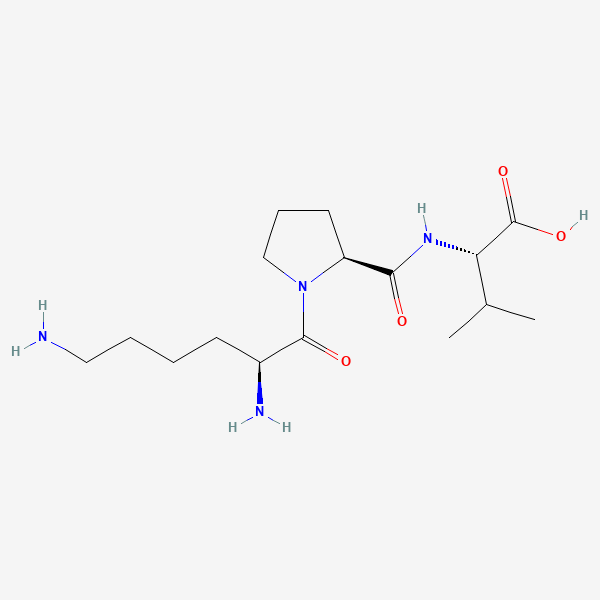
KPV is a lab-made peptide of just three amino acids — lysine, proline, and valine (single-letter K-P-V, which is where the name comes from). Those three are the very tail end of alpha-MSH, a hormone your body already makes; KPV is that hormone’s anti-inflammatory business end, snipped off and used on its own. Trimming the hormone down to this three-residue tail is the whole trick: KPV keeps the inflammation-calming activity but drops the parts of alpha-MSH that darken skin or nudge appetite.
KPV free base has the formula C16H30N4O4, a molecular weight of 342.43 g/mol, and CAS number 67727-97-3. There’s a catch the FDA now leans on: “KPV free base” and “KPV acetate” are two different bulk substances, not interchangeable names — the acetate salt weighs more because the acetate is part of the material. A vial labeled only “KPV” can leave out the first thing you’d need to make sense of its stated mass, its purity certificate, or its stability data: which chemical form is actually inside. It’s also not an FDA-approved medicine or a lawful dietary-supplement ingredient.
How does KPV work?
KPV works, in lab models, by slipping inside cells and turning down NF-κB — picture NF-κB as the cell’s inflammation alarm, the switch that tells it to start blaring out inflammatory cytokines. Quiet the switch and the downstream noise drops. In gut and immune cells, KPV gets in through a transporter called PepT1, a doorway built for exactly these short protein fragments, and oral KPV reduced inflammation in two mouse colitis models (Gastroenterology, PMID 18061177).
PepT1 has a useful quirk worth knowing. It mostly lives in the small intestine, but an inflamed colon — the colitis situation — ramps up PepT1 where it normally isn’t. In plain terms: the more inflamed the gut tissue, the harder it pulls KPV in. That’s the mechanistic reason “just swallow it” isn’t as naive as it sounds for gut problems — the target tissue does part of the delivery work itself.
The mechanism doesn’t collapse into one tidy receptor story, though. KPV also shut down NF-κB in cultured human bronchial cells by blocking a signaling piece called p65RelA from moving into the nucleus (PMID 22837805), and separate mouse-colitis work found a benefit even when melanocortin receptor 1 wasn’t working normally. FDA’s 2026 review says KPV’s precise molecular targets are still unresolved. The map is real; it just stops well short of a human body.
Does KPV actually work? What the science says
KPV’s evidence is a cell-and-animal story, and here’s the honest headline: it’s entirely preclinical. Several results point the same direction — less inflammatory signaling in cells, less tissue damage in mouse colitis, faster closure in a rabbit cornea — but the whole human column is blank. No trial has given KPV free base or KPV acetate to a person by any route, which keeps the top-line grade at animal-only, none in humans, even though the preclinical work is well past a single lucky experiment.
| Question | What researchers actually tested | Evidence tier | What it cannot answer |
|---|---|---|---|
| Gut inflammation | Free KPV in cultured intestinal and immune cells, then oral dosing in DSS and TNBS mouse colitis models | Animal-only | Whether KPV improves symptoms, endoscopic healing, or relapse rates in human IBD |
| Targeted oral delivery | KPV-loaded nanoparticles in an oral hydrogel, aimed at inflamed mouse colon tissue | Animal-only | Whether a consumer capsule reaches the same tissue or reproduces the engineered formulation |
| Corneal repair | Topical KPV at 1, 5, or 10 mg/mL after mechanical corneal abrasion in rabbits | Animal-only | Whether a skin cream heals human wounds, eczema, acne, or surgical sites |
| General anti-inflammatory signaling | NF-κB and cytokine readouts in cultured intestinal, immune, skin, and airway cells | In-vitro | A useful human dose, route, duration, interaction profile, or long-term safety |
The gut work has the most continuity behind it. Two separate 2008 groups reported KPV calming distinct mouse colitis models (PMID 18092346), and a 2017 team pushed it further: they packed KPV into hyaluronic-acid nanoparticles about 272 nm across, wrapped them in an oral hydrogel, and the targeted particles reached inflamed colon cells and outperformed plain KPV particles in mice (Molecular Therapy, PMID 28143741). Read that one carefully, though — it’s a win for a clever delivery system, not proof that loose powder in a capsule does the same job.
The cornea result is worth stating precisely, because online it usually gets inflated into “KPV heals skin.” Rabbits had their entire corneal surface scraped off, then received topical KPV; at 60 hours, all eight KPV-treated corneas had fully closed and none of the vehicle-treated ones had (PMID 16965771). Clean result — one specific tissue, one animal model. It doesn’t travel to eczema, acne, or a surgical scar on its own.
There’s also a dish-level antimicrobial thread: KPV curbed Staphylococcus aureus and Candida albicans in culture, an activity inherited from its parent hormone (PMID 10670585), and a linked dimer, [Ac-CKPV]2, killed Candida — including azole-resistant strains — in the lab (PMID 15946192). Interesting, and entirely in a dish.
My read: KPV is one of the more coherent preclinical stories in the research-peptide world — a plausible mechanism, a target tissue that helps deliver the drug to itself, and gut results that repeat across labs and models. What it doesn’t have is a single human data point, and that isn’t a footnote — it’s the whole open question. The encouraging part is where that question sits: a well-framed, testable lead parked right at the doorway of human research, not a claim that was tried in people and fell apart.
Is KPV safe? Side effects
KPV’s honest safety answer is unusually bare: no human exposure study has tested KPV free base or KPV acetate by mouth, on skin, by injection, or any other route. FDA’s 2026 review also found none of the standard safety studies — no acute-toxicity, repeat-dose, genotoxicity, reproductive-toxicity, or carcinogenicity data — for either substance. “Only three amino acids” describes how small KPV is; it is not a safety record. And no reported adverse events is not the same as evidence of no adverse events.
What people describe anecdotally is mild and uncontrolled: injection-site reactions, occasional short-lived flu-like feelings, and skin irritation with topical use. Because these are self-reports, they can’t establish how often anything happens, whether KPV caused it, or whether the real culprit was a formulation or handling problem. They don’t shift the central fact: no serious event has been reported, and that is not the same as KPV being shown safe.
The practical risks start with identity. FDA found inconsistent naming across KPV salts and derivatives, incomplete impurity controls, no useful data on whether the peptide clumps together (aggregates), and missing microbiological controls for the topical products people nominated. Peptides can aggregate or break down with shifts in pH, temperature, or concentration, and a vial bought online adds dose accuracy and sterility to that list. KPV may well turn out to be forgiving; the data that would show it simply aren’t here yet.
FDA & legal status (2026)
KPV is not FDA-approved, is not a lawful dietary-supplement ingredient, and was not on the federal 503A Bulks List as of July 17, 2026. The live wrinkle is specific: FDA staff evaluated KPV free base and KPV acetate for use in compounded topical creams and gels, and proposed not adding either one. A Pharmacy Compounding Advisory Committee discussion is scheduled for July 23, 2026 — but that meeting, and whatever it recommends, is not a final FDA determination.
The 38-page FDA briefing on KPV gives four reasons: KPV products aren’t well characterized; how much compounding is actually happening is unclear; FDA found no human safety or effectiveness information; and approved treatments already exist for the wound-healing and inflammatory uses KPV was nominated for. FDA also found websites selling compounded oral, injectable, topical, and nasal KPV. That’s worth stating plainly: compounded products are being marketed, but being marketed doesn’t make them FDA-approved or confirm they qualify under section 503A.
| Question | Status on July 17, 2026 | What that means |
|---|---|---|
| FDA approval | Not approved | No FDA-reviewed KPV indication, label, or drug product exists |
| Compounding (503A) | FDA staff propose against listing; July 23 committee meeting pending | A pharmacy offering a KPV cream is not evidence it’s approved or lawfully compoundable |
| Research-chemical & compounded sales | Sold online; compounded oral, topical, injectable, and nasal products marketed | Available and marketed doesn’t mean approved, safe, or effective |
| Elite sport | Prohibited at all times (WADA S0) | Treated as a non-approved substance; a hard no for tested athletes |
This is a decision in motion, not background wallpaper. Before July 23, the accurate status is: FDA staff recommend against 503A inclusion; committee input and a final agency decision are still pending. Anyone telling you KPV is already cleared for compounding — or that the meeting itself restores legal compounding — has skipped the step that actually decides it.
How people use KPV: doses, routes, and mixing
There is no validated human dose for KPV — no completed trial has set one, so every number in circulation is either a mouse figure or a community convention. In the research, KPV shows up as free peptide in mouse drinking water, engineered oral nanoparticles, topical drops in rabbit eyes, and solutions on cultured cells: routes and formulations that aren’t interchangeable, and none of which is a human protocol. Online, it’s sold as lyophilized powder, capsules, creams, and nasal sprays.
The community doses higher up this page (roughly 200–500 mcg injected, higher taken orally) are what people actually run, not clinically validated amounts — the confident decimal points on a vendor’s chart don’t make them a tested dose. Getting a concentration right from a powder is pure arithmetic, and our reconstitution & dosing calculator turns a vial size, a water volume, and a target amount into the exact insulin-syringe units to draw, without pretending to recommend a dose.
On mixing, people most often ask whether KPV can share a syringe with a healing peptide like BPC-157. The honest answer is insufficient data: no published co-formulation study and no numerical pH-stability window shows KPV stays intact mixed with another peptide. A stability assay did detect KPV breaking down after forced acid, alkali, and peroxide exposure, which tells you it isn’t indestructible — not that any given pairing is fine. Our mixing compatibility reference keeps those pairs at “not enough data,” however common the stack looks in forum posts.
KPV vs BPC-157
KPV and BPC-157 are the two research peptides the gut-healing crowd weighs against each other, and the cleanest way to hold them apart is this: KPV is the anti-inflammatory one, BPC-157 is the repair one. KPV’s evidence centers on quieting NF-κB-driven inflammation in the gut and skin; BPC-157’s centers on rebuilding tissue — tendon, ligament, and gut lining — largely by growing new blood vessels in animals. Neither has a human RCT; both are research-chemical-only. That difference is also why they’re the most-stacked gut pair: different jobs, same goal. The full head-to-head lives on the BPC-157 vs KPV comparison, and the rest of the family is on the healing peptides hub.
Two immune-side neighbors sharpen the picture. LL-37 is an antimicrobial peptide that punches holes in microbial membranes and can crank inflammation up; KPV is studied for turning inflammation down, aside from the dish-level antimicrobial activity noted above. Thymosin alpha-1 is a bigger, 28-amino-acid immune modulator that actually has human trials and approvals outside the US. KPV is smaller and earlier — its clinical story hasn’t started yet.
Frequently asked questions
Does KPV work for gut inflammation or IBD?
In mice, consistently — KPV calmed inflammation across multiple colitis models, including when given by mouth. In people, it’s untested: there’s no human trial of KPV for IBD, ulcerative colitis, or any gut condition, and no human safety data. So the honest status is a strong, repeatable animal signal for gut inflammation with the human test still ahead of it, not behind it.
Is KPV better taken orally or injected?
It depends on the target. For gut inflammation, the community favors oral capsules, because the point is local contact with inflamed intestinal lining rather than blood levels — and inflamed gut tissue actively pulls KPV in through the PepT1 transporter. For whole-body or skin goals, people inject subcutaneously or use a topical cream. None of these routes has a human trial behind it; the logic is mechanistic, not proven.
Has KPV worked in human trials?
No. KPV has consistent animal and cell evidence for reducing inflammation, but FDA found no clinical study or human exposure data by any route. It’s graded animal-only, none in humans — a preclinical lead still waiting on its first human test.
Is KPV legal?
KPV is not an approved drug or a lawful dietary-supplement ingredient. It’s sold as a research chemical and, increasingly, as compounded oral, topical, injectable, and nasal products — but FDA staff proposed against adding KPV free base or acetate to the 503A Bulks List, with an advisory discussion set for July 23, 2026 and a final decision still pending.
Is KPV a melanocortin peptide?
KPV comes from a melanocortin hormone (alpha-MSH) — it’s the last three amino acids of it — but the interesting part is that at anti-inflammatory doses it appears to work without the melanocortin-receptor effects, like skin darkening, that the full hormone triggers. That separation is much of why researchers find it worth studying.
Is KPV banned in sport?
Treat it as banned. KPV isn’t named individually on WADA’s Prohibited List, but because it has no regulatory approval for human use, it falls under the S0 “non-approved substances” category — prohibited at all times for tested athletes.
Who KPV is for — and who should skip it?
KPV tends to pull in people fighting an inflammatory problem that hasn’t budged for the obvious fixes — a cranky gut, stubborn skin, a histamine system that overreacts — who read that a small, clean fragment of a natural hormone might turn the noise down, and want to understand it before committing. The case for being interested is real: the anti-inflammatory signal repeats across cell systems and mouse gut models, the gut-delivery logic is unusually elegant, and the targeting keeps getting more precise.
It isn’t for anyone who wants a sure thing. KPV’s molecular target is still unresolved, there’s no human efficacy trial, no long-term human safety data, and the product you’d actually buy is unregulated and — thanks to the free-base-versus-acetate muddle — not always clearly labeled. It’s not for people who are pregnant or breastfeeding, for tested athletes, or for anyone managing a serious gut or medical condition who’d be trading evidence-backed care for a preclinical bet. So, back to that flare that won’t settle: KPV is a promising lead whose human chapter hasn’t been written yet — worth watching, especially with the FDA decision live, as long as you hold it at exactly that weight.
Evidence by outcome
Each outcome KPV has been studied for, with the honest evidence grade and what the studies actually found. A tier never stands alone — the verdict rides with it.
| Outcome | Evidence | What was found |
|---|---|---|
| Gut / intestinal inflammation | Animal-onlyHelped⚠ none in humans | In mouse models of colitis, KPV reduced intestinal inflammation, including when delivered orally via nanoparticles. The effect is consistent across several rodent studies, but no controlled human trial has tested KPV for gut disease, so this stays animal-only. |
| Skin inflammation & wound healing | In-vitroHelped⚠ none in humans | In cultured skin and immune cells, KPV lowered pro-inflammatory signaling. This points to a plausible role in calming skin inflammation, but it is dish-level evidence — there is no human skin trial of KPV. |
| Corneal epithelial wound healing | Animal-onlyHelped⚠ none in humans | In a rabbit corneal-abrasion study, topical KPV accelerated epithelial closure, with all eight KPV-treated corneas closed at 60 hours versus none of the vehicle-treated corneas. This is a specific animal wound model, not evidence that KPV heals human skin or other wounds. |
| General anti-inflammatory signaling | In-vitroHelped⚠ none in humans | Across cell studies, KPV dampened NF-κB activation and downstream inflammatory cytokines. That mechanism is the best-replicated finding for KPV, but a mechanism shown in cells is not proof of a benefit in a person. |
FDA & legal status
- United States: research use only (as of Jul 2026)
KPV is not an FDA-approved drug or a lawful dietary-supplement ingredient. FDA is evaluating KPV free base and KPV acetate for the 503A Bulks List, with an advisory meeting scheduled for July 23, 2026. FDA staff's May 2026 briefing proposes not adding either substance because characterization is inadequate and human safety and effectiveness data are absent. No final FDA determination had been issued as of this date.
openFDA Drugs@FDA lists no approved product for KPV as of 2026-07-15.
Chemical identifiers
- Molecular formula
- C11H12O3
- Molecular weight
- 192.21 g/mol
- IUPAC name
- 2-oxo-5-phenylpentanoic acid
Verified external records:
References
- 1.KPV — indexed research (PubMed, National Library of Medicine)
- 2.KPV and intestinal inflammation — indexed research (PubMed)
- 3.KPV — registered clinical studies (ClinicalTrials.gov)
- 4.FDA — human drug approvals and status
- 5.PepT1-mediated tripeptide KPV uptake reduces intestinal inflammation
- 6.Melanocortin-derived tripeptide KPV in two murine models of inflammatory bowel disease
- 7.Orally targeted delivery of KPV nanoparticles in mouse ulcerative-colitis models
- 8.Topical KPV and corneal epithelial wound healing in rabbits
- 9.KPV suppression of NF-kappaB signaling in human bronchial epithelial cells
- 10.Antimicrobial effects of alpha-MSH and its KPV fragment against Staphylococcus aureus and Candida albicans
- 11.Candidacidal activity of the alpha-MSH-derived dimer [Ac-CKPV]2
- 12.FDA 2026 evaluation of KPV free base and KPV acetate for the 503A Bulks List
- 13.WADA 2026 Prohibited List
More on KPV
Everything else we've written about KPV — what the community reports, the explainers that cover it, and the terms it keeps running into.