Also known as: Dipeptide diaminobutyroyl benzylamide diacetate · SYN-AKE
MechanisticUnclear⚠ none in humans
On this page
- What is Syn-Ake?
- How does Syn-Ake work?
- What does the research show?
- What the community reports
- Is Syn-Ake safe? Side effects
- FDA & legal status (2026)
- How is Syn-Ake used?
- Syn-Ake vs other “topical Botox” peptides
- Frequently asked questions
- Who is Syn-Ake for — and who should be cautious?
- Evidence by outcome
- FDA & legal status
- Chemical identifiers
- References
- Related compounds
- More on Syn-Ake
Syn-Ake is a synthetic skincare peptide built to copy waglerin-1, a peptide in Temple viper venom that quiets the nerve signal telling a muscle to contract. Marketed as a needle-free “topical Botox,” Syn-Ake is a legal cosmetic ingredient, not an FDA-approved drug. The mechanism is sensible; the independent human proof largely hasn’t been published yet.
What is Syn-Ake?
Syn-Ake is a small synthetic peptide — a short chain of amino acids — used in anti-aging serums and creams, where its chemical name (INCI) is Dipeptide Diaminobutyroyl Benzylamide Diacetate. “Syn-Ake” is the trade name people actually search for. As the diacetate salt it has the formula C23H37N5O7 and a molecular weight of about 495.6 g/mol (CAS 823202-99-9; PubChem CID 71465152). The name is a wink at its origin story: Syn-Ake was designed to imitate a piece of snake venom, without any snake being involved in what ends up in the jar.
How does Syn-Ake work?
Syn-Ake’s proposed mechanism is borrowed from waglerin-1, the venom peptide it imitates. Waglerin-1 blocks the muscle-type nicotinic acetylcholine receptor — the docking port a nerve uses to tell a muscle “contract” — which relaxes the muscle (indexed research). The idea behind Syn-Ake is that a topical version can gently ease the tiny, constantly repeated contractions of the small muscles under the skin — think of lifting your foot slightly off the gas pedal rather than slamming the brake — so the creases those contractions carve, like forehead and frown lines, look softer. Honest caveat: this is a mechanism by analogy, and how much a face-cream dose reaches those muscles in a real person is not established in the published literature.
What does the research show?
Syn-Ake’s evidence is mechanistic, not clinical. A PubMed search for the compound by name returns essentially no human efficacy trials, so the case for it rests on the well-documented receptor-blocking action of waglerin-1 and the reasoning that a mimic should behave similarly. That is a plausible hypothesis, not a proven result. The wrinkle-depth reduction percentages that appear on product pages trace back to manufacturer testing rather than independent, controlled, peer-reviewed trials — under our evidence grading, that makes them commercial claims, not efficacy data. The forward-looking read: what’s missing is independent human testing, not a study that ran and came up empty.
What the community reports
Outside the lab, Syn-Ake has a steady following in skincare circles, usually folded into a routine alongside retinoids, peptides like Argireline, and copper peptides such as GHK-Cu. The common report is a subtle “smoother, more relaxed” look over weeks of daily use, not a dramatic freeze. These accounts are anecdotal — no control group, no blinding, and a strong pull from people who liked the product enough to review it. They explain why interest is high; they cannot tell you how often Syn-Ake does nothing.
Is Syn-Ake safe? Side effects
Syn-Ake is generally treated as well tolerated at the low concentrations used in cosmetics, and the honest reason to be calm about it is also the honest reason to temper expectations: it’s a large, water-soluble peptide applied to intact skin, which usually means limited absorption. The most commonly reported issue is mild local irritation or redness, the same risk that comes with most active skincare. The real gap is data — there is very little peer-reviewed human safety research on Syn-Ake by name, and none on long-term use. A sensible, non-prescriptive habit is a patch test on a small area before regular use, the way you’d trial any new active.
FDA & legal status (2026)
Syn-Ake is a legal cosmetic ingredient in the United States, not an FDA-approved drug. Cosmetics don’t go through FDA approval the way medicines do — the FDA does not pre-clear most cosmetic ingredients before they’re sold (FDA cosmetics). So a serum containing Dipeptide Diaminobutyroyl Benzylamide Diacetate can be sold freely, but the moment a brand markets it as something that treats wrinkles like a medical product, it risks being an unapproved drug claim. As of 2026 there is no FDA drug approval for Syn-Ake; the dated status block below has the specifics, and cosmetic guidance is worth re-checking over time.
How is Syn-Ake used?
Syn-Ake shows up as an ingredient inside finished serums and creams, not as something you mix or inject — this is a leave-on topical, so the injection tools elsewhere on this site don’t apply to it. In formulas it’s typically listed a short way down the ingredient deck at low percentages, and the reported routine is simple: apply the product to clean skin, usually once or twice a day, and give it several weeks. Any specific concentration on a label is a formulation choice by the brand, not a clinically validated dose — we’re describing how it’s used, not prescribing a protocol.
Syn-Ake vs other “topical Botox” peptides
Syn-Ake is one of several peptides sold on the same promise: a gentler, needle-free take on the muscle-relaxing idea behind Botox. The best-known siblings are the acetyl hexapeptides — Argireline (acetyl hexapeptide-8) and SNAP-8 — which target a different step in the same nerve-to-muscle pathway, plus copper peptides like GHK-Cu that work on collagen instead of muscle signaling. None of these has the rigorous, independent human trial record that would let us call it proven. You can see the whole group, with honest evidence tiers, on the cosmetic & skin peptides hub, which sits inside the wider peptide reference.
Frequently asked questions
Does Syn-Ake actually work like Botox?
Syn-Ake targets a related idea — quieting the nerve signal that makes small facial muscles contract — but it is far milder and works from the surface, not by injection into the muscle. Botulinum toxin has decades of clinical trials behind it; Syn-Ake’s wrinkle claims mostly come from manufacturer testing, not independent trials. Expect “subtly softer,” not “frozen.”
Is Syn-Ake made from real snake venom?
No. Syn-Ake is fully synthetic. It was designed to mimic waglerin-1, a peptide found in Temple viper venom, but the ingredient in your serum is made in a lab and contains no actual venom.
Is Syn-Ake safe to put on your skin?
At cosmetic concentrations Syn-Ake is generally considered well tolerated, with mild irritation the main reported issue. The honest limitation is thin peer-reviewed safety data on Syn-Ake specifically. A patch test before regular use is a reasonable precaution with any new active.
Is Syn-Ake legal?
Yes. Syn-Ake (INCI: Dipeptide Diaminobutyroyl Benzylamide Diacetate) is a legal cosmetic ingredient in the United States. It is not an FDA-approved drug, and it can’t legally be marketed as a medical wrinkle treatment.
How long does Syn-Ake take to work, and is it permanent?
Reported routines run over weeks of daily use, and any effect fades once you stop — like most topical actives, Syn-Ake isn’t a permanent change. Because the strong human efficacy data isn’t published, treat timelines you see quoted as expectations to test, not guarantees.
Who is Syn-Ake for — and who should be cautious?
Syn-Ake tends to attract people chasing softer expression lines who want a gentler, needle-free option than injectables — the reader comparing a $40 serum to a clinic visit. The honest framing: the mechanism is sensible, borrowed from a venom peptide whose receptor-blocking action is real, and that’s a reason for optimism. But the independent human proof for Syn-Ake itself hasn’t been published, the safety literature is thin, and the effect people describe is subtle rather than dramatic. Anyone expecting Botox-level results, or with reactive skin who skips patch tests, has good reason to go in with measured expectations.
Evidence by outcome
Each outcome Syn-Ake has been studied for, with the honest evidence grade and what the studies actually found. A tier never stands alone — the verdict rides with it.
| Outcome | Evidence | What was found |
|---|---|---|
| Reducing the appearance of expression wrinkles (topical) | MechanisticUnclear⚠ none in humans | Syn-Ake's case rests on mechanism, not trials. It is built to copy waglerin-1, whose block of the muscle nicotinic receptor is documented, so in theory a topical version could ease the micro-contractions behind expression lines. No peer-reviewed human efficacy trial for Syn-Ake by name is indexed in PubMed, and the wrinkle-reduction figures that circulate come from manufacturer testing, not independent controlled studies. |
FDA & legal status
- United States: unscheduled (as of Jul 2026)
Syn-Ake (INCI: Dipeptide Diaminobutyroyl Benzylamide Diacetate) is sold legally as a cosmetic ingredient in leave-on skincare. Cosmetics do not get "FDA approval" the way drugs do — the FDA does not pre-approve most cosmetic ingredients. It is not an FDA-approved drug, and marketing it with strong anti-wrinkle "treatment" claims can cross the line into an unapproved drug claim. Re-verify against current FDA cosmetics guidance.
openFDA Drugs@FDA lists no approved product for Syn-Ake as of 2026-07-15.
Chemical identifiers
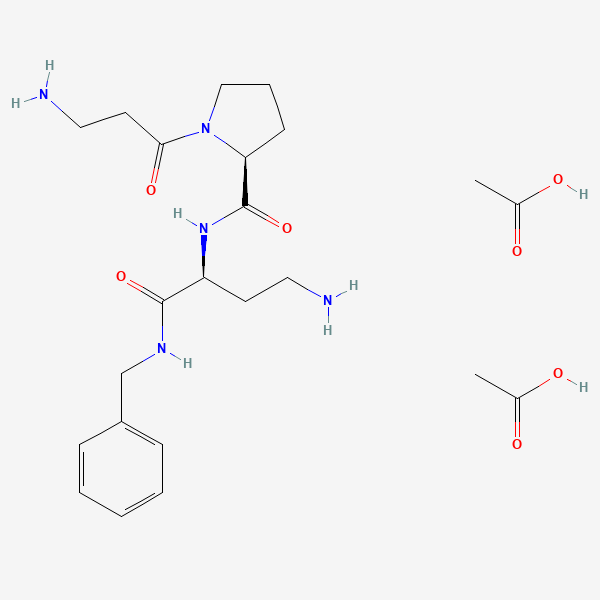
- Molecular formula
- C23H37N5O7
- Molecular weight
- 495.6 g/mol
- IUPAC name
- acetic acid;(2S)-N-[(2S)-4-amino-1-(benzylamino)-1-oxobutan-2-yl]-1-(3-aminopropanoyl)pyrrolidine-2-carboxamide
Verified external records:
References
- 1.Dipeptide diaminobutyroyl benzylamide diacetate — compound record (PubChem, CID 71465152)
- 2.Dipeptide diaminobutyroyl benzylamide diacetate — indexed research (PubMed)
- 3.Waglerin-1 and the muscle nicotinic acetylcholine receptor — indexed research (PubMed)
- 4.FDA — how cosmetics are regulated in the United States
More on Syn-Ake
Everything else we've written about Syn-Ake — what the community reports, the explainers that cover it, and the terms it keeps running into.